Algiers in New Orleans in Orleans Parish, Louisiana — The American South (West South Central)
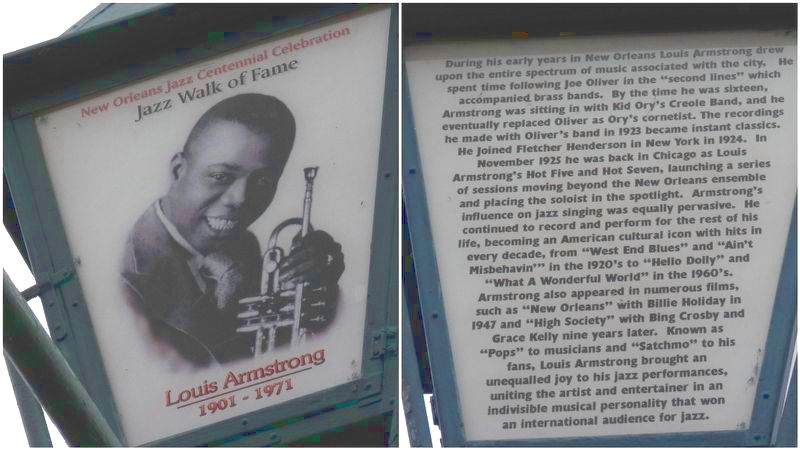
Louis Armstrong
1901-1971
| — | Jazz Walk of Fame | — |
Photographed by Cajun Scrambler, November 26, 2020
1. Louis Armstrong Marker
Panel 1
During his early years in New Orleans Louis Armstrong drew upon the entire spectrum of music associated with the city. He spent time following Joe Oliver in the "second lines” which accompanied brass bands. By the time he was sixteen, Armstrong was sitting in with Kid Ory's Creole Band, and he eventually replaced Oliver as Ory's cornetist. The recordings he made with Oliver's band in I923 became instant classics. He Joined Fletcher Henderson in New York in 1924. In November 1925 he was back in Chicago as Louis Armstrong's Hot Five and Hot Seven, launching a series of sessions moving beyond the New Orleans ensemble and placing the soloist in the spotlight. Armstrong's influence on jazz singing was equally pervasive. He continued to record and perform for the rest of his life, becoming an American cultural icon with hits in every decade, from "West End Blues” and "Ain't Misbehavin” in the 1920's to "Hello Dolly” and "What A Wonderful World” in the 1960's. Armstrong also appeared in numerous films, such as "New Orleans” with Billie Holiday in 1947 and "High Society” with Bing Crosby and Grace Kelly
this page online
Panel 2
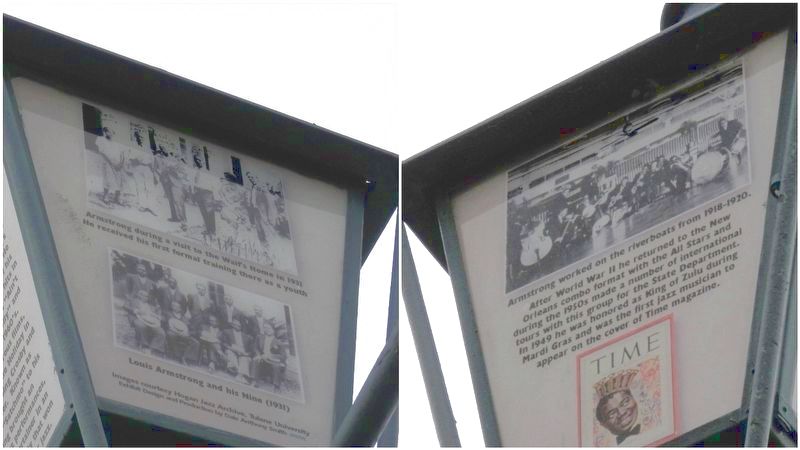
Armstrong during a visit to the Waif's home in 1931. He received his first formal training there as a youth.
Armstrong and his Nine (1931)
Panel 3
Armstrong worked on the riverboats from 1918-1920. After World War II he returned to the New Orleans combo format with the All Stars and during the 1950s made a number of international tours with this group for the State Department. In 1949 he was honored as King of Zulu during Mardi Gras and was the first jazz musician to appear on the cover of Time magazine.
Erected by New Orleans Jazz Centennial Celebration.
Topics. This historical marker is listed in these topic lists: Arts, Letters, Music • Entertainment.
Location. 29° 57.132′ N, 90° 3.304′ W. Marker is in New Orleans, Louisiana, in Orleans Parish. It is in Algiers. It can be reached from Bounty Street
Photographed by Cajun Scrambler
2. Louis Armstrong Marker

Regionally, this marker is in one of Louisiana’s River Parishes. It is also in the American South, specifically in the Deep South, on the Gulf Coast, and in the Great River Road Region. Globally, it is in North America, a Gulf of Mexico state, the Western Hemisphere, the Western World, and the Anglosphere. Historically, it finds itself in what was once New Spain, the Viceroyalty of New France, the territory of the Mississippian Culture, the Louisiana Purchase, one of the Confederate States of America, and the Antebellum South.
Other nearby markers. At least 8 other markers are within walking distance of this marker: Historic Algiers (within shouting distance of this marker); Louis D. Armstrong (within shouting distance of this marker); Henry "Red" Allen (within shouting distance of this marker); Sidney Bechet (about 400 feet away, measured in a direct line); Enslaved Africans (about 400 feet away); The Boswell Sisters (about
Photographed by Cajun Scrambler, November 26, 2020
3. Louis Armstrong Marker
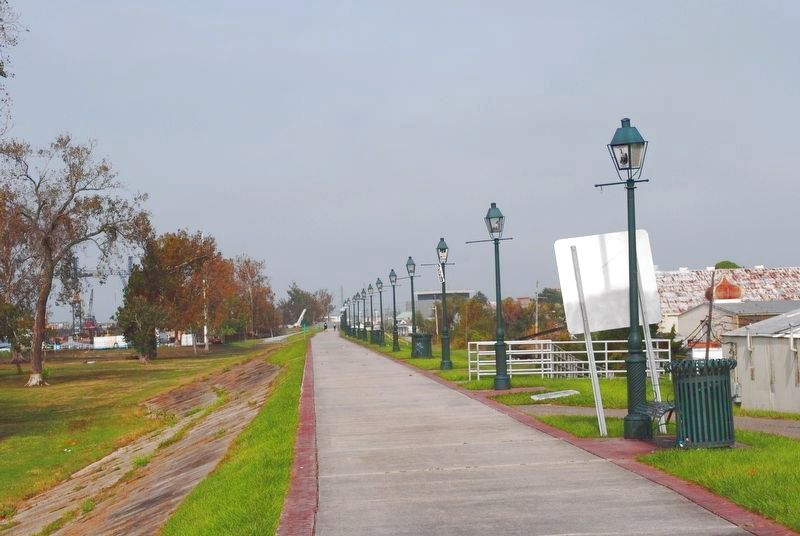
More about this marker. Located on the Mississippi River Trail, on top of Levee, at northern terminus of Delaronde Street.
Photographed by Cajun Scrambler, November 26, 2020
4. Jazz Walk of Fame
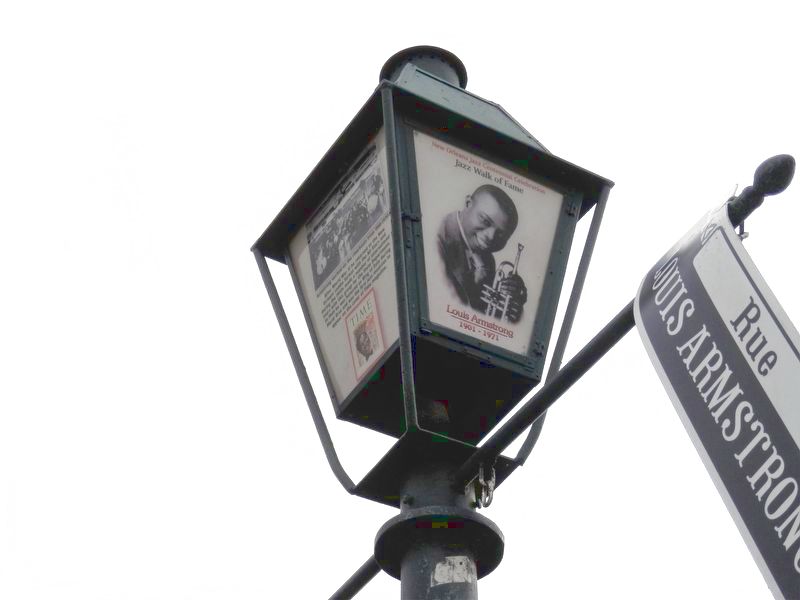
Markers are glass panels on light fixtures placed along the Mississippi River Trail levee top path.
Credits. This page was last revised on February 12, 2023. It was originally submitted on November 26, 2020, by Cajun Scrambler of Assumption, Louisiana. This page has been viewed 538 times since then and 32 times this year. Photos: 1, 2, 3, 4. submitted on November 26, 2020, by Cajun Scrambler of Assumption, Louisiana.
