Kalispell in Flathead County, Montana — The American West (Mountains)
West Side Historic District
Photographed by Barry Swackhamer, August 20, 2020
1. West Side Historic District Marker
Inscription.
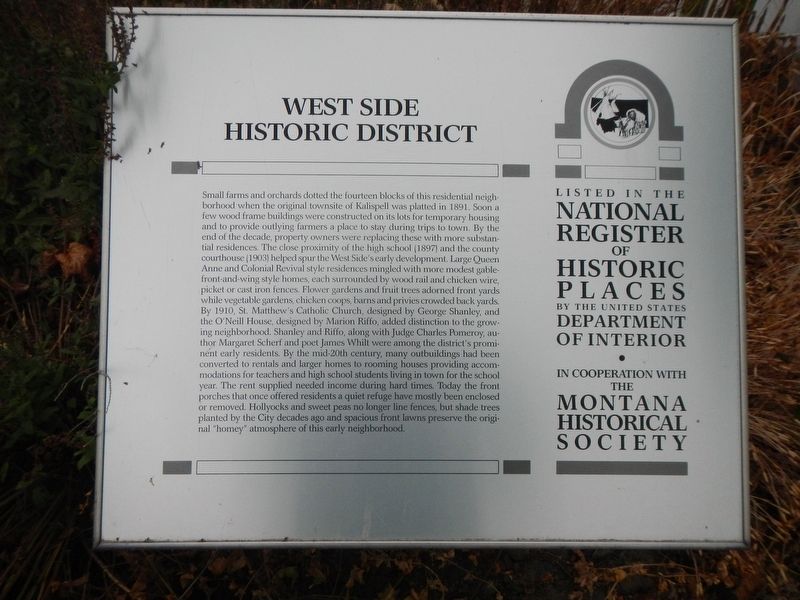
West Side Historic District. . Small farms and orchards dotted the fourteen blocks of this residential neighborhood when the original townsite of Kalispell was platted in 1891. Soon a few wood frame buildings were constructed on its lots for temporary housing and to provide outlying farmers a place to stay during trips to town. By the end of the decade, property owners were replacing these with more substantial residences. The close proximity of the high school (1897) and the county courthouse (1903) helped spur the West Sides early development. Large Queen Anne and Colonial Revival style residences mingled with more modest gable-front-and-wing style homes, each surrounded by wood rail and chicken wire, picket, or cast iron fences. Flower gardens and fruit trees adorned front yards while vegetable gardens, chicken coops, barns, and privies crowded back yards. By 1910, St. Matthews Catholic Church, designed by George Shanley, and the ONeill House, designed by Marion Riffo, added distinction to the growing neighborhood. Shanley and Riffo, along with Judge Charles Pomeroy, author Margaret Scherf, and poet James Whilt were among the districts prominent early residents. By the mid twentieth century, many outbuildings had been converted to rentals and larger homes to rooming houses providing accommodations for teachers and high school students living in town for the school year. The rent supplied needed income during hard times. Today the front porches that once offered residents a quiet refuge have mostly been enclosed or removed. Hollyhocks and sweet peas no longer line fences, but shade trees planted by the city decades ago and spacious front lawns preserve the original “homey” atmosphere of this early neighborhood.
Small farms and orchards dotted the fourteen blocks of this residential neighborhood when the original townsite of Kalispell was platted in 1891. Soon a few wood frame buildings were constructed on its lots for temporary housing and to provide outlying farmers a place to stay during trips to town. By the end of the decade, property owners were replacing these with more substantial residences. The close proximity of the high school (1897) and the county courthouse (1903) helped spur the West Sides early development. Large Queen Anne and Colonial Revival style residences mingled with more modest gable-front-and-wing style homes, each surrounded by wood rail and chicken wire, picket, or cast iron fences. Flower gardens and fruit trees adorned front yards while vegetable gardens, chicken coops, barns, and privies crowded back yards. By 1910, St. Matthews Catholic Church, designed by George Shanley, and the ONeill House, designed by Marion Riffo, added distinction to the growing neighborhood. Shanley and Riffo, along with Judge Charles Pomeroy, author Margaret Scherf, and poet James Whilt were among the districts prominent
Click or scan to see this page online
early residents. By the mid twentieth century, many outbuildings had been converted to rentals and larger homes to rooming houses providing accommodations for teachers and high school students living in town for the school year. The rent supplied needed income during hard times. Today the front porches that once offered residents a quiet refuge have mostly been enclosed or removed. Hollyhocks and sweet peas no longer line fences, but shade trees planted by the city decades ago and spacious front lawns preserve the original “homey” atmosphere of this early neighborhood.
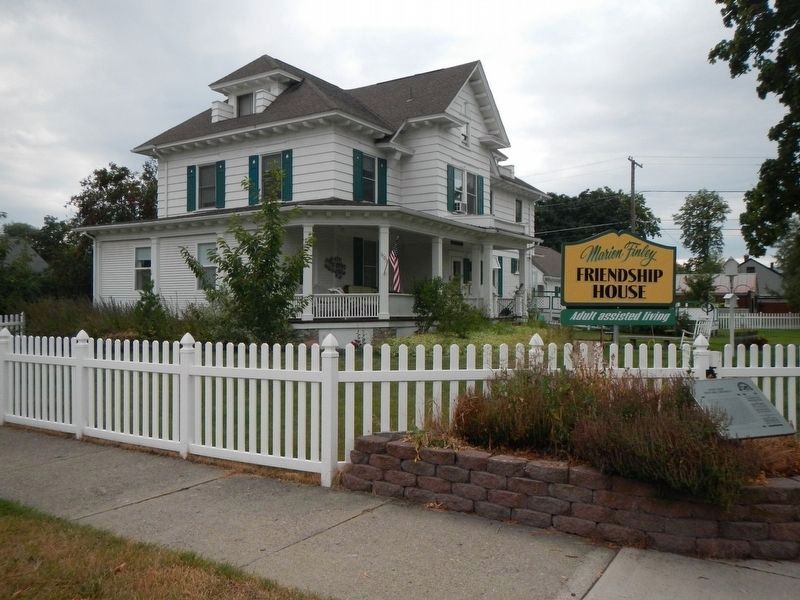
Location. 48° 11.549′ N, 114° 18.892′ W. Marker is in Kalispell, Montana, in Flathead County. It is on 2nd Avenue West near 6th Street West. Touch for map. Marker is at or near this postal address: 546 2nd Avenue
Regionally, this marker is in Western Montana and in Glacier Country. It is also in the American Mountain West and in the Lewis & Clark Corridor. Globally, it is in North America, the Rocky Mountains, the Western Hemisphere, the Western World, and the Anglosphere. Historically, it finds itself in what was once Ruperts Land and also the Louisiana Purchase.
Credits. This page was last revised on December 20, 2020. It was originally submitted on November 27, 2020, by Barry Swackhamer of Brentwood, California. This page has been viewed 210 times since then and 12 times this year. Photos:1, 2. submitted on November 27, 2020, by Barry Swackhamer of Brentwood, California.

