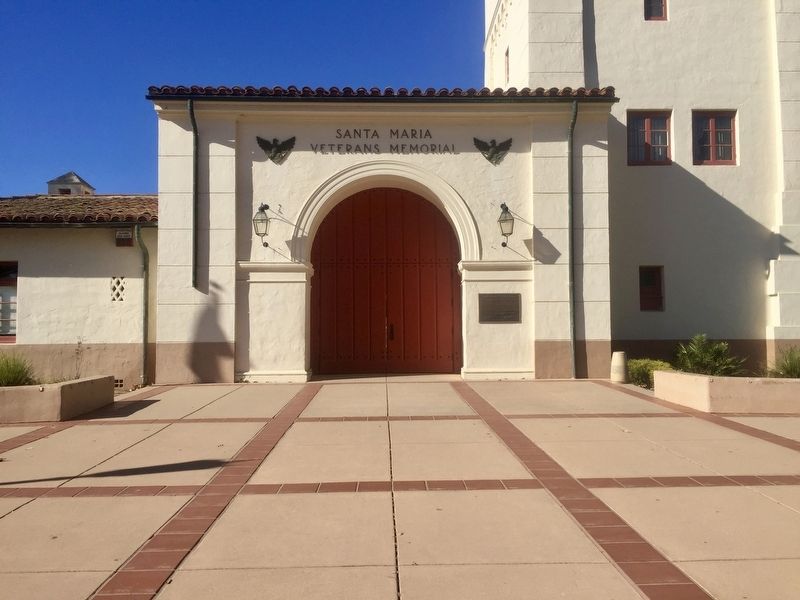
Santa Maria in Santa Barbara County, California — The American West (Pacific Coastal)
Veterans' Memorial Cultural Center and Park
Photographed by Andrew Ruppenstein, November 30, 2020
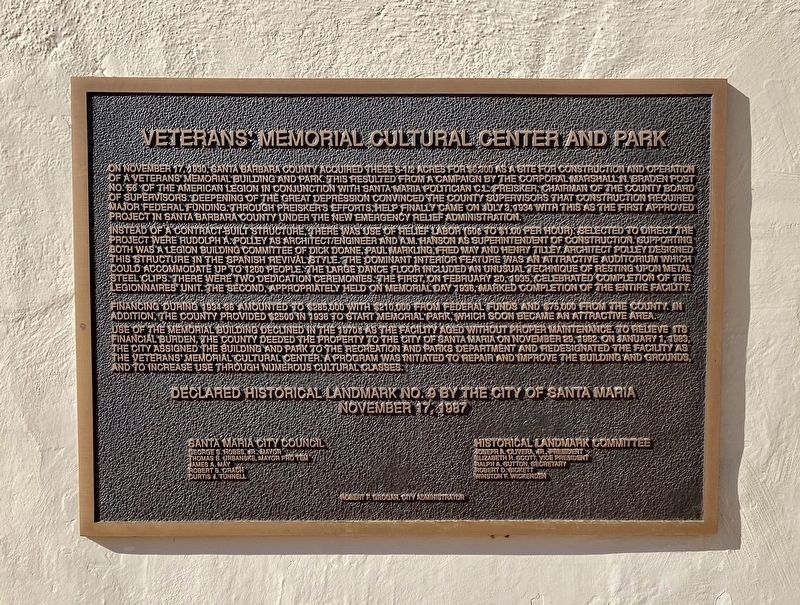
1. Veterans' Memorial Cultural Center and Park Marker
Inscription.
Veterans' Memorial Cultural Center and Park. . On November 17, 1930, Santa Barbara County acquired these 5½ acres for $6200 as a site for construction and operation of a veterans memorial building and park. This resulted from a campaign by the Corporal Marshall N. Braden Post No. 56 of the American Legion in conjunction with Santa Maria politician C.L. Preisker, Chairman of the County Board of Supervisors. Deepening of the Great Depression convinced the county supervisors that construction required major federal funding: through Preisker's efforts, help finally came on July 3, 1934 with this as the first approved project in Santa Barbara County under the New Emergency Relief Administration.
Instead of a contract-built structure, there was use of relief labor (50’ to $1.00 per hour). Selected to direct the project were Rudolph A. Polley as architect/engineer and A.M. Hanson as superintendent of construction. Supporting both was a legion building committee of Dick Doane, Paul Markling, Fred May and Henry Tilley. Architect Polley designed his structure in the Spanish Revival style. The dominant interior feature was an attractive auditorium which could accommodate up to 1200 people. The large dance floor included an unusual technique of resting upon metal steel clips. There were two dedication ceremonies. The first, on February 20, 1935, celebrated completion of Legionnaires' unit. The second, appropriately held on Memorial Day 1936, marked completion of the entire facility. Financing during 1934-36 amounted to $285,000 with $216,000 from federal funds and $75,000 from the county. In addition, the county provided $2500 in 1936 to start Memorial Park, which soon became an attractive area.
Use of the Memorial Building declined in the 1970s as the facility aged without proper maintenance. To relieve its financial burden, the County deeded the property to the City of Santa Maria on November 29, 1982. On January 1, 1988, the city assigned the building and park to the Recreation and Parks Department and redesignated the facility as the Veterans' Memorial Cultural Center. A program was initiated to repair and improve the building and grounds, and to increase use through numerous cultural classes.
Declared Historical Landmark No. 9 by the City Of Santa Maria , November 17, 1987
(Council and Committee names not transcribed.)
On November 17, 1930, Santa Barbara County acquired these 5½ acres for $6200 as a site for construction and operation of a veterans memorial building and park. This resulted from a campaign by the Corporal Marshall N. Braden Post
No. 56 of the American Legion in conjunction with Santa Maria politician C.L. Preisker, Chairman of the County Board of Supervisors. Deepening of the Great Depression convinced the county supervisors that construction required major federal funding: through Preisker's efforts, help finally came on July 3, 1934 with this as the first approved
project in Santa Barbara County under the New Emergency Relief Administration.
Instead of a contract-built structure, there was use of relief labor (50’ to $1.00 per hour). Selected to direct the project were Rudolph A. Polley as architect/engineer and A.M. Hanson as superintendent of construction. Supporting
both was a legion building committee of Dick Doane, Paul Markling, Fred May and Henry Tilley. Architect Polley designed his structure in the Spanish Revival style. The dominant interior feature was an attractive auditorium which
could accommodate up to 1200 people. The large dance floor included an unusual technique of resting upon metal steel clips. There were two dedication ceremonies. The first, on February 20, 1935, celebrated completion of Legionnaires' unit. The second, appropriately held on Memorial Day 1936, marked completion of the entire facility.
Financing during 1934-36 amounted to $285,000 with $216,000 from federal funds and $75,000 from the county. In addition, the county provided $2500 in 1936 to start Memorial Park, which soon became an attractive area.
Use of the Memorial Building declined in the 1970s as the facility aged without proper maintenance. To relieve its financial burden, the County deeded the property to the City of Santa Maria on November 29, 1982. On January 1, 1988, the city assigned the building and park to the Recreation and Parks Department and redesignated the facility as
the Veterans' Memorial Cultural Center. A program was initiated to repair and improve the building and grounds, and to increase use through numerous cultural classes.
Declared Historical Landmark No. 9 by the City Of Santa Maria
November 17, 1987
Location. 34° 57.474′ N, 120° 26.348′ W. Marker is in Santa Maria, California, in Santa Barbara County. It is at the intersection of North Pine Street and West Tunnell Street, on the left when traveling north on North Pine Street. Touch for map. Marker is at or near this postal address: 313 West Tunnell Street, Santa Maria CA 93458, United States of America. Touch for directions.

Regionally, this marker is on California’s Central Coast, specifically on the Coast Ranges, and specifically in the Transverse Ranges. It is also on the American Pacific Coast. Globally, it is in North America, on the Ring of Fire, in the Pacific Rim, in the Western Hemisphere, in the Western World, and in the Anglosphere. Historically, it finds itself in what was once New Spain and also Mexicos Alta California.
Other nearby markers. At least 8 other markers are within walking distance of this marker: IOOF Temple (approx.
Photographed by Andrew Ruppenstein, November 30, 2020
2. Veterans' Memorial Cultural Center and Park Marker - wide view
Photographed by Andrew Ruppenstein, November 30, 2020
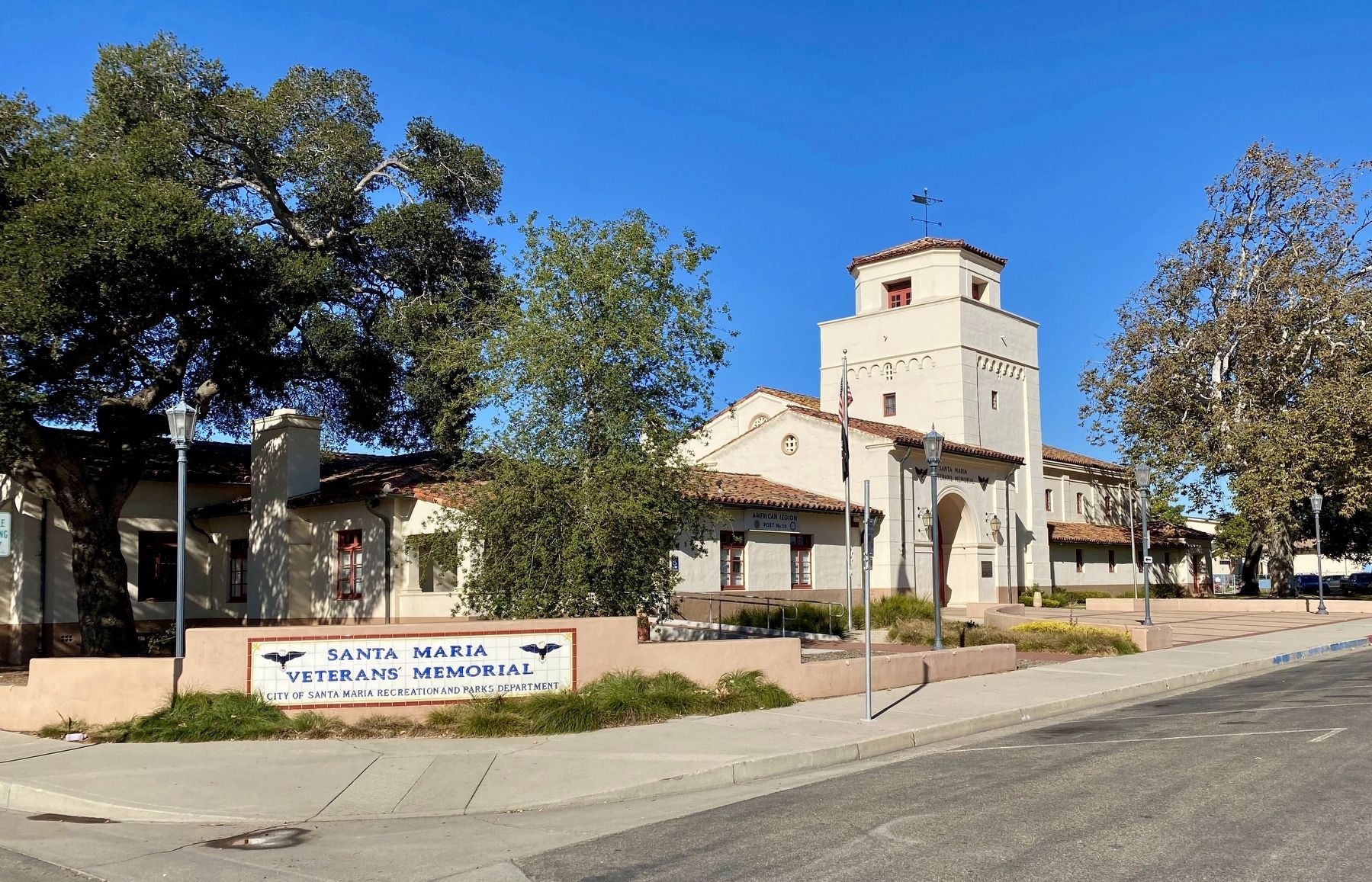
3. Veterans' Memorial Cultural Center
Credits. This page was last revised on December 1, 2020. It was originally submitted on December 1, 2020, by Andrew Ruppenstein of Lamorinda, California. This page has been viewed 582 times since then and 29 times this year. Photos:1, 2, 3. submitted on December 1, 2020, by Andrew Ruppenstein of Lamorinda, California.