
Chalmette in St. Bernard Parish, Louisiana — The American South (West South Central)
Chalmette Battlefield And National Cemetery
Jean Lafitte National Historical Park
Photographed by Craig Doda, December 24, 2018
1. Chalmette Battlefield And National Cemetery Marker
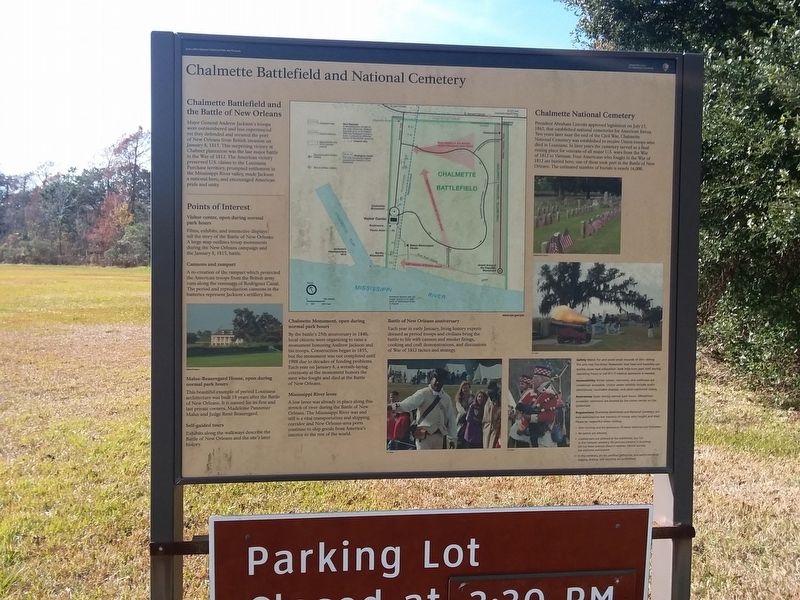
Chalmette Battlefield and the Battle of New Orleans
Major General Andrew Jackson's troops were outnumbered and less experienced yet they defended and secured the port of New Orleans from British invasion on January 8, 1815. This surprising victory at Chalmet plantation was the last major battle in the War of 1812. The American victory preserved U.S. claims to the Louisiana Purchase territory, prompted settlement in the Mississippi River valley, made Jackson a national hero, and encouraged American pride and unity.
Chalmette National Cemetery
President Abraham Lincoln approved legislation on July 17, 1862, that established national cemeteries for American forces. Two years later near the end of the Civil War, Chalmette National Cemetery was established to receive Union troops who died in Louisiana. In later years the cemetery served as a final resting place for veterans of all major U.S. wars from the War of 1812 to Vietnam. Four Americans who fought in the War of 1812 are buried here; one of them took part in the Battle of New Orleans. The estimated number of burials is nearly 16,000.
Points of Interest
Visitor center, open during normal park hours
Films,
this page online
Cannons and rampart
A re-creation of the rampart which protected the American troops from the British army runs along the remnants of Rodriguez Canal. The period and reproduction cannons in the batteries represent Jackson's artillery line.
Malus-Beauregard House, open during normal park hours
This beautiful example of period Louisiana architecture was built 18 years after the Battle of New Orleans, It is named for its first and last private owners, Madeleine Pannetier Malus and Judge René Beauregard.
Self-guided tours
Exhibits along the walkways describe the Battle of New Orleans and the site's later history.
Chalmette Monument, open during normal park hours
By the battle's 25th anniversary in 1840, local citizens were organizing to raise a monument honoring Andrew Jackson and his troops. Construction began in 1855, but the monument was not completed until 1908 due to decades of funding problems. Each year on January
Photographed by Craig Doda, December 24, 2018
2. Chalmette Battlefield And National Cemetery Marker
Mississippi River levee
A low levee was already in place along this stretch of river during the Battle of New Orleans. The Mississippi River was and still is a vital transportation and shipping corridor and New Orleans-area ports continue to ship goods from America's interior to the rest of the world.
Battle of New Orleans anniversary
Each year in early January, living history experts dressed as period troops and civilians bring the battle to life with cannon and musket firings, cooking and craft demonstrations, and discussions of War of 1812 tactics and strategy.
Erected by National Park Service, Department of the Interior.
Topics. This historical marker is listed in this topic list: War of 1812. A significant historical date for this entry is January 8, 1815.
Location. 29° 56.791′ N, 89° 59.501′ W. Marker is in Chalmette, Louisiana, in St. Bernard Parish. It can be reached from Battlefield Road west of West St Bernard Highway (State Route 46), on the right when traveling west. Located at East Entrance to Chalmette

Photographed by James Hulse, January 13, 2023
3. The entrance to the Chalmette Battlefield And National Cemetery and Marker (ride side of road)

Regionally, this marker is in Bayou Country and in Greater New Orleans. It is also in the American South, specifically in the Deep South, and on the Gulf Coast. Globally, it is in North America, a Gulf of Mexico state, the Western Hemisphere, the Western World, and the Anglosphere. Historically, it finds itself in what was once New Spain, the Viceroyalty of New France, the territory of the Mississippian Culture, the Louisiana Purchase, one of the Confederate States of America, and the Antebellum South.
Other nearby markers. At least 8 other markers are within walking distance of this marker: Chalmette Battlefield (within shouting distance of this marker); The Kentucky Rifle (within shouting distance of this marker); Fazendeville (within shouting distance of this marker); Batteries Seven and Eight (about 400 feet away, measured in a direct line); Batteries Five and Six (about 700 feet away); The Main Attack (approx. 0.2 miles away); Pakenham's Fall (approx. 0.2 miles away); Battle Of New Orleans 200th Anniversary (approx. ¼ mile away). Touch for a list and map of all markers in Chalmette.
Other markers no longer nearby. Batteries 5 and 6 (was about 600 feet away but has been confirmed missing); The Battle Ends (was approx. 0.2 miles away but has been confirmed missing).
Additional commentary.
1. Entrance marker.
This is a duplicate marker of one on the west side of the battlefield park.
— Submitted December 4, 2020.
Credits. This page was last revised on January 13, 2023. It was originally submitted on December 4, 2020, by Craig Doda of Napoleon, Ohio. This page has been viewed 455 times since then and 45 times this year. Photos: 1, 2. submitted on December 4, 2020, by Craig Doda of Napoleon, Ohio. 3. submitted on January 13, 2023, by James Hulse of Medina, Texas. • Mark Hilton was the editor who published this page.
