Northeast Los Angeles in Los Angeles County, California — The American West (Pacific Coastal)
Eagle Rock City Hall
1923
Photographed by Craig Baker, December 26, 2019
1. Eagle Rock City Hall Marker
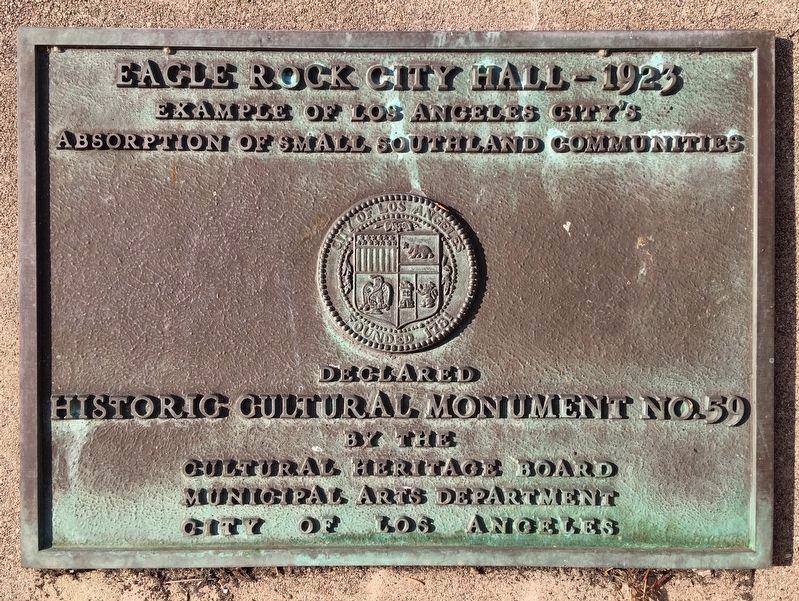
Eagle Rock City Hall — 1923. Example of Los Angeles City's absorption of small Southland communities.
Declared Los Angeles Historic Cultural Monument No. 59 by the Cultural Heritage Board, Cultural Arts Department, City of Los Angeles.
Erected 1969 by City of Los Angeles. (Marker Number 59.)
Topics and series. This historical marker is listed in these topic lists: Architecture • Government & Politics • Settlements & Settlers • War, World II. In addition, it is included in the Los Angeles Historic-Cultural Monument series list. A significant historical year for this entry is 1923.
Location. 34° 8.364′ N, 118° 12.675′ W. Marker is in Los Angeles, California, in Los Angeles County. It is in Northeast Los Angeles. It is on Colorado Boulevard 0.1 miles east of Eagle Rock Boulevard, on the left when traveling east. Touch for map. Marker is at or near this postal address: 2035 Colorado Blvd, Los Angeles CA 90041, United States of America. Touch for directions.

Regionally, this marker is in the Transverse Ranges. It is also on the American Pacific Coast. Globally, it is in North America, on the Ring
this page online
Other nearby markers. At least 8 other markers are within 2 miles of this marker, measured as the crow flies: Jennie C. Brayton Building (approx. 0.2 miles away); Women’s Clubhouse (approx. 0.2 miles away); Old Eagle Rock Branch Library (approx. 0.2 miles away); First House in Eagle Rock (approx. 0.4 miles away); Egasse-Braasch House (approx. 0.4 miles away); Barack Obama ‘83 (approx. 0.8 miles away); Castle Crag (approx. 0.9 miles away); Somerset Farm (approx. 1.3 miles away). Touch for a list and map of all markers in Los Angeles.
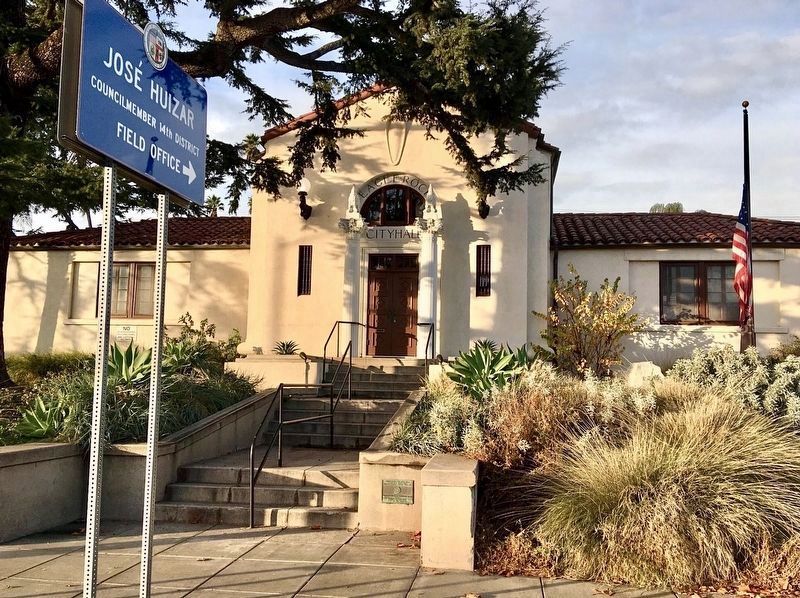
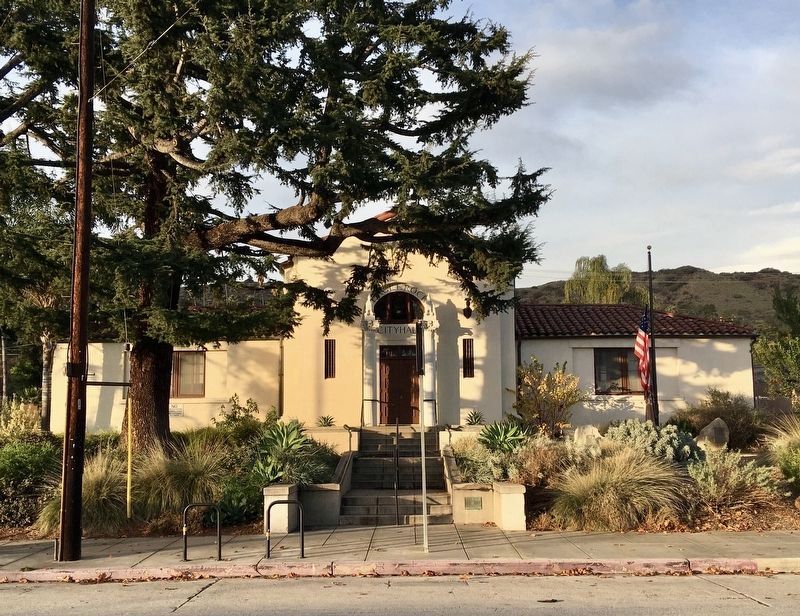
Regarding Eagle Rock City Hall. Architect William Lee Woollet designed an Italian Renaissance Revival building that is a compliment to its location on a slightly-raised site. Built to house the offices of the mayor, clerk, city attorney, water department, chief of police, fire department, and the city council chamber, it was completed in 1922, just one year before Eagle Rock gave up its status as an
Photographed by Craig Baker, December 26, 2019
2. Eagle Rock City Hall Marker
The marker is at the bottom of the stairs.
A 1928 addition housed the city's Engine Co. 42 until 1959 when the current fire station was built next door. During World War II, the ration board and draft board occupied part of the building. In 1969, the building was declared City Historic Cultural Monument No. 59 at the petition of the Eagle Rock Valley Historical Society. Today the building is vacated by all but a council-member field office (2019). Planned restoration will make it more accommodating for civic use. The building is a reminder of an independent City of Eagle Rock.
Photographed by Craig Baker, December 26, 2019
3. Eagle Rock City Hall
Photographed by Craig Baker, December 26, 2019
4. The Eagle Rock
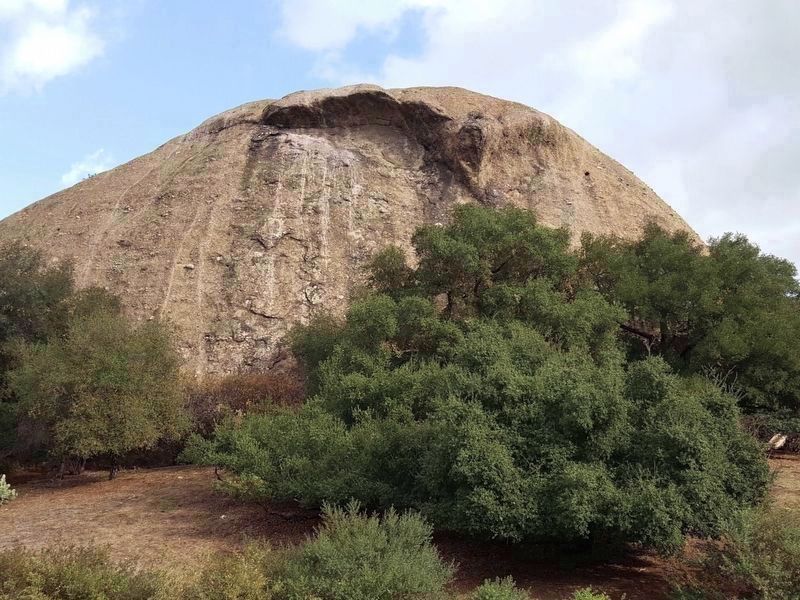
Located 1½ miles east of Eagle Rock City Hall, it is Los Angeles Historic-Cultural Monument No. 10.
Credits. This page was last revised on May 14, 2025. It was originally submitted on December 11, 2020, by Craig Baker of Sylmar, California. This page has been viewed 1,471 times since then and 88 times this year. Photos: 1, 2, 3, 4. submitted on December 11, 2020, by Craig Baker of Sylmar, California. • J. Makali Bruton was the editor who published this page.
