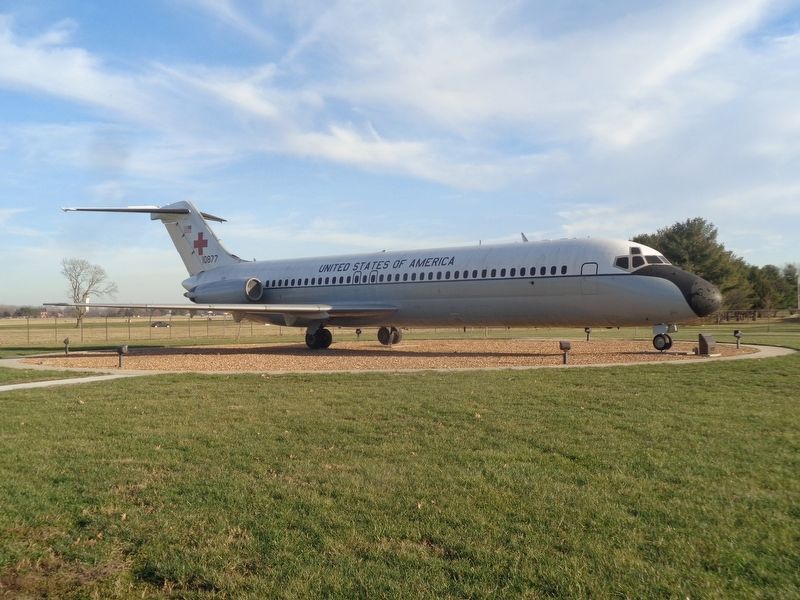
Scott Air Force Base in St. Clair County, Illinois — The American Midwest (Great Lakes)
C-9A Nightingale
71-0877
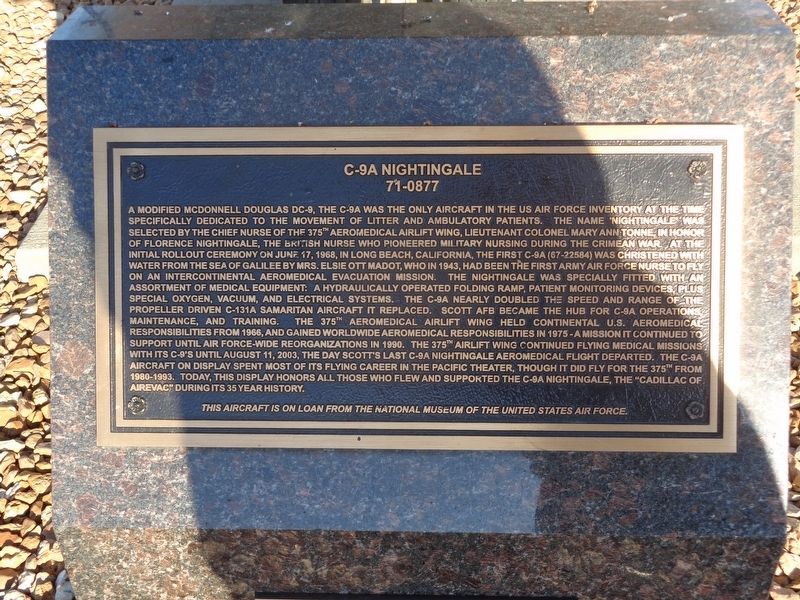
Photographed by Jason Voigt, December 10, 2020
1. C-9A Nightingale Marker
Inscription.
C-9A Nightingale. A modified McDonnell Douglas DC-9, the C-9A was the only aircraft in the US Air Force inventory at the time specifically dedicated to the movement of litter and ambulatory patients. The name "nightingale" was selected by the chief nurse of the 375th Aeromedical Airlift Wing, Lieutenant Colonel Mary Ann Tonne, in honor of Florence Nightingale, the British nurse who pioneered military nursing during the Crimean War. At the initial rollout ceremony on June 17, 1968, in Long Beach, California, the first C-9A (67-22584) was christened with water from the Sea of Galilee by Mrs. Elsie Ott Madot, who in 1943, had been the first Army Air Force nurse to fly on an intercontinental aeromedical evacuation mission. The Nightingale was specially fitted with an assortment of medical equipment: a hydraulically operated folding ramp, patient monitoring devices, plus special oxygen, vacuum, and electrical systems. The C-9A nearly doubled the speed and range of the propeller driven C-131A Samaritan aircraft it replaced. Scott AFB became the hub for C-9A operations, maintenance, and training. The 375th Aeromedical Airlift Wing held continental U.S. aeromedical responsibilities from 1966, and gained worldwide aeromedical responsibilities in 1975 - a mission it continued to support until Air Force-wide reorganizations in 1990. The 375th Airlift Wing continued flying medical missions, with its C-9's until August 11, 2003, the day Scott's last C-9A Nightingale aeromedical flight departed. The C-9A aircraft on display spent most of its flying career in the Pacific Theater, though it did fly for the 375th from 1980-1993. Today, this display honors all those who flew and supported the C-9A Nightingale, the "Cadillac of Airevac" during its 35 year history., This aircraft is on loan from the National Museum of the United States Air Force.
A modified McDonnell Douglas DC-9, the C-9A was the only aircraft in the US Air Force inventory at the time specifically dedicated to the movement of litter and ambulatory patients. The name "nightingale" was selected by the chief nurse of the 375th Aeromedical Airlift Wing, Lieutenant Colonel Mary Ann Tonne, in honor of Florence Nightingale, the British nurse who pioneered military nursing during the Crimean War. At the initial rollout ceremony on June 17, 1968, in Long Beach, California, the first C-9A (67-22584) was christened with water from the Sea of Galilee by Mrs. Elsie Ott Madot, who in 1943, had been the first Army Air Force nurse to fly on an intercontinental aeromedical evacuation mission. The Nightingale was specially fitted with an assortment of medical equipment: a hydraulically operated folding ramp, patient monitoring devices, plus special oxygen, vacuum, and electrical systems. The C-9A nearly doubled the speed and range of the propeller driven C-131A Samaritan aircraft it replaced. Scott AFB became the hub for C-9A operations, maintenance, and training. The 375th Aeromedical Airlift Wing held continental
Click or scan to see this page online
U.S. aeromedical responsibilities from 1966, and gained worldwide aeromedical responsibilities in 1975 - a mission it continued to support until Air Force-wide reorganizations in 1990. The 375th Airlift Wing continued flying medical missions, with its C-9's until August 11, 2003, the day Scott's last C-9A Nightingale aeromedical flight departed. The C-9A aircraft on display spent most of its flying career in the Pacific Theater, though it did fly for the 375th from 1980-1993. Today, this display honors all those who flew and supported the C-9A Nightingale, the "Cadillac of Airevac" during its 35 year history.
This aircraft is on loan from the National Museum of the United States Air Force.
Location. 38° 32.935′ N, 89° 51.989′ W. Marker is in Scott Air Force Base, Illinois, in St. Clair County. It can be reached from Seibert Road 0.7 miles east of Air Mobility Drive (Illinois Route 158). Marker is located at Scott Field Heritage Air Park, near the west entrance
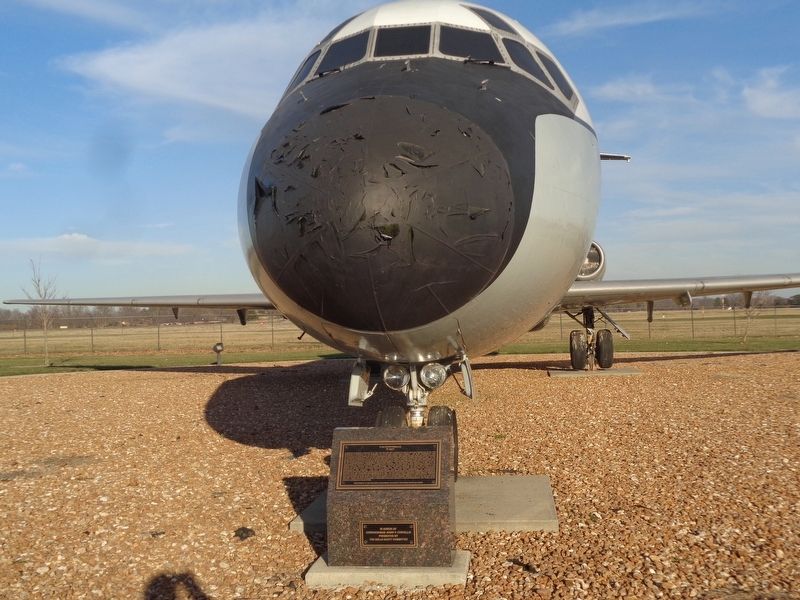
Photographed by Jason Voigt, December 10, 2020
2. C-9A Nightingale Marker

of Scott Air Force Base. Touch for map. Marker is at or near this postal address: 763 Seibert Rd, Scott Air Force Base IL 62225, United States of America. Touch for directions.
Regionally, this marker is in Greater St. Louis. It is also in the American Midwest, in the Lewis & Clark Corridor, in the Corn Belt, and in the Great River Road Region. Globally, it is in North America, the Western Hemisphere, the Western World, and the Anglosphere. Historically, it finds itself in what was once the Viceroyalty of New France, the territory of the Mississippian Culture, and the Northwest Territory.
Credits. This page was last revised on December 12, 2020. It was originally submitted on December 12, 2020, by Jason Voigt of Glen Carbon, Illinois. This page has been viewed 610 times since then and 52 times this year. Photos:1, 2, 3, 4. submitted on December 12, 2020, by Jason Voigt of Glen Carbon, Illinois.