Downtown Los Angeles in Los Angeles County, California — The American West (Pacific Coastal)
Plaza Park
Birthplace of Los Angeles
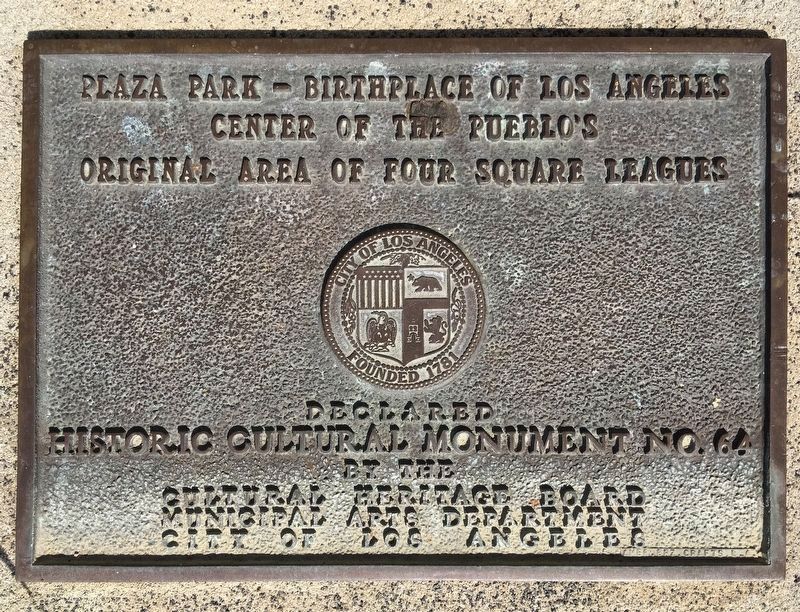
Photographed by Craig Baker, January 4, 2021
1. Plaza Park Marker
Erected 1970. (Marker Number 64.)
Topics and series. This historical marker is listed in these topic lists: Hispanic Americans • Settlements & Settlers. In addition, it is included in the Los Angeles Historic-Cultural Monument series list.
Location. 34° 3.39′ N, 118° 14.328′ W. Marker is in Los Angeles, California, in Los Angeles County. It is in Downtown Los Angeles. It can be reached from Main Street north of U.S. 101, on the right when traveling north. It is at the base of the octagon bandstand, facing Main Street. Touch for map. Marker is at or near this postal address: 125 Paseo De La Plaza, Los Angeles CA 90012, United States of America. Touch for directions.

Regionally, this marker is in the Transverse Ranges. It is also on the American Pacific Coast. Globally, it is in North America, on the Ring of Fire, on the Pacific Rim, in the Western Hemisphere, in the Western
this page online
Other nearby markers. At least 8 other markers are within walking distance of this marker: Los Pobladores (a few steps from this marker); Carlos III (a few steps from this marker); Felipe de Neve, 1728–84 (within shouting distance of this marker); Christine Sterling (within shouting distance of this marker); The Old Spanish Trail (within shouting distance of this marker); Los Angeles Plaza (within shouting distance of this marker); Quintero (within shouting distance of this marker); Rosas (within shouting distance of this marker). Touch for a list and map of all markers in Los Angeles.
Regarding Plaza Park. This Historic-Cultural Monument is bounded by Spring Street, Macy Street, Alameda Street, Arcadia Street, and Cesar E. Chavez Avenue.
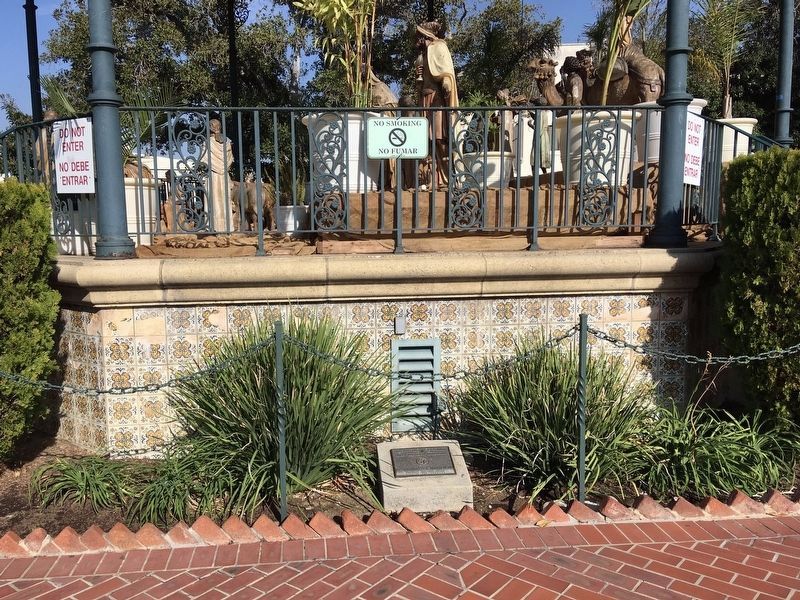
Photographed by Craig Baker, January 4, 2021
2. Plaza Park Marker
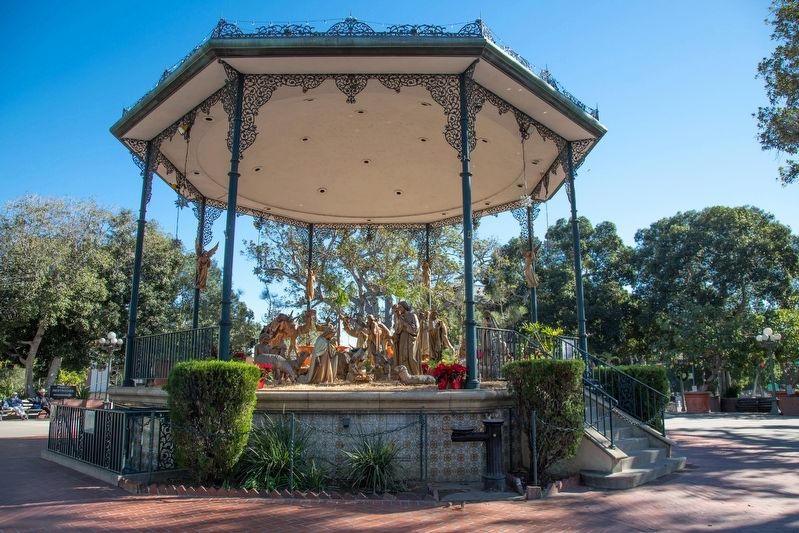
Photographed by J. J. Prats, December 4, 2018
3. Octagon Bandstand
The marker is not visible in this image. It is in the flower bed similar to the one shown, the next one around on the left.
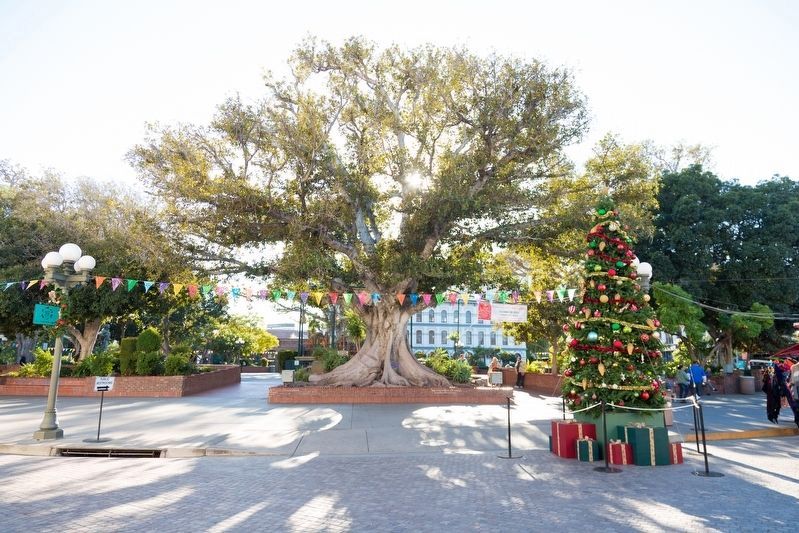
Photographed by J. J. Prats, December 4, 2018
4. Plaza Park
This view is from Olvera Street.

from Wikimedia Commons, 1869
5. Plaza del Pueblo de Los Angeles
Dating from the era of the Pueblo de Los Angeles, The Plaza and "Old Plaza Church" (Mission Nuestra Señora Reina de los Angeles) in 1869. There is a square main brick reservoir in the middle of the Plaza at the right, which was the terminus of the town's historic lifeline: the Zanja Madre. The Plaza itself was rounded and turned into a traditional ornate plaza, with a fountain that later became the bandstand. The building in the top right background was the Lugo House.
Credits. This page was last revised on April 24, 2026. It was originally submitted on December 14, 2020, by J. J. Prats of Powell, Ohio. This page has been viewed 757 times since then and 48 times this year. Photos: 1, 2. submitted on January 5, 2021, by Craig Baker of Sylmar, California. 3. submitted on December 14, 2020, by J. J. Prats of Powell, Ohio. 4. submitted on December 22, 2020, by J. J. Prats of Powell, Ohio. 5. submitted on December 14, 2020, by J. J. Prats of Powell, Ohio.
