Chesapeake Beach in Calvert County, Maryland — The American Northeast (Mid-Atlantic)
Railroad Artifacts At The Museum
Chesapeake Beach Railway

Photographed by Devry Becker Jones (CC0), December 18, 2020
1. Railroad Artifacts At The Museum Marker
The Chesapeake Beach Railway ran trains to Chesapeake Beach from 1900 until the bankruptcy of the Railway in 1935. After that time the East Washington Railway operated out of the maintenance yard and roundhouse at Seat Pleasant, Maryland. Between 1935 and 1945 the surviving CBR equipment, including engines, was sold or scrapped. No complete engine or any engine parts from that railway are known to survive.
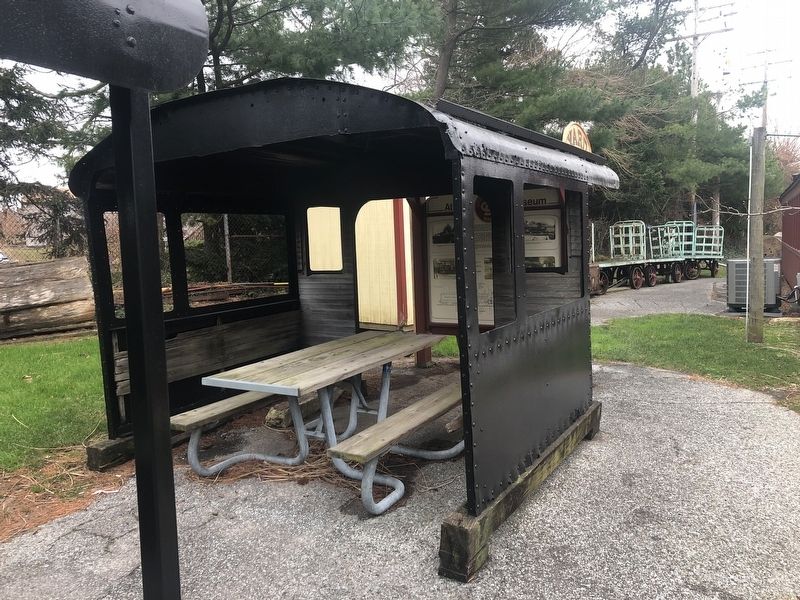
The railway locomotive cabs that you see here are the type found on the small steam locomotives operated by The Chesapeake Beach Railway. They were rescued from the abandoned railway yards at Seat Pleasant by members of The Chesapeake Beach Railway Museum Committee. In 1979 the Museum Committee and the Board of Calvert County Commissioners agreed to save all remnants of the CBR and other documents of local railroading history. The cabs were moved to the Museum at that time. Here they are being preserved for the enjoyment and education of the community.
Although these cabs are only a small part of the whole steam locomotive, they help make history come alive in the present. They are a real fragment of the past
this page online
How a Steam Locomotive Works
A small locomotive is a machine with two main parts. The first part is a firebox and boiler where steam is produced. The second part is the engine where steam energy is converted into mechanical motion. Cylinders on the engine contain pistons that are pushed by steam pressure. This force in turn pushes the pistons back and forth, propelling the connecting rods and thus turning the drive wheels. The locomotive then moves forward or backward depending on the engineer's use of the Johnson bar, or direction control.
Most of the controls for the operation of the engine are located on the boiler backhead in the cab where the engineer and the fireman sit. The fireman stokes the fire with coal. Then the engine will move forward as the engineer releases the brakes and opens the throttle allowing steam into the cylinder. The throttle is the lever used to start the engine and control the speed. To stop the locomotive the engineer applies the brakes then closes the throttle.
Ready to go? All aboard!
Erected by Chesapeake Beach Railway Museum.
Photographed by Devry Becker Jones (CC0), December 18, 2020
2. Railroad Artifacts At The Museum Marker
Topics. This historical marker is listed in this topic list: Railroads & Streetcars. A significant historical year for this entry is 1900.
Location. 38° 41.4′ N, 76° 32.015′ W. Marker is in Chesapeake Beach, Maryland, in Calvert County. It can be reached from Mears Avenue 0.1 miles east of C Street, on the right when traveling east. Touch for map. Marker is at or near this postal address: 4155 Mears Ave, Chesapeake Beach MD 20732, United States of America. Touch for directions.

Regionally, this marker is in Southern Maryland. It is also in the American South, specifically in the Upper South, in the Mid-Atlantic, in the Tidewater, in the Chesapeake Bay Region, and on the Eastern Seaboard. Globally, it is in the North Atlantic Region, North America, the Western Hemisphere, the Western World, and the Anglosphere. Historically, it finds itself in what was once one of the original Thirteen Colonies and also the Antebellum South.
Other nearby markers. At least 8 other markers are within walking distance of this marker: Chesapeake Beach Railway (a few steps from this marker); Chesapeake Beach Railway Station (a few steps from this marker); a different marker also named The Chesapeake Beach Railway (within shouting distance of this marker); Railroad Bed (about 400 feet away, measured in a direct line); Bald Eagle (about 600 feet away); a different marker also named Chesapeake Beach Railway (about 600 feet away); Abner's Crab House (approx. ¼ mile away); Fishing Creek Aquatic Life (approx. ¼ mile away). Touch for a list and map of all markers in Chesapeake Beach.
Credits. This page was last revised on December 18, 2020. It was originally submitted on December 18, 2020, by Devry Becker Jones of Washington, District of Columbia. This page has been viewed 300 times since then and 27 times this year. Photos: 1, 2. submitted on December 18, 2020, by Devry Becker Jones of Washington, District of Columbia.
