Canal Bridges
Crossing the Canal in Carroll County, Indiana
| — | Wabash & Erie Canal Park Village | — |
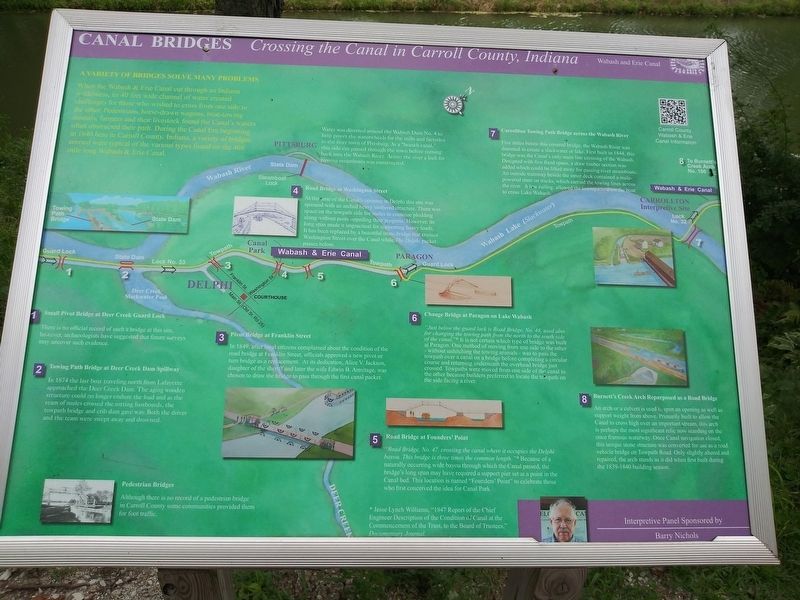
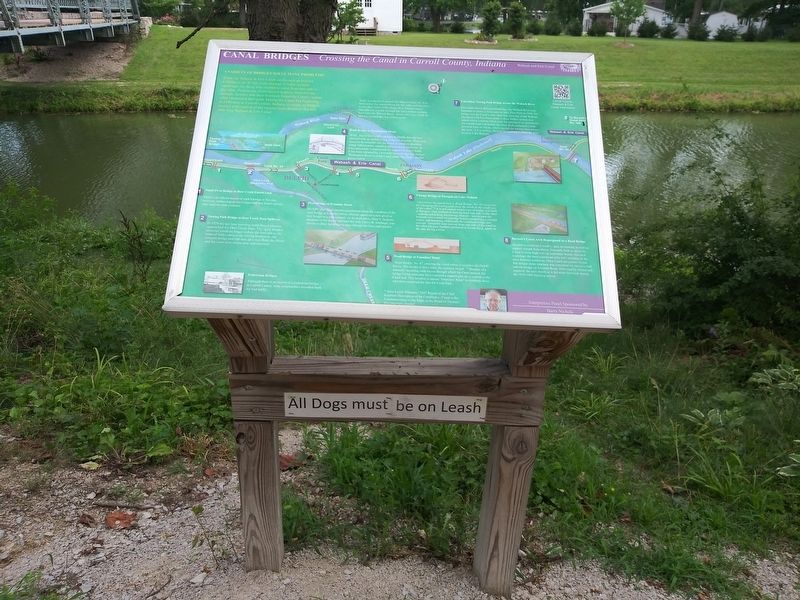
A Variety of Bridges Solve Many Problems
When the Wabash & Erie Canal cut through an Indiana wilderness, its 40 feet wide channel of water created challenges for those who wished to cross from one side to the other. Pedestrians, horse-drawn wagons, boat-towing animals, farmers and their livestock found the Canal's waters often obstructed their path. During the Canal Era beginning in 1840 here in Carroll County, Indiana, a variety of bridges erected were typical of the various types found on the 468 mile long Wabash & Erie Canal.
1. Small Pivot Bridge at Deer Creek Guard Lock
There is no official record of such a bridge at this site,
however, archaeologists have suggested that future surveys
may uncover such evidence,
2. Towing Path Bridge at Deer Creek Dam Spillway
In 1874 the last boat traveling north from Lafayette
approached the Deer Creek Dam. The aging wooden
structure could no longer endure the load and as the
team of mules crossed the rotting footboards, the
towpath bridge and crib dam gave way. Both the driver
and the team were swept away and drowned.
3. Pivot Bridge at Franklin Street
In
this page online
4. Road Bridge at Washington Street
At the time of the Canal's opening in Delphi this site was
spanned with an arched heavy timbered structure. There was
space on the towpath side for mules to continue plodding
along without posts impeding their progress. However, its
long span made it impractical for supporting heavy loads.:
It has been replaced by a beautiful stone bridge that crosses
Washington Street over the Canal while The Delphi packet
passes below.
5. Road Bridge at Founders' Point
"Road Bridge, No. 47, crossing the canal where it occupies the Delphi
bayou. This bridge is three times the common length."Because of a
naturally occurring wide bayou through which the Canal passed, the
bridge's long span may have required a support pier set at a point in the
Canal bed. This location
6. Change Bridge at Paragon on Lake Wabash
"Just below the guard lock is Road Bridge, No. 46, used also
for changing the towing path from the north to the south side
of the canal." It is not certain which type of bridge was built
at Paragon. One method of moving from one side to the other
- without unhitching the towing animals - was to pass the
towpath over a canal on a bridge before completing a circular
course and returning underneath the overhead bridge just
crossed. Towpaths were moved from one side of the canal to
the other because builders preferred to locate the towpath on
the side facing a river.
7. Carrollton Towing Path Bridge across the Wabash River
Five miles below this covered bridge, the Wabash River was
dammed to create a slackwater or lake. First built in 1844, this
bridge was the Canal's only main line crossing of the Wabash.
Designed with five fixed spans, a draw timber section was
added which could be lifted away for passing river steamboats.
An outside tramway beside the inner deck contained a mule-
powered
8. Burnett's Creek Arch Repurposed as a Road Bridge
An arch or a culvert is used to span an opening as well as
support weight from above. Primarily built to allow the
Canal to cross high over an important stream, this arch
is perhaps the most significant relic now standing on the
once famous waterway. Once Canal navigation closed,
this unique stone structure was converted for use as a road
vehicle bridge on Towpath Road. Only slightly altered and
repaired, the arch stands as it did when first built during
the 1839-1840 building season.
* Jesse Lynch Williams, "1847 Report of the Chief Engineer Description of the Condition of Canal at the Commencement of the Trust, to the Board of Trustees," Documentary Journal.
Pedestrian Bridges
Although there is no record of a pedestrian bridge
in Carroll County some communities provided them
for foot traffic.
Erected by Barry Nichols.
Topics and series. This historical marker is listed in these topic lists: Bridges & Viaducts
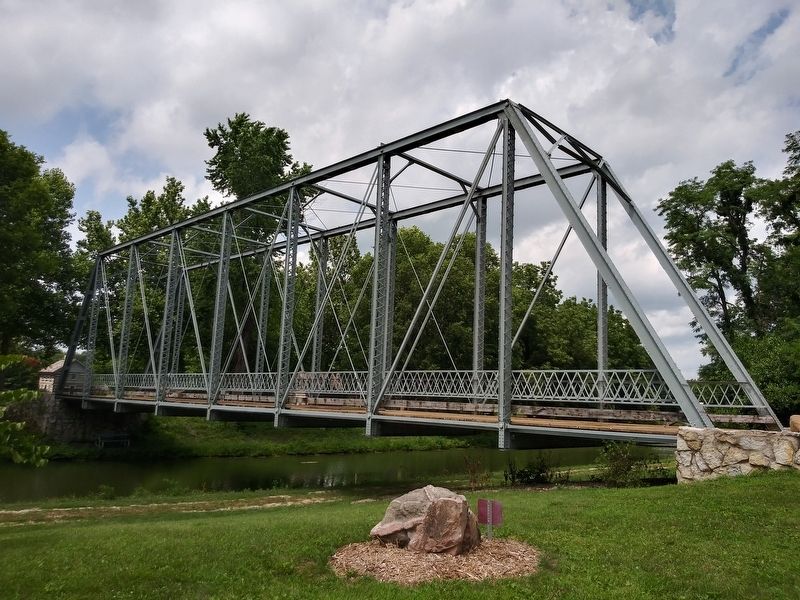
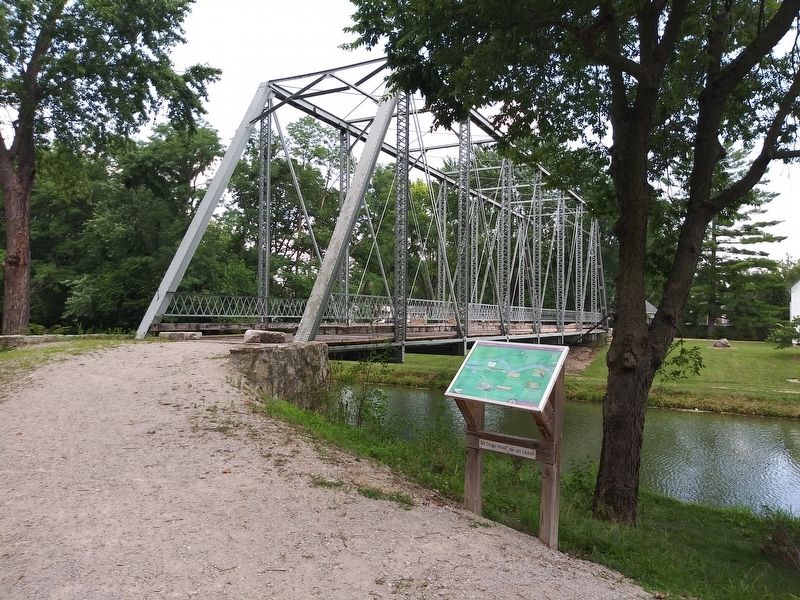
Location. 40° 35.5′ N, 86° 40.8′ W. Marker is in Delphi, Indiana, in Carroll County. It can be reached from the intersection of West North Washington Street and North Charles Street, on the right when traveling east. On the Grounds of the Wabash & Erie Canal Conference & Interpretive Center. Touch for map. Marker is at or near this postal address: 12252 West North Washington Street, Delphi IN 46923, United States of America. Touch for directions.

Regionally, this marker is in Northern Indiana. It is also in the American Midwest and in the Corn Belt. Globally, it is in North America, the Western Hemisphere, the Western World, and the Anglosphere. Historically, it finds itself in what was once the territory of the Mississippian Culture and also the Northwest Territory.
Other nearby markers. At least 8 other markers are within walking distance of this marker: Canal Village (a few steps from this marker); The Paper Maker's Shop (within shouting distance of this marker); Cabin Homestead 1830s (within shouting distance of this marker); Fouts Kitchen And Medical Plants Garden (within shouting distance of this marker); The Cooper (within shouting distance of this marker); Education Along The Canal (within shouting distance of this marker); Broom Maker (within shouting distance of this marker); The Broom Making Process (within shouting distance of this marker). Touch for a list and map of all markers in Delphi.
Credits. This page was last revised on December 25, 2020. It was originally submitted on December 25, 2020, by Craig Doda of Napoleon, Ohio. This page has been viewed 440 times since then and 19 times this year. Photos: 1, 2, 3, 4. submitted on December 25, 2020, by Craig Doda of Napoleon, Ohio. • Devry Becker Jones was the editor who published this page.
