Cabin Homestead 1830s
A Source of shelter, food & economy
| — | Wabash & Erie Canal Park Village | — |
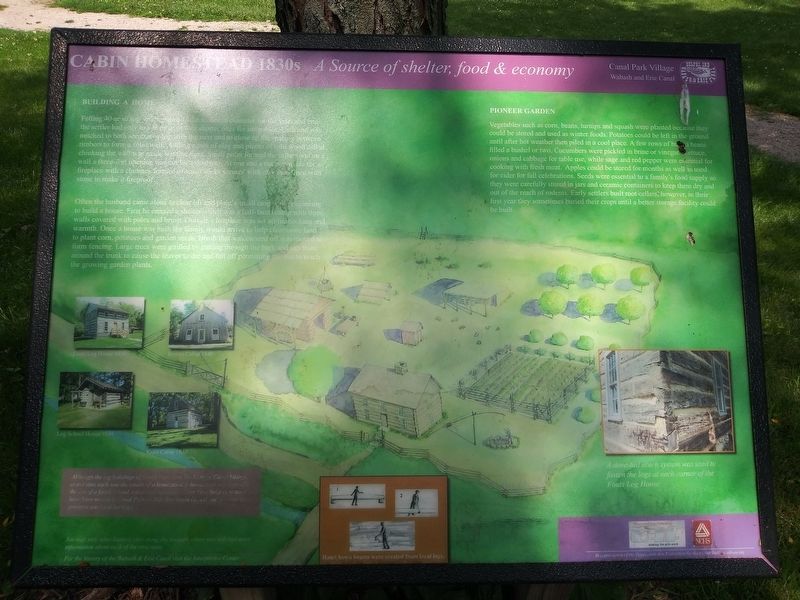
Building A Home
Felhng 40 or so logs in the forest 15-26 inches in diameter for the sides and ends the settler had only to add three or four shorter ones for the gables. Each end was notched to both secure one log with the next and to close up the spacing between timbers to form a solid wall. Adding a mix of clay and pieces of split wood called chinking the wall was made weather tight. Small poles formed the rafters and on a wall a three-feet opening was cut for a doorway. At one end a cut was made for a fireplace with a chimney formed of small sticks secured with clay then lined with stone to make it fireproof.
Often the husband came alone to clear off and plant a small crop while beginning to build a house. First he erected a shelter which was a half-faced camp with three walls covered with poles and brush. Outside a fireplace was set up for cooking and warmth. Once a house was built the family would arrive to help clear more land to plant corn, potatoes and garden seeds. Brush that was cleared off was moved to form fencing. Large trees were girdled by cutting through the bark and sap from around the
this page online
Pioneer Garden
Vegetables such as corn, beans, turnips and squash were planted because they
could be stored and used as winter foods. Potatoes could be left in the ground
until after hot weather then piled in a cool place. A few rows of hulled beans
filled a bushel or two. Cucumbers were pickled in brine or vinegar. Lettuce,
onions and cabbage for table use, while sage and red pepper were essential for
cooking with fresh meat. Apples could be stored for months as well as used
for cider for fall celebrations. Seeds were essential to a family's food supply so
they were carefully stored in jars and ceramic containers to keep them dry and
out of the reach of rodents. Early settlers built root cellars; however, in their
first year they sometimes buried their crops until a better storage facility could
be built.
A dove-tail notch system was used to fasten the logs at each corner of the Fouts Log House.
Erected by Tippecanoe Arts Federation.
Topics and series. This historical marker is listed in these topic
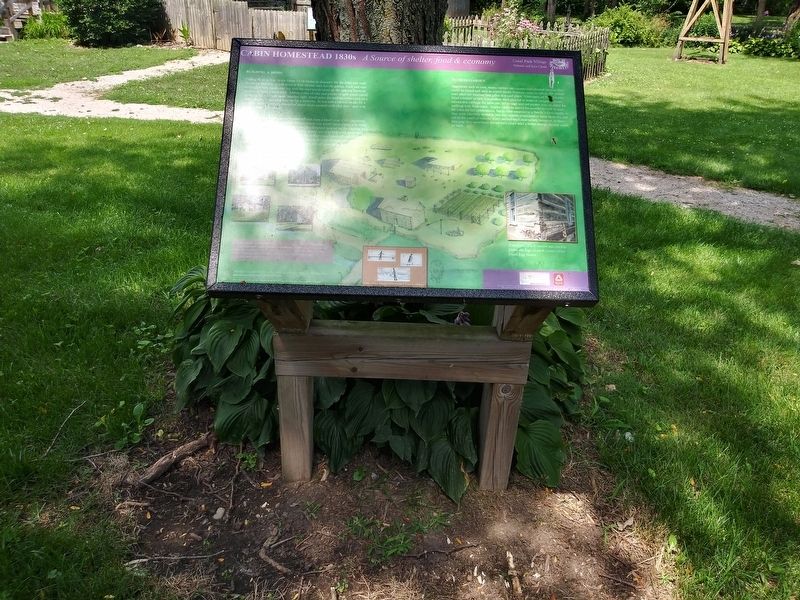
Location. 40° 35.517′ N, 86° 40.8′ W. Marker is in Delphi, Indiana, in Carroll County. It is at the intersection of West North Washington Street and North Charles Street, on the right when traveling east on West North Washington Street. On the Grounds of the Wabash & Erie Canal Conference & Interpretive Center. Touch for map. Marker is at or near this postal address: 12252 West North Washington Street, Delphi IN 46923, United States of America. Touch for directions.

Regionally, this marker is in Northern Indiana. It is also in the American Midwest and in the Corn Belt. Globally, it is in North America, the Western Hemisphere, the Western World, and the Anglosphere. Historically, it finds itself in what was once the territory of the Mississippian Culture and also the Northwest Territory.
Other nearby markers. At least 8 other markers are within walking distance of this marker: The Paper Maker's Shop (here, next to this marker); Fouts Kitchen And Medical Plants Garden (here, next to this marker); The Cooper (a few steps from this marker); Education Along The Canal (a few steps from this marker); Broom Maker (a few steps from this marker); The Broom Making Process (a few steps from this marker); Canal Bridges (within shouting distance of this marker); Canal Village (within shouting distance of this marker). Touch for a list and map of all markers in Delphi.
Credits. This page was last revised on December 25, 2020. It was originally submitted on December 25, 2020, by Craig Doda of Napoleon, Ohio. This page has been viewed 248 times since then and 13 times this year. Photos: 1, 2. submitted on December 25, 2020, by Craig Doda of Napoleon, Ohio. • Devry Becker Jones was the editor who published this page.
