Nevada Street in San Antonio in Bexar County, Texas — The American South (West South Central)
The Historic African American Cemetery

Photographed by James Hulse, December 24, 2020
1. The Historic African American Cemetery Marker
During San Antonio's segregated era these grounds became designated at the burial place for citizens of African descent. Many important historical figures are interred at this location, including Lafayette Walker a leader during Reconstruction that opposed the "Negro Agent" James Newcomb in seeking rights for African Americans.
Names and accomplishments: Ella Austin established a home for black orphans; Bishop Abraham S. Grant lobbied for segregated schools, and had segregated school named after him; anti-segregationist Harold Tarver, principal of the Dunbar School and an opponent of Bishop Grant; Lynn Eusan, a 1960's human rights activist, and the first black homecoming queen for the University of Houston; leaders of the 1904 "Streetcar Boycott" Jesse Brumbrey, and O.J. Carter, and William L. Hegwood, editor with the San Antonio Inquirer indicted by the "Bureau of Investigation" for allowing articles to be published criticizing the treatment of black soldiers that rebelled against white supremacy in the "Houston Riot", and were subsequently hanged at Ft. Sam Houston.
Author: Mario Marcel Salas
City of San Antonio TIRZ Board
this page online
District 2 City Councilmember Sheila McNeil, Chair
Erected by City of San Antonio.
Topics. This historical marker is listed in these topic lists: African Americans • Cemeteries & Burial Sites. A significant historical year for this entry is 1904.
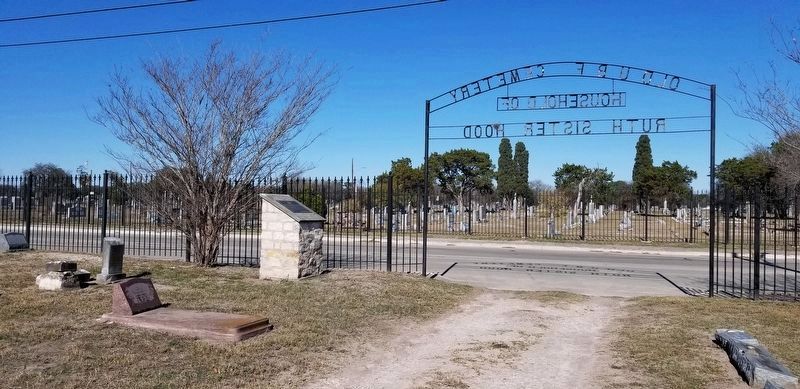
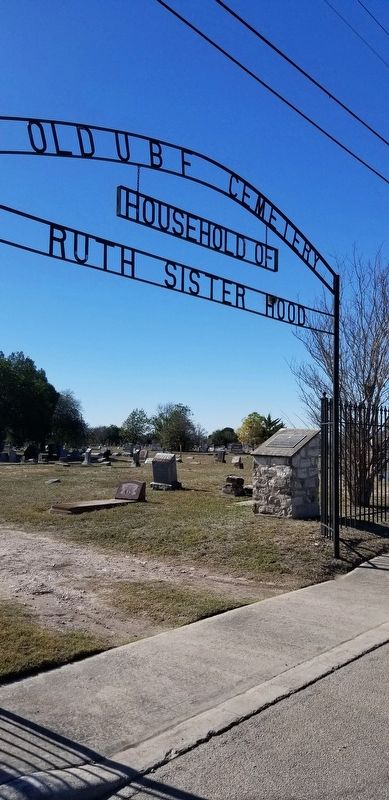
Location. 29° 25.106′ N, 98° 27.74′ W. Marker is in San Antonio, Texas, in Bexar County. It is in Nevada Street. It is on Montana Street 0.1 miles west of South New Braunfels Avenue, on the left when traveling west. The marker is located at the entrance to the Old UBF Cemetery - Household of Ruth Sister Hood. This cemetery is also known as City Cemetery #3. Touch for map. Marker is in this post office area: San Antonio TX 78203, United States of America. Touch for directions.

Regionally, this marker is in South Texas. It is also in the American South. Globally, it is in North America, a Gulf of Mexico state, the Western Hemisphere, the Western World, and the Anglosphere. Historically, it finds itself in what was once New Spain, the Republic of Texas, and one of the Confederate States of America.
Other nearby markers. At least 8 other markers are within walking distance
Photographed by James Hulse, December 24, 2020
2. The Historic African American Cemetery Marker is located west of the entrance to the cemetery
Also see . . .
1. Houston Riot of 1917. In their two-hour march on the city, the mutinous Blacks killed fifteen Whites, including four policemen, and seriously wounded twelve others, one of whom, a policeman, subsequently died. Four Black soldiers also died. Two were accidentally shot by their own men, one in camp and the other on San Felipe Street. After they had killed Capt. Joseph Mattes of the Illinois National Guard, obviously mistaking him for a policeman, the Blacks began quarreling over a course of action. Source: The Handbook of Texas (Submitted on December 29, 2020, by James Hulse of Medina, Texas.)
2. Segregation.
Photographed by James Hulse, December 24, 2020
3. The entrance to the Old UBF Cemetery from Montana Street
Credits. This page was last revised on February 2, 2023. It was originally submitted on December 29, 2020, by James Hulse of Medina, Texas. This page has been viewed 1,201 times since then and 85 times this year. Photos: 1, 2, 3. submitted on December 29, 2020, by James Hulse of Medina, Texas. • J. Makali Bruton was the editor who published this page.
