Miles City in Custer County, Montana — The American West (Mountains)
Water Wagon Shed
Fort Keogh Historic District
Photographed by Barry Swackhamer, September 13, 2020
1. Water Wagon Shed Marker
Inscription.
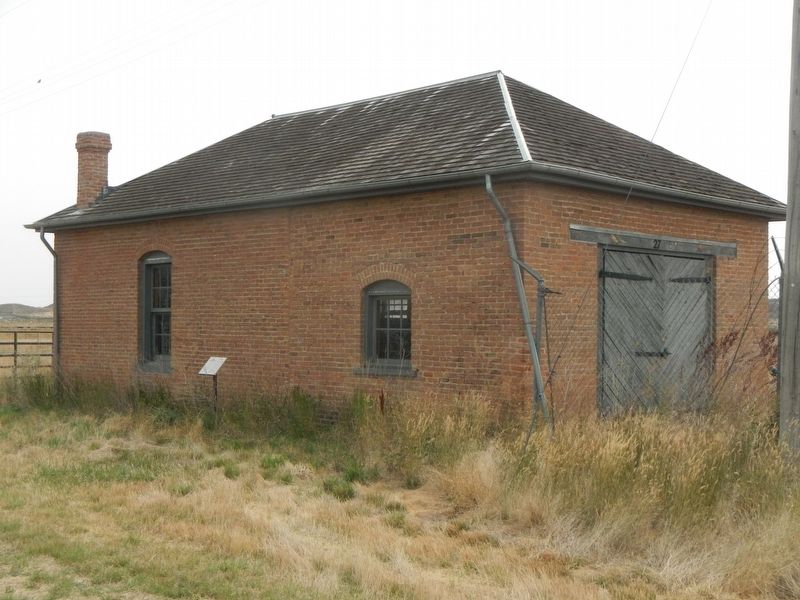
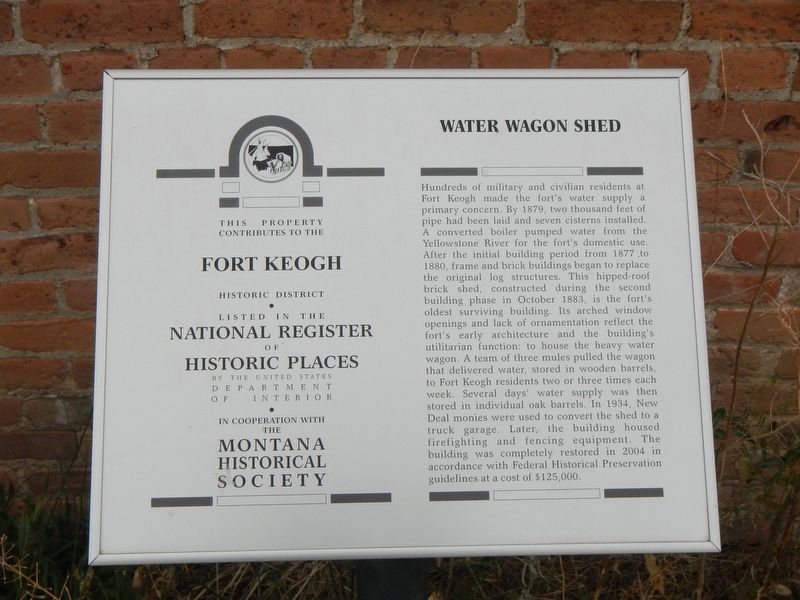
Water Wagon Shed. Fort Keogh Historic District. Hundreds of military and civilian residents at Fort Keogh made the fort’s water supply a primary concern. By 1879, two thousand feet of pipe had been laid and seven cisterns installed. A converted boiler pumped water from the Yellowstone River for the fort’s domestic use. After the initial building period from 1877 to 1880, frame and brick buildings began to replace the original log structures. This hipped-roof brick shed, constructed during the second building phase in October 1883, is the fort’s oldest surviving building. Its arched window openings and lack of ornamentation reflect the fort’s early architecture and the building’s utilitarian function: to house the heavy water wagon. A team of three mules pulled the wagon that delivered water, stored in wooden barrels, to Fort Keogh residents two or three times each week. Several days’ water supply was then stored in individual oak barrels. In 1934, New Deal monies were used to convert the shed to a truck garage. Later, the building housed firefighting and fencing equipment. The building was completely restored in 2004 in accordance with Federal Historical Preservation guidelines at a cost of $125,000.
Hundreds of military and civilian residents at Fort Keogh made the fort’s water supply a primary concern. By 1879, two thousand feet of pipe had been laid and seven cisterns installed. A converted boiler pumped water from the Yellowstone River for the fort’s domestic use. After the initial building period from 1877 to 1880, frame and brick buildings began to replace the original log structures. This hipped-roof brick shed, constructed during the second building phase in October 1883, is the fort’s oldest surviving building. Its arched window openings and lack of ornamentation reflect the fort’s early architecture and the building’s utilitarian function: to house the heavy water wagon. A team of three mules pulled the wagon that delivered water, stored in wooden barrels, to Fort Keogh residents two or three times each week. Several days’ water supply was then stored in individual oak barrels. In 1934, New Deal monies were used to convert the shed to a truck garage. Later, the building housed firefighting and fencing equipment. The building was completely restored in 2004 in accordance with Federal Historical Preservation guidelines at a cost of $125,000.
Erected by Montana Historical Society.
Topics and series. This historical marker is listed in this topic list: Forts and Castles
Location. 46° 22.875′ N, 105° 52.697′ W. Marker is in Miles City, Montana, in Custer County. It is on Fort Keogh Road near Business Interstate 94. Touch for map. Marker is in this post office area: Miles City MT 59301, United States of America. Touch for directions.

Regionally, this marker is in Southeast Montana, in Custer Country and in the Powder River Basin. It is also in the American Mountain West, in the Lewis & Clark Corridor, on the prairies, on the Great Plains, and specifically on the Northern Plains. Globally, it is in North America, the Western Hemisphere, the Western World, and the Anglosphere. Historically, it finds itself in what was once Rupert’s Land and also the Louisiana Purchase.
Photographed by Barry Swackhamer, September 13, 2020
2. Water Wagon Shed and Marker
Credits. This page was last revised on January 9, 2021. It was originally submitted on January 9, 2021, by Barry Swackhamer of Brentwood, California. This page has been viewed 242 times since then and 9 times this year. Photos:1, 2. submitted on January 9, 2021, by Barry Swackhamer of Brentwood, California.