Near Miles City in Custer County, Montana — The American West (Mountains)
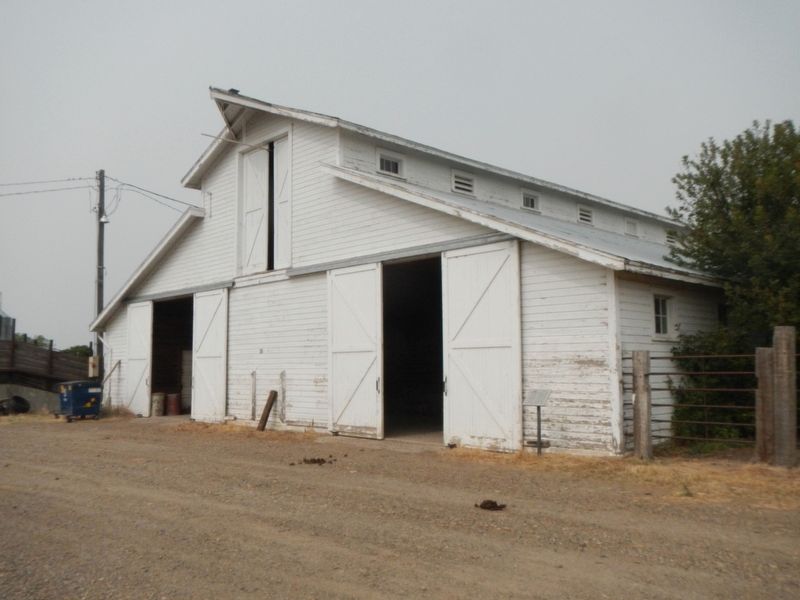
Horse Barn
Fort Keogh Historic District
Photographed by Barry Swackhamer, September 13, 2020
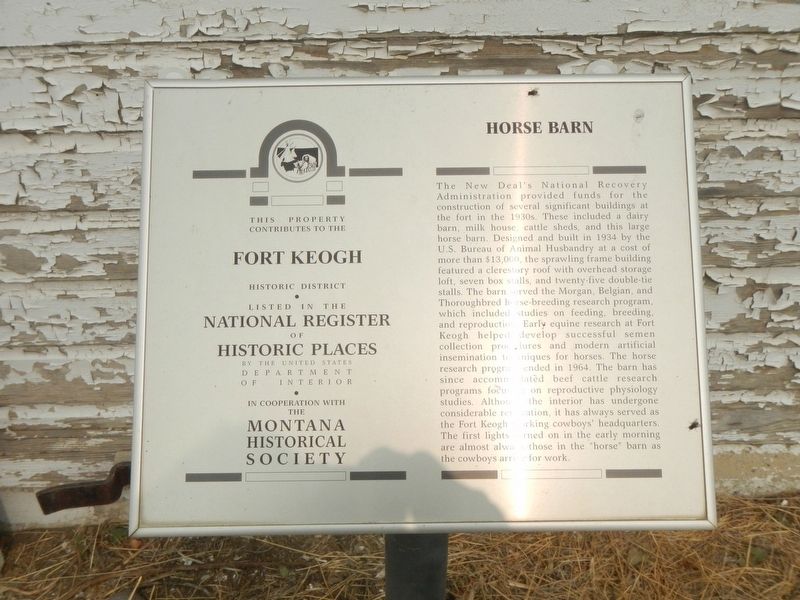
1. Horse Barn Marker
Inscription.
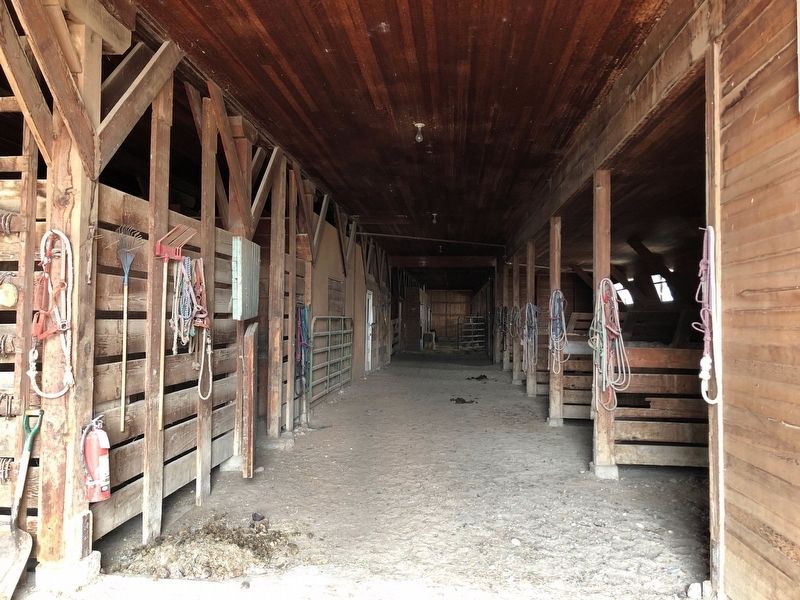
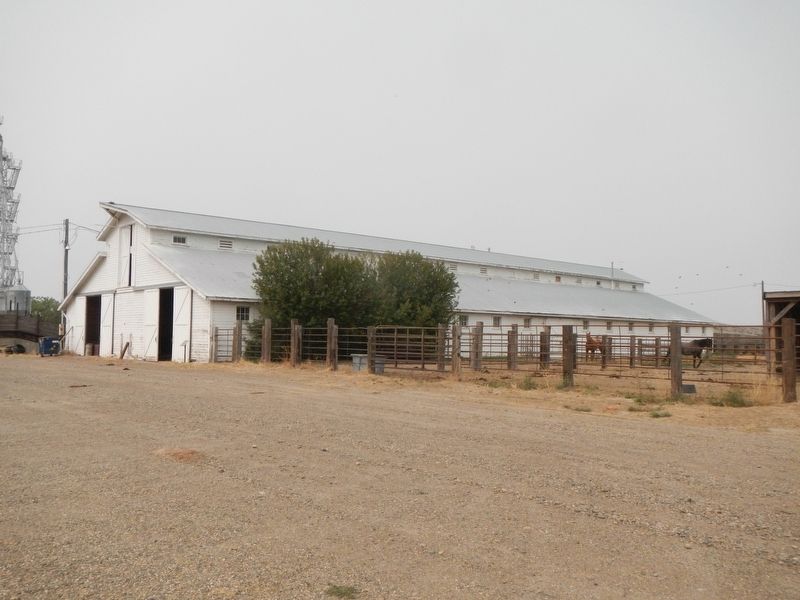
Horse Barn. Fort Keogh Historic District. The New Deals National Recovery Administration provided funds for the construction of several significant buildings at the fort in the 1930s. These included a dairy barn, milk house, cattle sheds, and this large horse barn. Designed and built in 1934 by the U.S. Bureau of Animal Husbandry at a cost of more than $13,000, the sprawling frame building featured a clerestory roof with overhead storage loft, seven box stalls, and twenty-five double-tie stalls. The barn served the Morgan, Belgian, and Thoroughbred horse-breeding research program, which included studies on feeding, breeding, and reproduction. Early equine research at Fort Keogh helped develop successful semen collection procedures and modern artificial insemination techniques for horses. The horse research program ended in 1964. The barn has since accommodated beef cattle research programs focusing on reproductive physiology studies. Although the interior has undergone considerable renovation, it has always served as the Fort Keogh working cowboys headquarters. The first lights turned on in the early morning are almost always those in the “horse” barn as the cowboys arrive for work.
The New Deals National Recovery Administration provided funds for the construction of several significant buildings at the fort in the 1930s. These included a dairy barn, milk house, cattle sheds, and this large horse barn. Designed and built in 1934 by the U.S. Bureau of Animal Husbandry at a cost of more than $13,000, the sprawling frame building featured a clerestory roof with overhead storage loft, seven box stalls, and twenty-five double-tie stalls. The barn served the Morgan, Belgian, and Thoroughbred horse-breeding research program, which included studies on feeding, breeding, and reproduction. Early equine research at Fort Keogh helped develop successful semen collection procedures and modern artificial insemination techniques for horses. The horse research program ended in 1964. The barn has since accommodated beef cattle research programs focusing on reproductive physiology studies. Although the interior has undergone considerable renovation, it has always served as the Fort Keogh working cowboys headquarters. The first lights turned on in the early morning are almost always those in the “horse” barn as the cowboys arrive for work.
Erected by Montana Historical Society.
Topics and series. This historical marker is listed in these topic lists: Animals
Location. 46° 22.88′ N, 105° 52.771′ W. Marker is near Miles City, Montana, in Custer County. It can be reached from Fort Keogh Road near Business Interstate 94. Touch for map. Marker is in this post office area: Miles City MT 59301, United States of America. Touch for directions.

Regionally, this marker is in Southeast Montana, in Custer Country and in the Powder River Basin. It is also in the American Mountain West, in the Lewis & Clark Corridor, on the prairies, on the Great Plains, and specifically on the Northern Plains. Globally, it is in North America, the Western Hemisphere, the Western World, and the Anglosphere. Historically, it finds itself in what was once Ruperts Land and also the Louisiana Purchase.
Photographed by Barry Swackhamer, September 13, 2020
2. Horse Barn and Marker
Photographed by Barry Swackhamer, September 13, 2020
3. Horse Barn, interior
Photographed by Barry Swackhamer, September 13, 2020
4. Horse Barn
Credits. This page was last revised on January 9, 2021. It was originally submitted on January 9, 2021, by Barry Swackhamer of Brentwood, California. This page has been viewed 373 times since then and 17 times this year. Photos:1, 2, 3, 4. submitted on January 9, 2021, by Barry Swackhamer of Brentwood, California.