Downtown Los Angeles in Los Angeles County, California — The American West (Pacific Coastal)
Mississippi Blues & The Grammy Awards

Photographed by Craig Baker, January 4, 2021
1. Mississippi Blues Marker
Mississippi Blues lies at the root of many strains of popular music celebrated every year in the Grammy Awards. The blues emerged in Mississippi and other states around the turn of the twentieth century, around the same time that the phonograph was gaining popularity. With the success of blues recordings by African American singers in the 1920s, the music became an economically important, though initially low-status, sector of the recording industry. In later decades mainstream acknowledgement of the blues increased dramatically, a development that was both reflected in and aided by various forms of recognition by The Recording Academy.
The Grammy Awards were established in 1958, at a time when blues was being
this page online
The Recording Academy has also retroactively acknowledged

Photographed by Craig Baker, January 4, 2021
2. Mississippi Blues Marker
This marker’s placement on the L.A. LIVE campus acknowledges the presence of The Grammy Museum, which offers blues education events that sometimes feature Mississippi artists, and the staging of the annual Grammy Awards Ceremony at the Staples Center.
Erected 2011 by Mississippi Blues Commission. (Marker Number 121.)
Topics and series. This historical

Photographed by Craig Baker, January 4, 2021
3. Mississippi Blues Marker
Location. 34° 2.666′ N, 118° 15.946′ W. Marker is in Los Angeles, California, in Los Angeles County. It is in Downtown Los Angeles. It is on Olympic Boulevard just west of Figueroa Street, on the left when traveling west. Located in the courtyard of the L.A. Live entertainment complex, near the Grammy Museum. Touch for map. Marker is at or near this postal address: 800 W Olympic Blvd, Los Angeles CA 90015, United States of America. Touch for directions.

Regionally, this marker is in the Transverse Ranges. It is also on the American Pacific Coast. Globally, it is in North America, on the Ring of Fire, on the Pacific Rim, in the Western Hemisphere, in the Western World, and in the Anglosphere. Historically, it finds itself in what was once New Spain and also Mexico’s Alta California.
Other nearby markers. At least 8 other markers are within walking distance of this marker: Kobe Bryant (about 300 feet away, measured in a direct
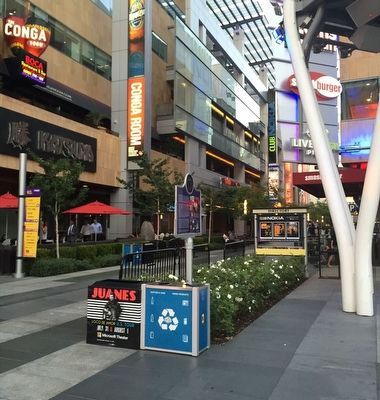
Photographed by Adam Margolis, July 29, 2015
4. Mississippi Blues Marker
Also see . . . Grammy Museum (official website). (Submitted on October 29, 2023, by Jason Voigt of Glen Carbon, Illinois.)

Photographed by Craig Baker, January 4, 2021
5. L.A. Live entertainment complex
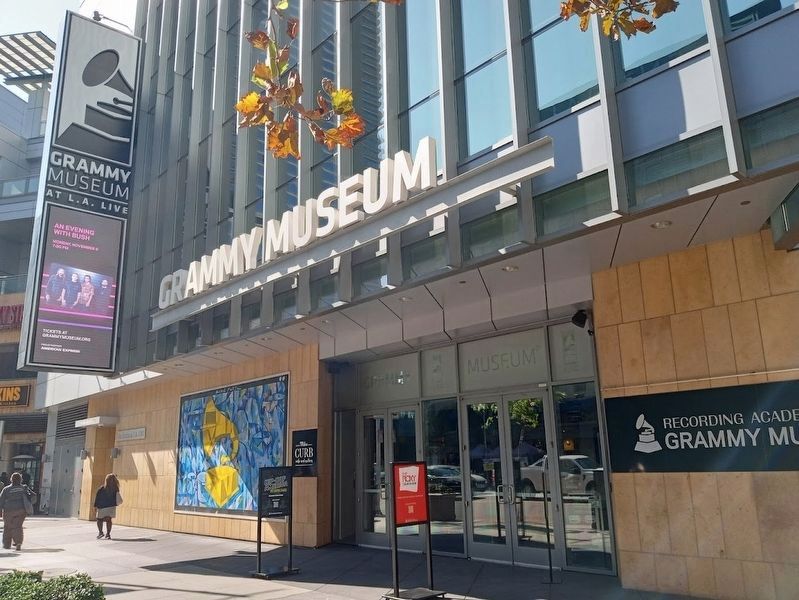
Photographed by Jason Voigt, October 26, 2023
6. The Grammy Museum at L.A. Live
The Grammy Museum, located on Olympic Boulevard, about 350 feet from the marker
Credits. This page was last revised on October 29, 2023. It was originally submitted on January 12, 2021, by Craig Baker of Sylmar, California. This page has been viewed 627 times since then and 25 times this year. Last updated on January 13, 2021, by Craig Baker of Sylmar, California. Photos: 1. submitted on January 12, 2021, by Craig Baker of Sylmar, California. 2. submitted on January 13, 2021, by Craig Baker of Sylmar, California. 3. submitted on January 12, 2021, by Craig Baker of Sylmar, California. 4. submitted on January 7, 2022, by Adam Margolis of Mission Viejo, California. 5. submitted on January 12, 2021, by Craig Baker of Sylmar, California. 6. submitted on October 29, 2023, by Jason Voigt of Glen Carbon, Illinois. • J. Makali Bruton was the editor who published this page.
