Forsyth in Rosebud County, Montana — The American West (Mountains)
Forsyth Water Pumping Station
Photographed by Barry Swackhamer, September 13, 2020
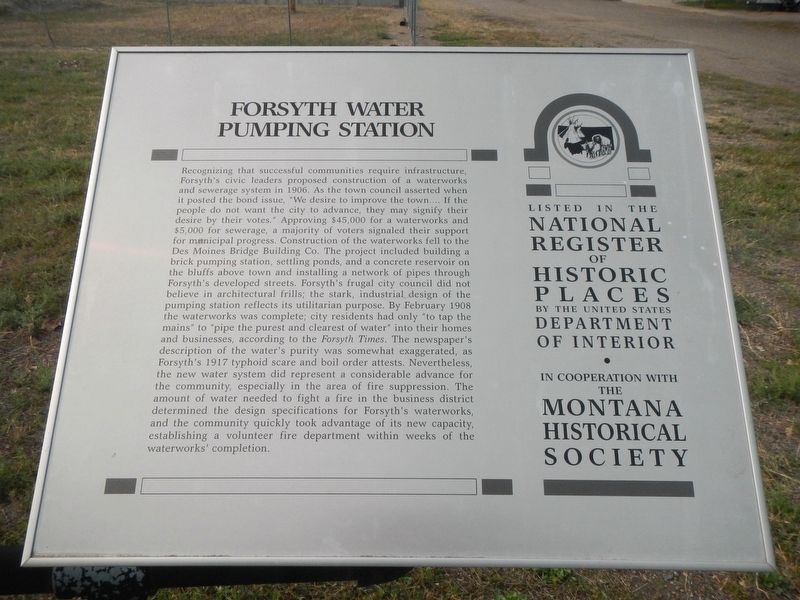
1. Forsyth Water Pumping Station Marker
Inscription.
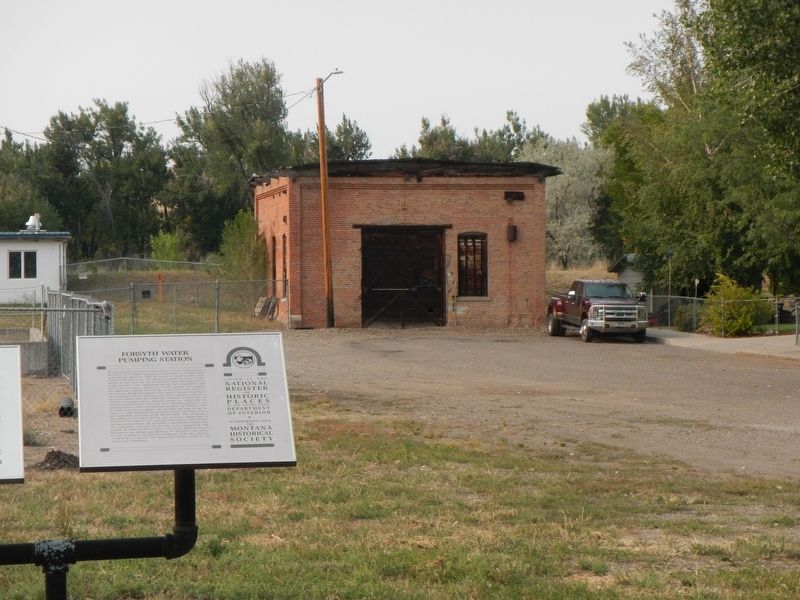
Recognizing that successful communities require infrastructure, Forsyth’s civic leaders proposed construction of a waterworks and sewerage system in 1906. As the town council asserted when it posted the bond issue, “We desire to improve the town.... If the people do not want the city to advance, they may signify their desire by their votes.” Approving $45,000 for a waterworks and $5,000 for sewerage, a majority of voters signaled their support for municipal progress. Construction of the waterworks fell to the Des Moines Bridge Building Co. The project included building a brick pumping station, settling ponds, and a concrete reservoir on the bluffs above town and installing a network of pipes through Forsyth’s developed streets. Forsyth’s frugal city council did not believe in architectural frills; the stark, industrial design of the pumping station reflects its utilitarian purpose. By February 1908, the waterworks was complete; city residents had only “to tap the mains” to “pipe the purest and clearest of water” into their homes and businesses, according to the Forsyth Times. The newspaper’s description of the water’s purity
Click or scan to see this page online
was somewhat exaggerated, as Forsyth’s 1917 typhoid scare and boil order attests. Nevertheless, the new water system did represent a considerable advance for the community, especially in the area of fire suppression. The amount of water needed to fight a fire in the business district determined the design specifications for Forsyth’s waterworks, and the community quickly took advantage of its new capacity, establishing a volunteer fire department within weeks of the waterworks’ completion.
Location. 46° 15.942′ N, 106° 41.382′ W. Marker is in Forsyth, Montana, in Rosebud County. It is at the intersection of 3rd Avenue North and Oak Street, on the left when traveling north on 3rd Avenue North. The marker is located in VFW Park. Touch for map. Marker is in this post office area: Forsyth MT 59327, United States of America. Touch for directions.
Regionally,
Photographed by Barry Swackhamer, September 13, 2020
2. Forsyth Water Pumping Station and Marker
this marker is in Montana’s Northern Cheyenne Nation, in Southeast Montana, in Custer Country and in the Powder River Basin. It is also in the American Mountain West, in the Lewis & Clark Corridor, on the prairies, on the Great Plains, and specifically on the Northern Plains. Globally, it is in North America, the Western Hemisphere, the Western World, and the Anglosphere. Historically, it finds itself in what was once Rupert’s Land and also the Louisiana Purchase.
Credits. This page was last revised on December 6, 2021. It was originally submitted on January 16, 2021, by Barry Swackhamer of Brentwood, California. This page has been viewed 260 times since then and 22 times this year. Photos:1, 2. submitted on January 16, 2021, by Barry Swackhamer of Brentwood, California.