Forsyth in Rosebud County, Montana — The American West (Mountains)
310 North Eleventh Avenue
Forsyth Residential Historic District
Photographed by Barry Swackhamer, September 14, 2020
1. 310 North Eleventh Avenue Marker
Inscription.
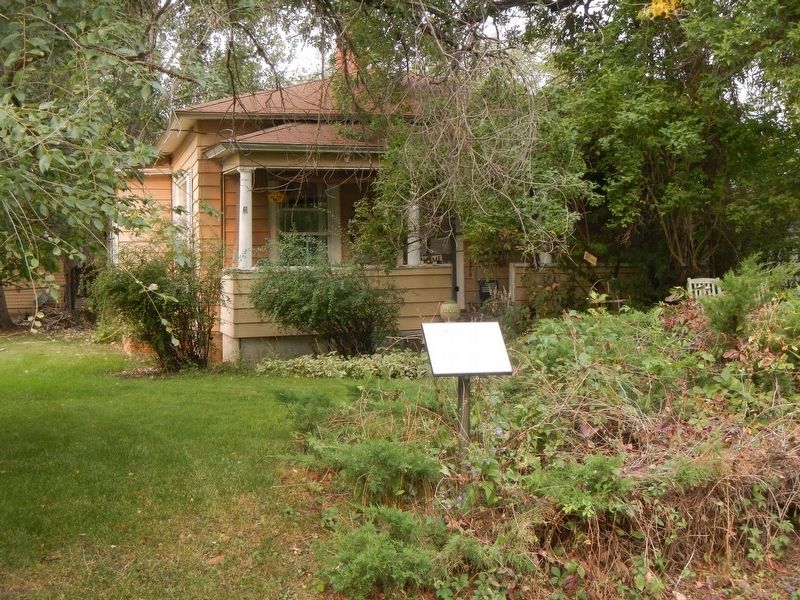
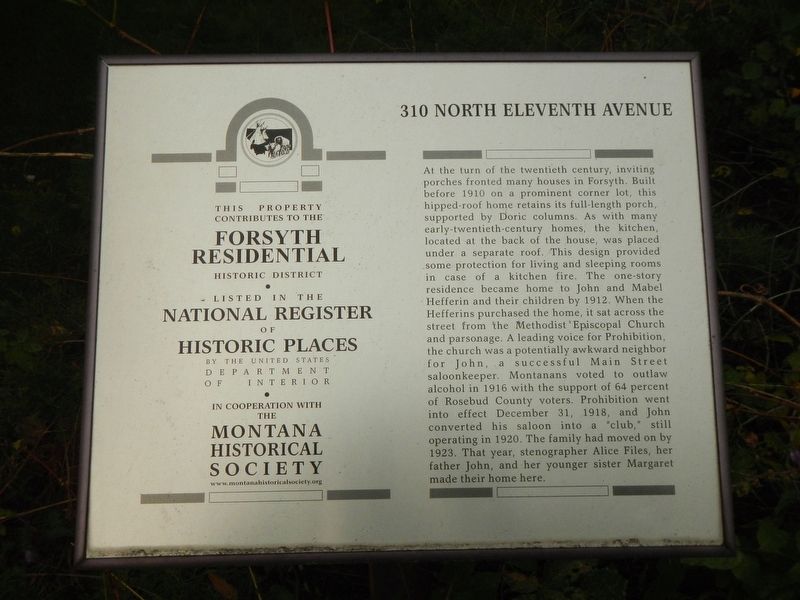
310 North Eleventh Avenue. Forsyth Residential Historic District. At the turn of the twentieth century, inviting porches fronted many houses in Forsyth. Built before 1910 on a prominent corner lot, this hipped-roof home retains its full-length porch, supported by Doric columns. As with many early-twentieth-century homes, the kitchen, located at the back of the house, was placed under a separate roof. This design provided some protection for living and sleeping rooms in case of a kitchen fire. The one-story residence became home to John and Mabel Hefferin and their children by 1912. When the Hefferins purchased the home, it sat across the street from the Methodist Episcopal Church and parsonage. A leading voice for Prohibition, the church was a potentially awkward neighbor for John, a successful Main Street saloonkeeper. Montanans voted to outlaw alcohol in 1916 with the support of 64 percent of Rosebud County voters. Prohibition went into effect December 31, 1918, and John converted his saloon into a “club,” still operating in 1920. The family had moved on by 1923. That year, stenographer Alice Files, her father John, and her younger sister Margaret made their home here.
At the turn of the twentieth century, inviting porches fronted many houses in Forsyth. Built before 1910 on a prominent corner lot, this hipped-roof home retains its full-length porch, supported by Doric columns. As with many early-twentieth-century homes, the kitchen, located at the back of the house, was placed under a separate roof. This design provided some protection for living and sleeping rooms in case of a kitchen fire. The one-story residence became home to John and Mabel Hefferin and their children by 1912. When the Hefferins purchased the home, it sat across the street from the Methodist Episcopal Church and parsonage. A leading voice for Prohibition, the church was a potentially awkward neighbor for John, a successful Main Street saloonkeeper. Montanans voted to outlaw alcohol in 1916 with the support of 64 percent of Rosebud County voters. Prohibition went into effect December 31, 1918, and John converted his saloon into a “club,” still operating in 1920. The family had moved on by 1923. That year, stenographer Alice Files, her father John, and her younger sister Margaret made their home here.
Location. 46° 16.098′ N, 106° 40.702′ W. Marker is in Forsyth, Montana, in Rosebud County. It is on North 11th Avenue near River Street, on the left when traveling north. Touch for map. Marker is at or near this postal address: 310 North 11th Avenue, Forsyth MT 59327, United States of America. Touch for directions.

Regionally, this marker is in Montana’s Northern Cheyenne Nation, in Southeast Montana, in Custer Country and in the Powder River Basin. It is also in the American Mountain West, in the Lewis & Clark Corridor, on the prairies, on the Great Plains, and specifically on the Northern Plains. Globally, it is in North America, the Western Hemisphere, the Western World, and the Anglosphere. Historically, it finds itself in what was once Ruperts Land and also the Louisiana Purchase.
Other nearby markers. At least 8 other markers are within walking distance of
Photographed by Barry Swackhamer, September 14, 2020
Credits. This page was last revised on January 19, 2021. It was originally submitted on January 19, 2021, by Barry Swackhamer of Brentwood, California. This page has been viewed 219 times since then and 16 times this year. Photos:1, 2. submitted on January 19, 2021, by Barry Swackhamer of Brentwood, California.