Private Claim 236 Lot of Hubert Lacroix
| — | River Raisin National Battlefield Park | — |
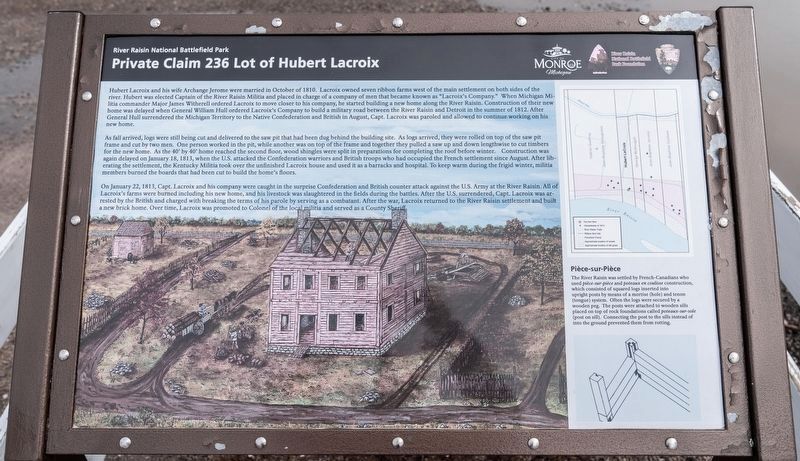
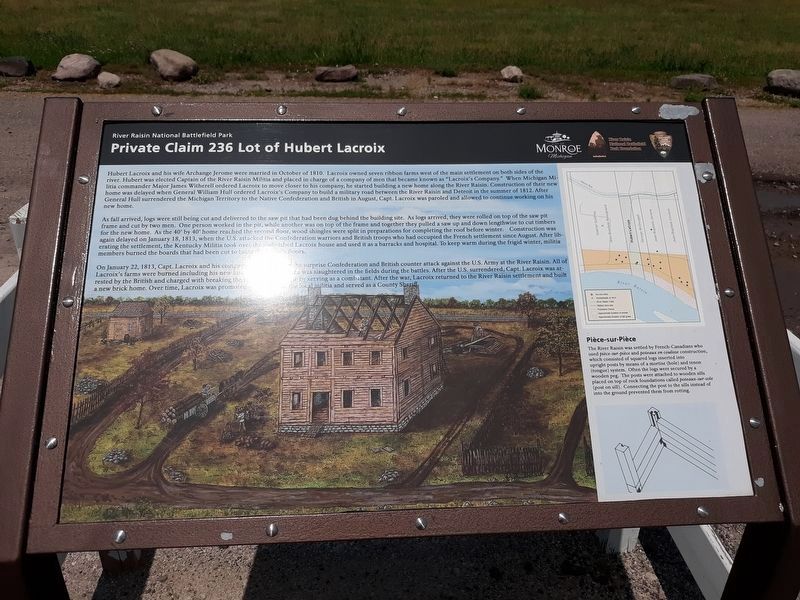
As fall arrived, logs were still being cut and delivered to the saw pit that had been dug behind the building site. As logs arrived, they were rolled on top of the saw pit frame and cut by two men. One person worked in the pit, while another was on top of the frame and together they pulled a saw up and
this page online
On January 22, 1813, Capt. Lacroix and his company were caught in the surprise Confederation and British counter attack against the U.S. Army at the River Raisin. All of Lacroix's farms were burned including his new home, and his livestock was slaughtered in the fields during the battles. After the U.S. surrendered, Capt. Lacroix was arrested by the British and charged with breaking the terms of his parole by serving as a combatant. After the war, Lacroix returned to the River Raisin settlement and built a new brick home. Over time,
Pièce-sur-Pièce
The River Raisin was settled by French-Canadians who
used pièce-sur-pièce and poteaux en coulisse construction,
which consisted of squared logs inserted into
upright posts by means of a mortise (hole) and tenon
(tongue) system. Often the logs were secured by a
wooden peg. The posts were attached to wooden sills
placed on top of rock foundations called poteaux-sur-sole
(post on sill). Connecting the post to the sills instead of
into the ground prevented them from rotting.
Erected by U.S. National Park Service, City of Monroe, Michigan.
Topics. This historical marker is listed in these topic lists: Settlements & Settlers • War of 1812. A significant historical date for this entry is January 18, 1813.
Location. 41° 54.785′ N, 83° 22.748′ W. Marker is in Monroe, Michigan, in Monroe County. It is on East Elm Avenue east of North Dixie Highway, on the left when traveling east. Touch for map. Marker is in this post office area: Monroe MI 48162, United States of America. Touch for directions.
Regionally, this marker is in Southeast
Other nearby markers. At least 8 other markers are within walking distance of this marker: Private Claim 236, Lot of George McDougal (within shouting distance of this marker); River Raisin Legacy Project (within shouting distance of this marker); a different marker also named River Raisin Legacy Project (within shouting distance of this marker); First District Court (within shouting distance of this marker); Private Claim 236 Lot of Jean (John) Baptiste Jerome (within shouting distance of this marker); Site of Battles of Jan. 18 - 22 (about 400 feet away, measured in a direct line); Private Claim 214 of G. Godfroy & J.B. Beaugrand (about 400 feet away); Private Claim 96 of Jean (John) Baptist Couture (about 600 feet away). Touch for a list and map of all markers in Monroe.
Credits. This page was last revised on March 27, 2021. It was originally submitted on January 24, 2021, by Craig Doda of Napoleon, Ohio. This page has been viewed 550 times since then and 47 times this year. Photos: 1, 2. submitted on March 26, 2021, by J.T. Lambrou of New Boston, Michigan. 3, 4. submitted on January 24, 2021, by Craig Doda of Napoleon, Ohio. • Mark Hilton was the editor who published this page.
