South Side in Billings in Yellowstone County, Montana — The American West (Mountains)
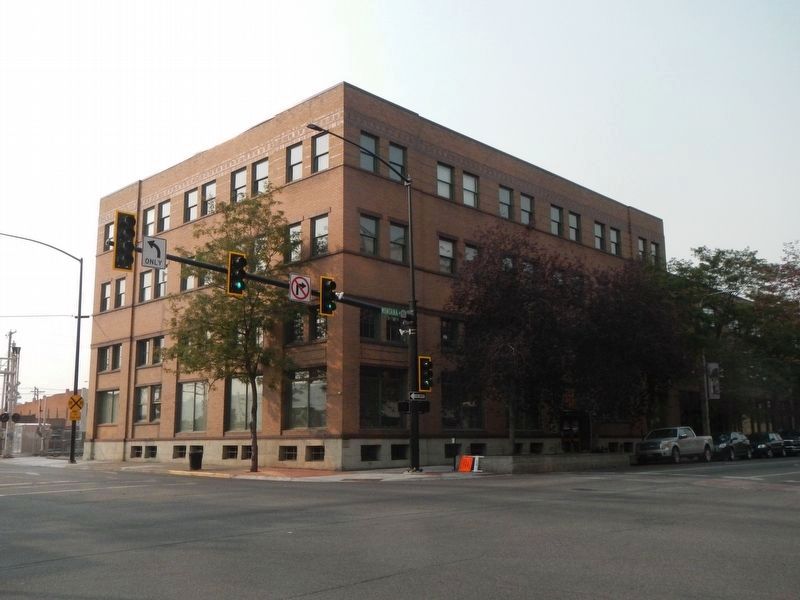
Oliver Building
Photographed by Barry Swackhamer, September 15, 2020
1. Oliver Building Marker
Inscription.
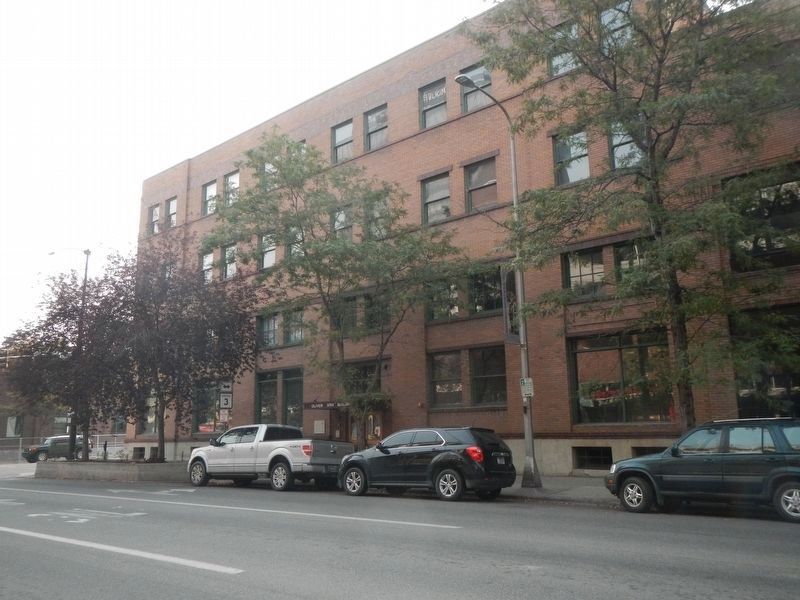
Oliver Building. . The homesteading boom was in full swing in 1910, but not all of Montana's newcomers came to farm. With the arrival of three transcontinental railroads, Billings became established as a regional hub of commerce. Many businesses saw opportunity in the region's expanding markets, and the city became the nation's sixth fastest- growing community. The Oliver Chilled Plow Works, which constructed this four-story, 37,500-square-foot business block, was one of many national corporations to build here. Among the largest farm implement dealers in the U.S., the plow works took its name from its founder, James Oliver, and his specially patented method to chill (or harden) plow points to reduce wear. H. B. Sill managed the farm implement and automobile dealership. A four-foot platform made it easy for the railroad to offload merchandise trackside, while the building's street-side faηades featured large display windows to entice customers. Upper floors provided apartments as well as warehouse space; in 1920, tenants included a dressmaker, janitor, stenographer, laborer, and "telephone girl." A fire in May 1930 swept through the structure's top floors, causing over $125,000 of damage. The Billings Hardware Company, which by then owned the building, hired architect Chandler Cohagen to oversee reconstruction. Cohagen is responsible for the Art Moderne style banding and geometric brickwork decorating the upper stories. A lasting example of Billings' rail-centered economy, the Oliver Building also reflects the growing popularity of the automobile. Stenciled on the northeast foundation is a sign reading "Glacier-to-Gulf," denoting the building as a landmark along a 1920s tourism "motorway" from Galveston, Texas, to Glacier National Park.
The homesteading boom was in full swing in 1910, but not all of Montana's newcomers came to farm. With the arrival of three transcontinental railroads, Billings became established as a regional hub of commerce. Many businesses saw opportunity in the region's expanding markets, and the city became the nation's sixth fastest- growing community. The Oliver Chilled Plow Works, which constructed this four-story, 37,500-square-foot business block, was one of many national corporations to build here. Among the largest farm implement dealers in the U.S., the plow works took its name from its founder, James Oliver, and his specially patented method to chill (or harden) plow points to reduce wear. H. B. Sill managed the farm implement and automobile dealership. A four-foot platform made it easy for the railroad to offload merchandise trackside, while the building's street-side faηades featured large display windows to entice customers. Upper floors provided apartments as well as warehouse space; in 1920, tenants included a dressmaker, janitor, stenographer, laborer, and "telephone girl." A fire in May 1930 swept through the structure's
Click or scan to see this page online
top floors, causing over $125,000 of damage. The Billings Hardware Company, which by then owned the building, hired architect Chandler Cohagen to oversee reconstruction. Cohagen is responsible for the Art Moderne style banding and geometric brickwork decorating the upper stories. A lasting example of Billings' rail-centered economy, the Oliver Building also reflects the growing popularity of the automobile. Stenciled on the northeast foundation is a sign reading "Glacier-to-Gulf," denoting the building as a landmark along a 1920s tourism "motorway" from Galveston, Texas, to Glacier National Park.
Location. 45° 46.901′ N, 108° 30.229′ W. Marker is in Billings, Montana, in Yellowstone County. It is in the South Side. It is at the intersection of Montana Avenue and North 27th Street, on the right when traveling east on Montana Avenue. Touch for map. Marker is at or near this postal address: 2702 Montana Avenue,
Photographed by Barry Swackhamer, September 15, 2020
Regionally, this marker is in Montana’s Yellowstone Country. It is also in the American Mountain West and in the Lewis & Clark Corridor. Globally, it is in North America, the Western Hemisphere, the Western World, and the Anglosphere. Historically, it finds itself in what was once Ruperts Land and also the Louisiana Purchase.
Photographed by Barry Swackhamer, September 15, 2020
3. Oliver Building
Credits. This page was last revised on February 16, 2023. It was originally submitted on January 30, 2021, by Barry Swackhamer of Brentwood, California. This page has been viewed 270 times since then and 19 times this year. Photos:1, 2, 3. submitted on January 30, 2021, by Barry Swackhamer of Brentwood, California.
Editor’s want-list for this marker. Mid-distance view of the building and marker. • Can you help?