Marker Logo
THE HISTORICAL
MARKER DATABASE
“Bite-Size Bits of Local, National, and Global History”
Billings in Yellowstone County, Montana — The American West (Mountains)
 

Babcock Theater
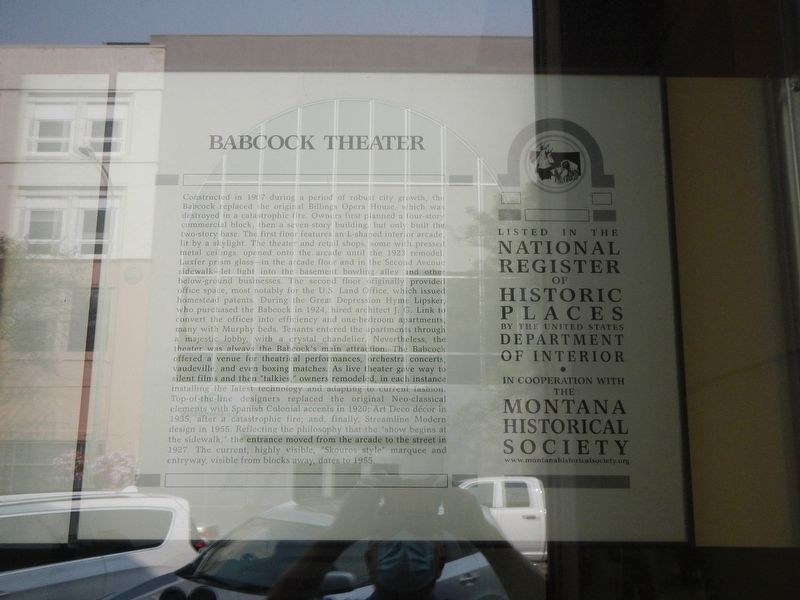
 
 
Babcock Theater Marker image. Click for full size.
Photographed by Barry Swackhamer, September 15, 2020
1. Babcock Theater Marker
Inscription. Constructed in 1907 during a period of robust city growth, the Babcock replaced the original Billings Opera House, which was destroyed in a catastrophic fire. Owners first planned a four-story commercial block, then a seven-story building, but only built the two-story base. The first floor features an L-shaped interior arcade, lit by a skylight. The theater and retail shops, some with pressed metal ceilings, opened onto the arcade until the 1923 remodel. Luxfer prism glass—in the arcade floor and in the Second Avenue sidewalk—let light into the basement bowling alley and other below-ground businesses. The second floor originally provided office space, most notably for the U.S. Land Office, which issued homestead patents. During the Great Depression Hyme Lipsker, who purchased the Babcock in 1924, hired architect J. G. Link to convert the offices into efficiency and one-bedroom apartments, many with Murphy beds. Tenants entered the apartments through a majestic lobby, with a crystal chandelier. Nevertheless, the theater was always the Babcock’s main attraction. The Babcock offered a venue for theatrical performances, orchestra
Paid Advertisement
Click or scan to see
this page online
concerts, vaudeville, and even boxing matches. As live theater gave way to silent films and then “talkies,” owners remodeled, in each instance installing the latest technology and adapting to current fashion. Top-of-the-line designers replaced the original Neo-classical elements with Spanish Colonial accents in 1920; Art Deco décor in 1935, after a catastrophic fire; and, finally, Streamline Modern design in 1955. Reflecting the philosophy that the “show begins at the sidewalk,” the entrance moved from the arcade to the street in 1927. The current, highly visible, “Skouros style” marquee and entryway, visible from blocks away, dates to 1955.
 
Erected by Montana Historical Society.
 
Topics and series. This historical marker is listed in these topic lists: ArchitectureArts, Letters, MusicEntertainmentIndustry & Commerce. In addition, it is included in the Montana National Register Sign Program series list.
 
Location. 45° 46.963′ N, 108° 30.415′ W. Marker is in Billings, Montana, in Yellowstone County. It can be reached from 2nd Avenue North near North Broadway,
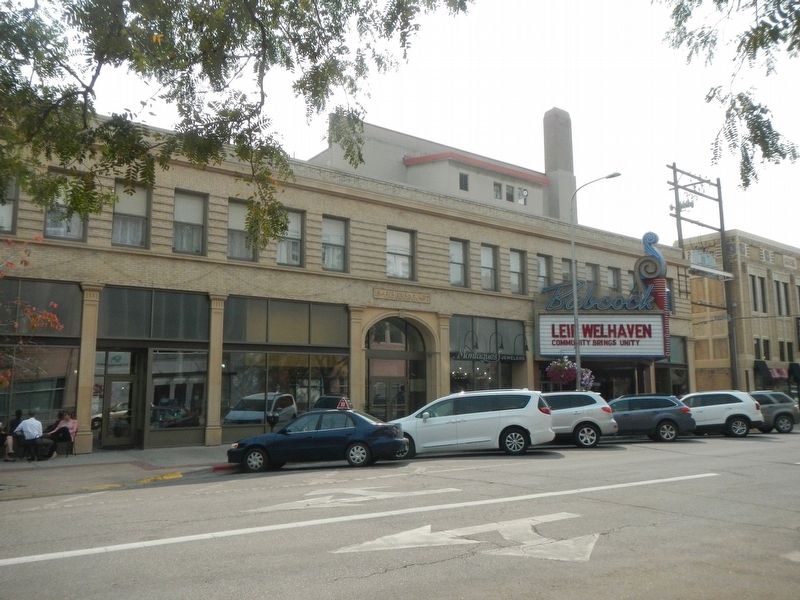
Babcock Theater Marker image. Click for full size.
Photographed by Barry Swackhamer, September 15, 2020
2. Babcock Theater Marker
The marker is in the widow of the arched entrance.

aka North 28th Street, on the right when traveling east. Touch for map. Marker is at or near this postal address: 2812 Second Avenue North, Billings MT 59101, United States of America. Touch for directions.

Regionally, this marker is in Montana’s Yellowstone Country. It is also in the American Mountain West and in the Lewis & Clark Corridor. Globally, it is in North America, the Western Hemisphere, the Western World, and the Anglosphere. Historically, it finds itself in what was once Rupert’s Land and also the Louisiana Purchase.

Other nearby markers. At least 8 other markers are within walking distance of this marker: Electric Building (within shouting distance of this marker); Billings' First Bank - 1883 (about 700 feet away, measured in a direct line); The Chapple Drug Store - 1893 (about 700 feet away); Losekamp Block (about 700 feet away); The Parmly Billings Library - 1901 (about 700 feet away); Standing Outside the Stockman's Café (about 700 feet away); The Losekamp Building - 1903 (about 700 feet away); Billings Chamber of Commerce Building (about 700 feet away). Touch for a list and map of all markers in
Paid Advertisement
Billings.
 
Also see . . .  Forged by Fire - Babcock Art House Cinema. With the theatre once again in ashes, owner Hyme Lipsker had to make a decision. Live theatre had remained out of fashion since the Great Depression, so Lipsker went all in on building a motion picture theatre. He hired A.B. Heinsbergen to decorate the interior, and the result was an art-deco hybrid of green pastels, chrome handrails, and marble walkways. (Submitted on February 6, 2021, by Barry Swackhamer of Brentwood, California.) 
 
 
Credits. This page was last revised on November 12, 2024. It was originally submitted on February 6, 2021, by Barry Swackhamer of Brentwood, California. This page has been viewed 515 times since then and 17 times this year. Photos:   1, 2. submitted on February 6, 2021, by Barry Swackhamer of Brentwood, California.

m=166403

CeraNet Cloud Computing sponsors the Historical Marker Database.
This website earns income from purchases you make after using our links to Amazon.com. We appreciate your support.
Paid Advertisement
Jul. 7, 2026