Downtown Los Angeles in Los Angeles County, California — The American West (Pacific Coastal)
Million Dollar Theatre/Grand Central Market
courtesy City of L.A., circa 1997
1. Million Dollar Theatre Marker
Grauman's Million Dollar Baby
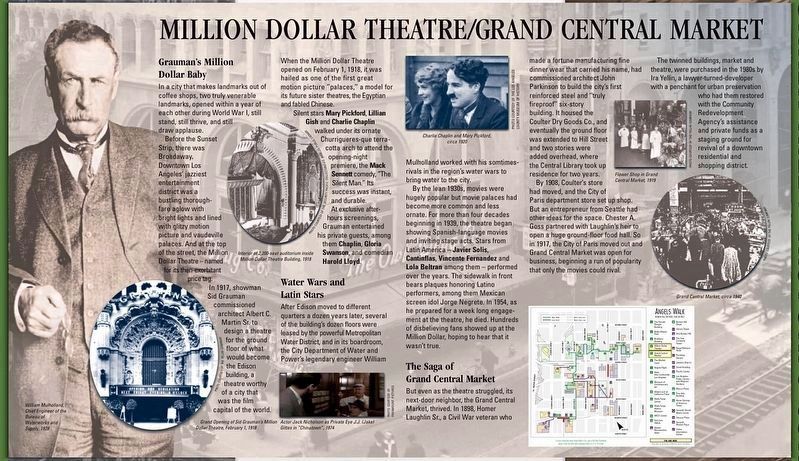
In a city that makes landmarks out of coffee shops, two truly venerable landmarks, opened within a year of each other during World War I, still stand, still thrive, and still draw applause. Before the Sunset Strip, there was Broadway. Downtown Los Angeles' jazziest entertainment district was a bustling thoroughfare aglow with bright lights and lined with glitzy motion picture and vaudeville palaces. And at the top of the street, the Million Dollar Theatre — named for its then-exorbitant price tag.
In 1917, showman Sid Grauman commissioned architect Albert C. Martin Sr. to design a theatre for the ground floor of what would become the Edison building, a theatre worthy of a city that was the film capital of the world.
When the Million Dollar Theatre opened on February 1, 1918, it was hailed as one of the first great motion picture "palaces," a model for its future sister theatres, the Egyptian and fabled Chinese.
Silent stars Mary Pickford, Lillian Gish and Charlie Chaplin walked under its ornate Churrigueresque terra-cotta arch to attend the opening-night premiere, the
this page online
At exclusive after-hours screenings, Grauman entertained his private guests, among them Chaplin, Gloria Swanson, and comedian Harold Lloyd.
Water Wars and Latin Stars
After Edison moved to different quarters a dozen years later, several of the building's dozen floors were leased by the powerful Metropolitan Water District, and in its boardroom, the City Department of Water and Power's legendary engineer William Mulholland worked with his somtimes-rivals in the region's water wars to bring water to the city.
By the lean 1930s, movies were hugely popular but movie palaces had become more common and less ornate. For more than four decades beginning in 1939, the theatre began showing Spanish language movies and inviting stage acts. Stars from Latin America — Javier Solis, Cantinflas, Vincente Fernandez and Lola Beltran among them — performed over the years. The sidewalk in front bears plaques honoring Latino performers, among them Mexican screen idol Jorge Negrete. In 1954, as he prepared for a week long engagement at the theatre, he died. Hundreds
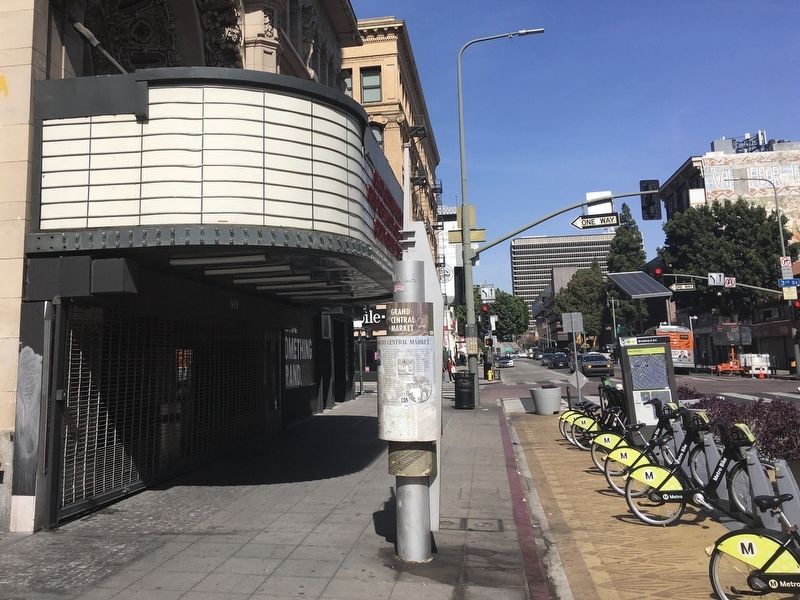
Photographed by Craig Baker, February 28, 2021
2. Million Dollar Theatre Marker
The Saga of Grand Central Market
But even as the theatre struggled, its next-door neighbor, the Grand Central Market, thrived. In 1898, Homer Laughlin Sr., a Civil War veteran who made a fortune manufacturing fine dinner wear that carried his name, had commissioned architect John Parkinson to build the city's first reinforced steel and "truly fireproof" six-story building. It housed the Coulter Dry Goods Co., and eventually the ground floor was extended to Hill Street and two stories were added overhead, where the Central Library took up residence for two years.
By 1908, Coulter's store had moved, and the City of Paris department store set up shop. But an entrepreneur from Seattle had other ideas for the space. Chester A. Goss partnered with Laughlin's heir to open a huge ground-floor food hall. So in 1917, the City of Paris moved out and Grand Central Market was open for business, beginning a run of popularity that only the movies could rival.
The twinned buildings, market and theatre, were purchased in the 1980s by Ira Yellin,
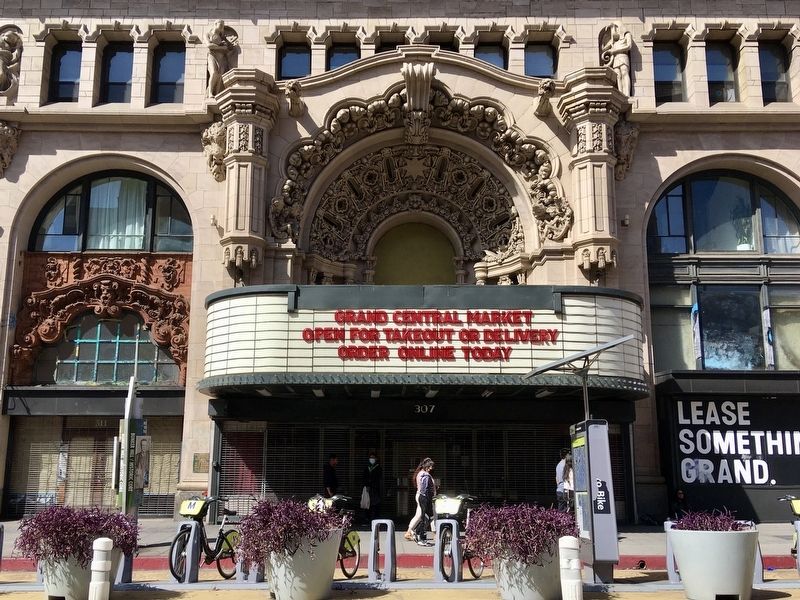
Photographed by Craig Baker, February 28, 2021
3. Million Dollar Theatre and Marker
Erected 1997 by City of Los Angeles. (Marker Number 1183.)
Topics and series. This historical marker is listed in these topic lists: Architecture • Entertainment • Industry & Commerce. In addition, it is included in the Los Angeles Historic-Cultural Monument series list. A significant historical date for this entry is February 1, 1918.
Location. 34° 3.049′ N, 118° 14.9′ W. Marker is in Los Angeles, California, in Los Angeles County. It is in Downtown Los Angeles. It is at the intersection of Broadway and 3rd Street, on the right when traveling south on Broadway. Touch for map. Marker is at or near this postal address: 307 S Broadway, Los Angeles CA 90013, United States of America. Touch for directions.

Regionally, this marker is in the Transverse Ranges. It is also on the American Pacific Coast. Globally, it is in North America, on the Ring of Fire, on the Pacific Rim, in the Western Hemisphere,
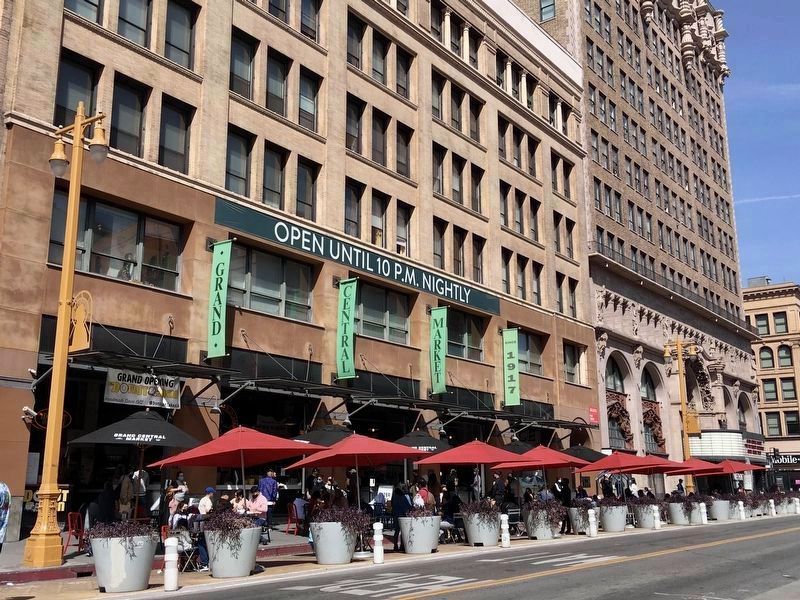
Photographed by Craig Baker, February 28, 2021
4. Grand Central Market, and Million Dollar Theatre
Other nearby markers. At least 8 other markers are within walking distance of this marker: Bradbury Building (within shouting distance of this marker); Irvine-Byrne Building (within shouting distance of this marker); Biddy Mason (about 300 feet away, measured in a direct line); Douglas Building (about 400 feet away); Spring Street (about 500 feet away); Angels Flight (about 500 feet away); Angels Flight Railway (about 500 feet away); a different marker also named Angels Flight (about 700 feet away). Touch for a list and map of all markers in Los Angeles.
Regarding Million Dollar Theatre/Grand Central Market. In 1978, the Million Dollar Theatre was listed in the National Register of Historic Places and is part of the Broadway Theater District.
In 2019, Grand Central Market was declared Los Angeles Historic-Cultural Monument No. 1183.
Also see . . . Angels walk LA. Self-guided walking tours of historic neighborhoods in Los Angeles. This marker is part of the Bunker Hill walk. (Submitted on October 2, 2024.)
Credits. This page was last revised on May 21, 2026. It was originally submitted on March 1, 2021, by Craig Baker of Sylmar, California. This page has been viewed 12,996 times since then and 1,939 times this year. Photos: 1, 2, 3, 4. submitted on March 1, 2021, by Craig Baker of Sylmar, California. • J. Makali Bruton was the editor who published this page.
