Near West Augusta in Augusta County, Virginia — The American South (Mid-Atlantic)
“We had a hardscramble up…”

Photographed by Robert H. Moore, II, February 27, 2009
1. “We had a hardscramble up…” Marker
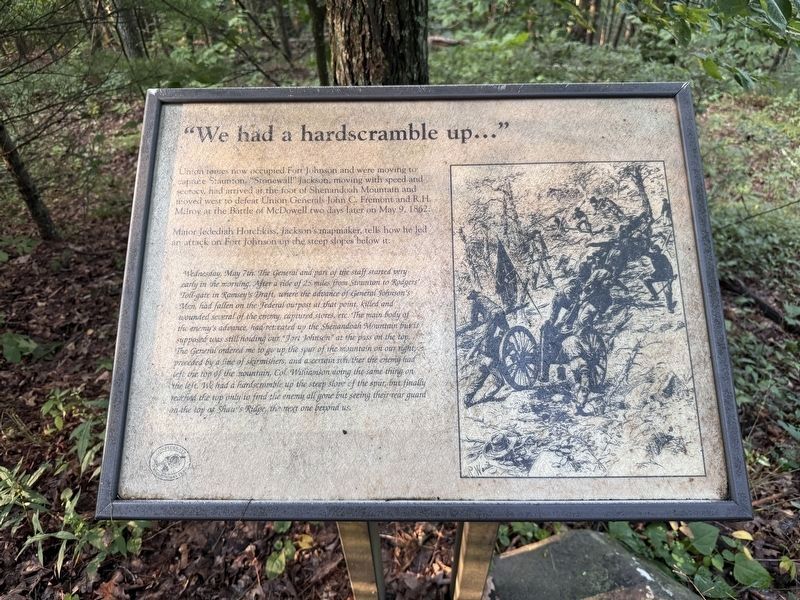
Union forces now occupied Fort Johnson and were moving to capture Staunton. “Stonewall” Jackson, moving with speed and secrecy, had arrived at the foot of Shenandoah Mountain and moved west to defeat Union Generals John C. Fremont and R.H. Milroy at the Battle of McDowell two days later on May 9, 1862.
Major Jedediah Hotchkiss, Jackson’s mapmaker, tells how he led an attack on Fort Johnson up the steep slopes below it:
Wednesday, May 7th. The General and part of the staff started very early this morning. After a ride of 25 miles from Staunton to Rodgers’ Toll-gate in Ramsey’s Draft, where the advance of General Johnson’s Men, had fallen on the Federal outpost at that point, killed and wounded several of the enemy, captured stores, etc. The main body of the enemy advance, had retreated up the Shenandoah Mountain but is supposed was still holding our “Fort Johnson” at the pass on the top. The General ordered me to go up the spur of the mountain on our right, preceded by a line of skirmishers, and ascertain whether the enemy had left the top of the mountain, Col. Williamson doing the same thing on the left. We had a hardscramble up the steep slope of the spur, but finally reached the top only to find the enemy all gone but seeing their rear guard on the top of Shaw’s Ridge, the next one beyond us.
Erected by Forest
this page online
Topics. This historical marker is listed in this topic list: War, US Civil. A significant historical month for this entry is May 1862.
Location. 38° 18.78′ N, 79° 22.933′ W. Marker is near West Augusta, Virginia, in Augusta County. It can be reached from U.S. 250 4.8 miles east of State Route 614, on the right when traveling west. Part of the “Confederate Breastworks Trail” at Fort Edward Johnson. Touch for map. Marker is in this post office area: West Augusta VA 24485, United States of America. Touch for directions.

Regionally, this marker is in Virginia’s Shenandoah Valley. It is also in the American South and specifically in the Upper South. Globally, it is in North America, the Western Hemisphere, the Western World, and the Anglosphere. Historically, it finds itself in what was once the territory of the Mississippian Culture, one of the original Thirteen Colonies, one of the Confederate States of America, and the Antebellum South.
Other nearby markers. At least 8 other markers are within walking distance of this marker: “Wee are now looking out for a fight…” (within shouting
Photographed by Devry Becker Jones (CC0), August 8, 2026
2. “We had a hardscramble up…” Marker
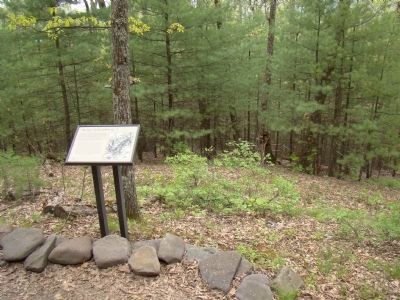
The marker has weathered but remains generally legible.
More about this marker. On the right is a drawing depicting Confederate soldiers bringing a cannon up the steep mountain slopes.
Related markers. Click here for a list of markers that are related to this marker. To better understand the relationship, study each marker in the order shown.
Photographed by J. J. Prats, May 2, 2010
3. “We had a hardscramble up…” Marker
Credits. This page was last revised on August 8, 2026. It was originally submitted on March 6, 2009, by Robert H. Moore, II of Winchester, Virginia. This page has been viewed 1,355 times since then and 23 times this year. Last updated on August 27, 2024, by Carl Gordon Moore Jr. of North East, Maryland. Photos: 1. submitted on March 6, 2009, by Robert H. Moore, II of Winchester, Virginia. 2. submitted on August 8, 2026, by Devry Becker Jones of Washington, District of Columbia. 3. submitted on May 5, 2010, by J. J. Prats of Powell, Ohio. • Devry Becker Jones was the editor who published this page.
