Woodland near Wilmington in New Castle County, Delaware — The American Northeast (Mid-Atlantic)
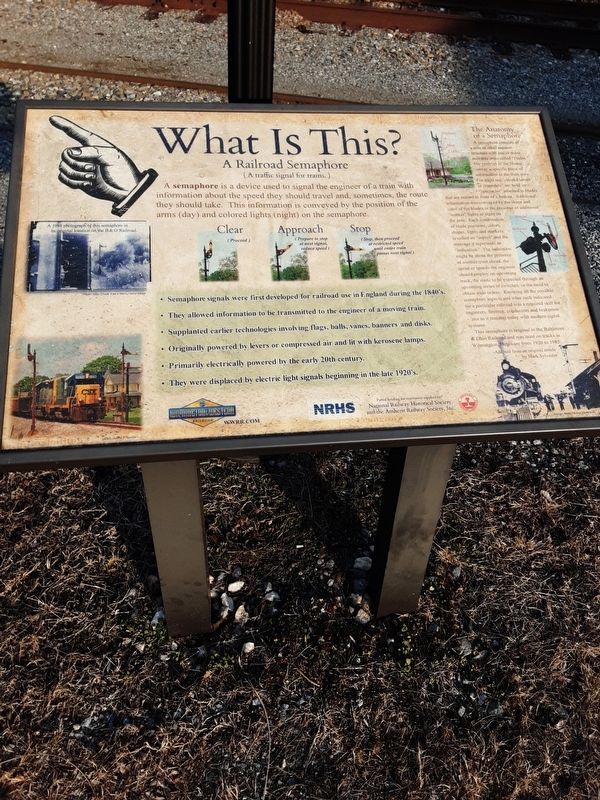
What Is This?
A Railroad Semaphore
| — | (A traffic signal for trains.) | — |
Photographed by Carl Gordon Moore Jr., March 11, 2021
1. What Is This? Marker
A semaphore is a device used to signal the engineer of a train with information about the speed they should travel and, sometimes, the route they should take. This information is conveyed by the position of the arms (day) and colored lights (night) on the semaphore.
Clear (Proceed)
Approach (Prepare to stop at next signal, reduce speed)
Stop (Stop, then proceed at restricted speed until entire train passes next signal)
• Semaphore signals were first developed for railroad use in England during the 1840's.
• They allowed information to be transmitted to the engineer of a moving train.
• Supplanted earlier technologies involving flags, balls, vanes, banners and disks.
• Originally powered by levers or compressed air and lit with kerosene lamps.
• Primarily electrically powered by the early 20th century.
• They were displaced by electric light signals beginning in the late 1920's.
[1st photo at left:]
A 1984 photogrnph of this semaphore in its original location on the B&O Railroad.
Photo: Mike Closek from a film by Steve Jensen
[2nd photo at left:]
photo: Aaron J. Border
[1st photo at right:]
Platform
this page online
[2nd photo at right:]
Pinnacle [,] Roundels [,] Blade [,] Mechanism [,] Spectacle [,] Lamp
[sketch at lower right:]
Design: Betsy Molina Mortensen
The Anatomy of a Semaphore
A semaphore consists of a pole or other support structure with one or more movable arms called "Blades." The position of the blades convey[s] a specific piece of information to the train crew. For night use, colored lenses or roundels are held in "spectacles" attached to blades that are moved in front of a lantern. Additional information was conveyed by the shape and color of the blades or the presence of additional "marker" lights or signs on the pole. Each combination of blade positions, colors, shapes, lights and markers is called an "aspect” and the message it represents an indication.” The indication might be about the presence of another train ahead, the speed or speeds the engineer should employ on upcoming track, the route to be expected through an upcoming series of switches. or the need to obtain train orders. Knowing all the possible semaphore aspects and what each indicated for a particular railroad was a required
Photographed by Carl Gordon Moore Jr., March 19, 2021
2. What Is This? Marker
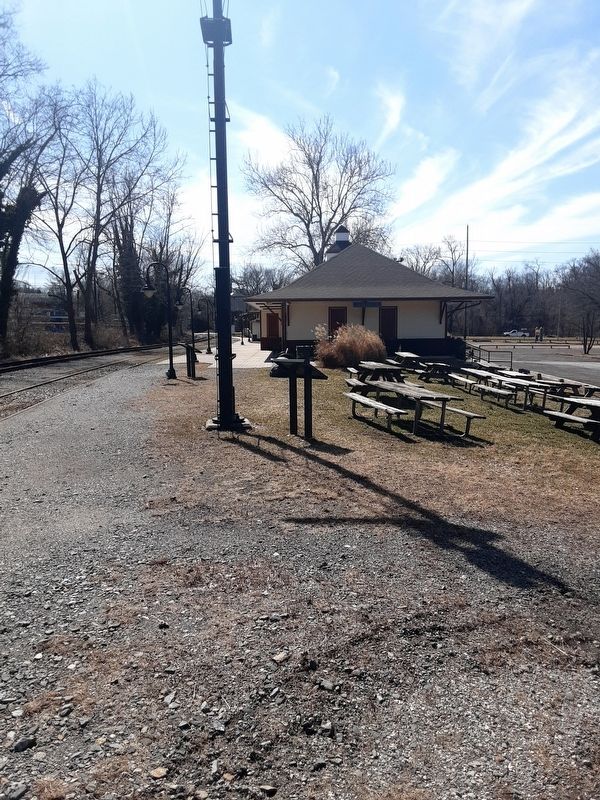
In background is the Greenbank station building. In the foreground, directly in front of the left of the building, is the "How a Steam Locomotive Works" plaque. Further back, next to a light standard, and not as far back as the building, is this ("What Is This?") plaque.
This semaphore is original to the Baltimore & Ohio Railroad and was used on tracks in Wilmington, Delaware from 1920 to 1985.
-Adapted from an original article by Mark Sylvester
National Railway Historical Society
and the Amherst Railway Society, Inc.
Wilmington & Western Railroad
wwrr.com
Topics. This historical marker is listed in this topic list: Railroads & Streetcars. A significant historical year for this entry is 1920.
Location. 39° 44.347′ N, 75° 37.919′ W. Marker is near Wilmington, Delaware, in New Castle County. It is in Woodland. It can be reached from Greenbank Road. This is on the grounds of the Wilmington & Western Railroad. It is near the railroad track to south of Greenbank Road, near the Greenbank station, which is south of this plaque. Touch for map. Marker is in this post office area: Wilmington DE 19808, United States of America. Touch for directions.

Regionally, this marker is in Greater Philadelphia. It is also in the American Mid-Atlantic, on the Delmarva Peninsula, and on the Eastern Seaboard. Globally, it is in the North Atlantic Region, North America, the Western Hemisphere, the Western World, and the Anglosphere. Historically, it finds itself in what was once New Netherland and also one of the original Thirteen Colonies.
Other nearby markers. At least 8 other markers are within walking distance of this marker: How a Steam Locomotive Works (here, next to this marker); Greenbank Mill (about 400 feet away, measured in a direct line); Wilmington & Western Railroad (about 400 feet away); The Lynching of George White (about 600 feet away); The "Annie Oakleys": First Female Prison Guards in the United States (about 700 feet away); New Castle County Workhouse-Women's Ward, 1929-1975 (approx. ¼ mile away); Fells Mill Historic District (approx. 0.7 miles away); The Home of William Julius "Judy" Johnson (approx. ¾ mile away). Touch for a list and map of all markers in Wilmington.
Credits. This page was last revised on February 13, 2023. It was originally submitted on March 12, 2021, by Carl Gordon Moore Jr. of North East, Maryland. This page has been viewed 452 times since then and 31 times this year. Photos: 1. submitted on March 12, 2021, by Carl Gordon Moore Jr. of North East, Maryland. 2. submitted on March 20, 2021, by Carl Gordon Moore Jr. of North East, Maryland. • Bill Pfingsten was the editor who published this page.
