Collinsville in Madison County, Illinois — The American Midwest (Great Lakes)
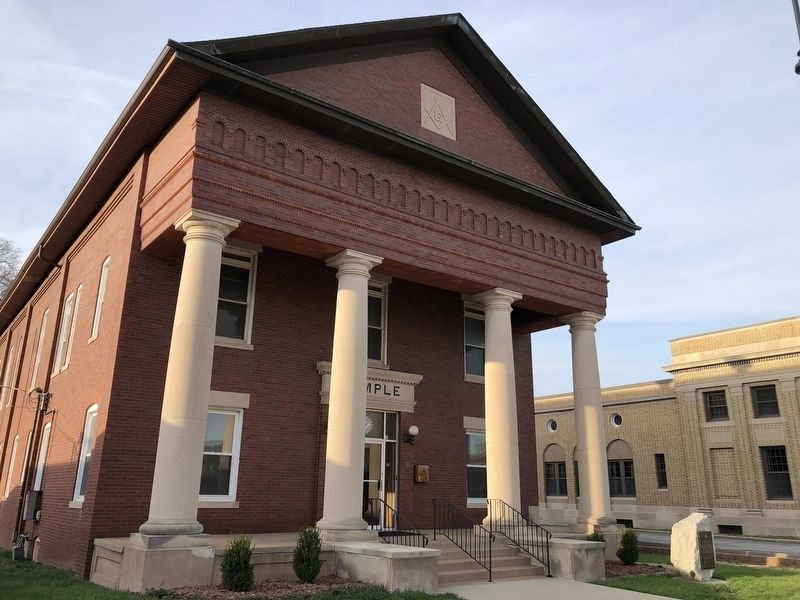
Collinsville Masonic Temple
212 West Clay Street
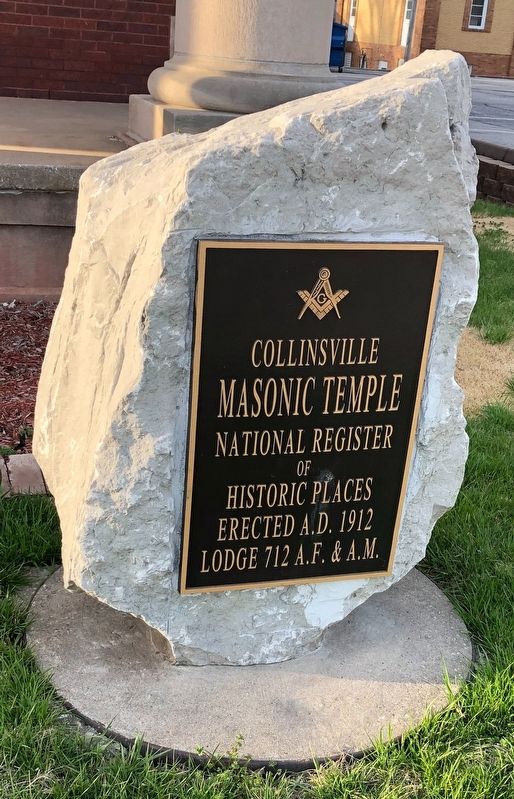
Erected by Collinsville Masonic Temple.
Topics. This historical marker is listed in these topic lists: Architecture • Fraternal or Sororal Organizations. A significant historical year for this entry is 1912.
Location. 38° 40.232′ N, 89° 59.314′ W. Marker is in Collinsville, Illinois, in Madison County. It is on West Clay Street just west of North Clinton Street, on the right when traveling west. Touch for map. Marker is at or near this postal address: 213 W Clay St, Collinsville IL 62234, United States of America. Touch for directions.

Regionally, this marker is in Greater St. Louis. It is also in the American Midwest, in the Lewis & Clark Corridor, in the Corn Belt, and in the Great River Road Region. Globally, it is in North America, the Western Hemisphere, the Western World, and the Anglosphere. Historically, it finds itself in what was once the territory of the Mississippian Culture and also the Northwest Territory.
Other nearby markers. At least 8 other markers are within walking distance of this marker: City of Collinstown Uptown Tour (about 800 feet away, measured in a direct line); The Magnolia Tree (approx. 0.2 miles away); The Dorris Fountain (approx. 0.2 miles away); The Collinsville Historical Museum (approx. 0.2 miles away); The 1937 Main Building (approx. 0.2 miles away); Pan (approx. 0.2 miles away); The Freedom Tree (approx. 0.2 miles away); Spanish War Veterans (approx. 0.2 miles away). Touch for a list and map of all markers in Collinsville.
Also see . . . National Register of Historic Places Nomination form for the Collinsville Masonic Temple.
This form was prepared on September 1, 2004 by Mark Schusky of the Collinsville Historic Preservation Commission. A statement of
this page online
The CoUinsville Masonic Temple is eligible for listing in the National Register under both Criterion A for social history and Criteria C as a good local example of Classical Revival architecture. The period of significance is from 1912, the year it was built, until 1955, the fifty-year cut-off for significance for the National Register.(Submitted on December 21, 2025, by Devry Becker Jones of Washington, District of Columbia.)
Credits. This page was last revised on December 21, 2025. It was originally submitted on March 28, 2021, by Devry Becker Jones of Washington, District of Columbia. This page has been viewed 463 times since then and 50 times this year. Photos: 1, 2. submitted on March 28, 2021, by Devry Becker Jones of Washington, District of Columbia.
