Near Jerome in Drew County, Arkansas — The American South (West South Central)
Jerome Relocation Center
1942 – 1944
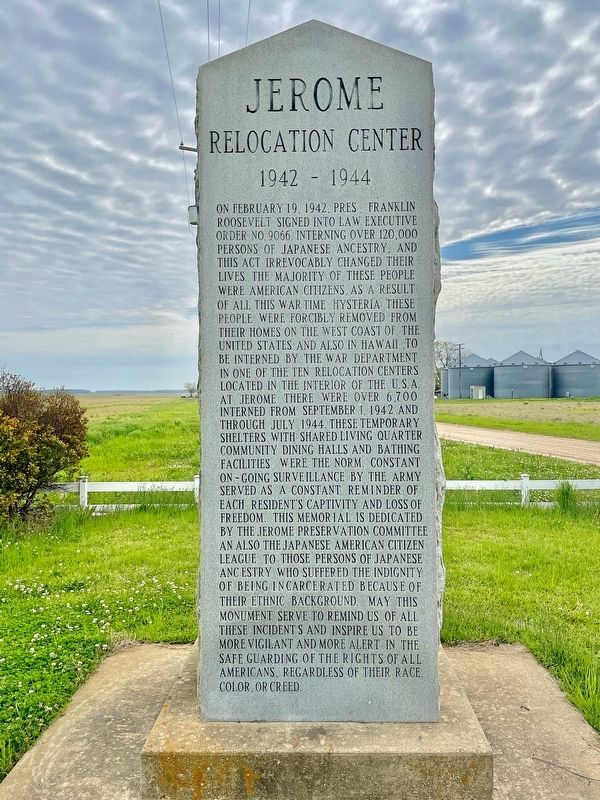
Photographed by Mark Hilton, April 5, 2021
1. Jerome Relocation Center Marker
this page online
Topics. This historical marker is listed in these topic lists: Asian Americans • War, World II. A significant historical date for this entry is February 19, 1942.
Location. 33° 24.71′ N, 91° 27.717′ W. Marker is near Jerome, Arkansas, in Drew County. It is on U.S. 165 near Ellington Farm Road (County Road 210), on the right when traveling north. Touch for map. Marker is at or near this postal address: 140 Ellington Farm Rd, Dermott AR 71638, United States of America. Touch for directions.

Regionally, this marker is in the Gulf Coastal Plain, specifically in the Mississippi Alluvial Plain, in Timberlands, and in the Quapaw Homeland. It is also in the American South, specifically in the Deep South, in the Upper South, and in the Piney Woods. Globally, it is in North America, the Western Hemisphere, the Western World, and the Anglosphere. Historically, it finds itself in what was once the territory of the Mississippian Culture, the Louisiana Purchase, one of the Confederate
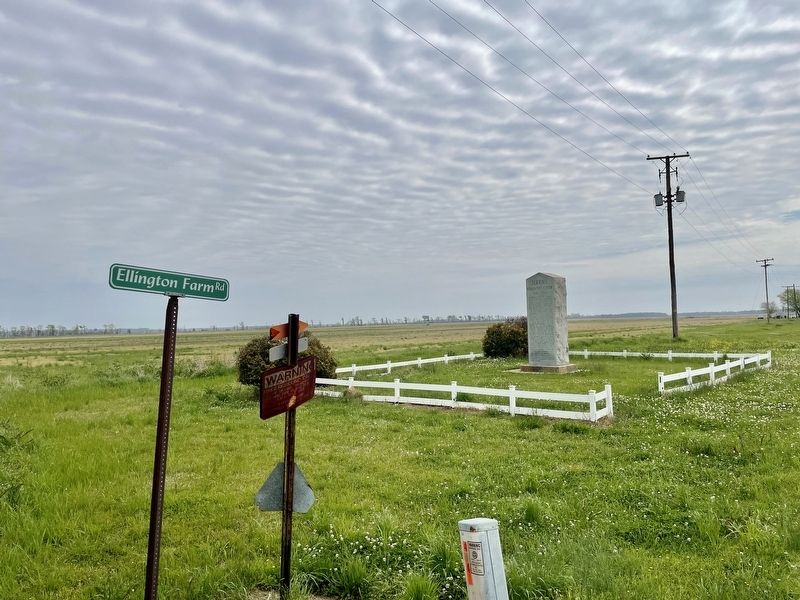
Photographed by Mark Hilton, April 5, 2021
2. Jerome Relocation Center Marker
Other nearby markers. At least 8 other markers are within 12 miles of this marker, measured as the crow flies: Early Railroads in Chicot County (approx. 8.2 miles away); New Hope Missionary Baptist Church (approx. 11.6 miles away); Chicot County Veterans Memorial (approx. 11.8 miles away); Chicot County (approx. 11.8 miles away); Chicot County Confederate Monument (approx. 11.8 miles away); Italian Immigrants On Sunnyside Plantation (approx. 11.8 miles away); Col. Charles A. Lindbergh (approx. 11.9 miles away); Colonel Charles A. Lindbergh (approx. 11.9 miles away).
Also see . . . Densho Encyclopedia article on the Jerome Relocation Center. (Submitted on April 7, 2021, by Mark Hilton of Montgomery, Alabama.)
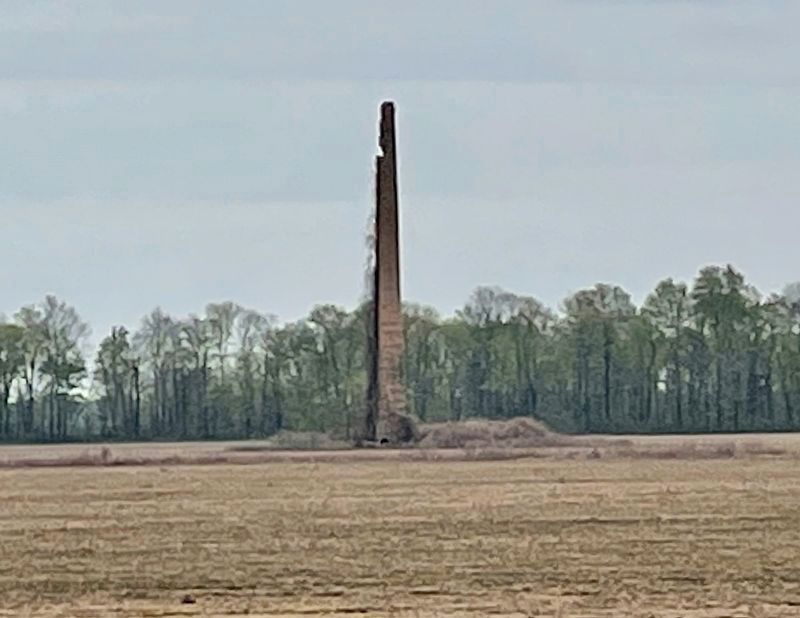
Photographed by Mark Hilton, April 5, 2021
3. Remaining hospital laundry smokestack of the Jerome Relocation Center.
A white fence, some foundations from some of the administration buildings, and one of the hospital laundry smokestacks are all that remain of a facility that housed 8,497 at its zenith. After closing, it was used as a German POW camp until the end of the war in Europe. The smokestack is located within sight of the monument.
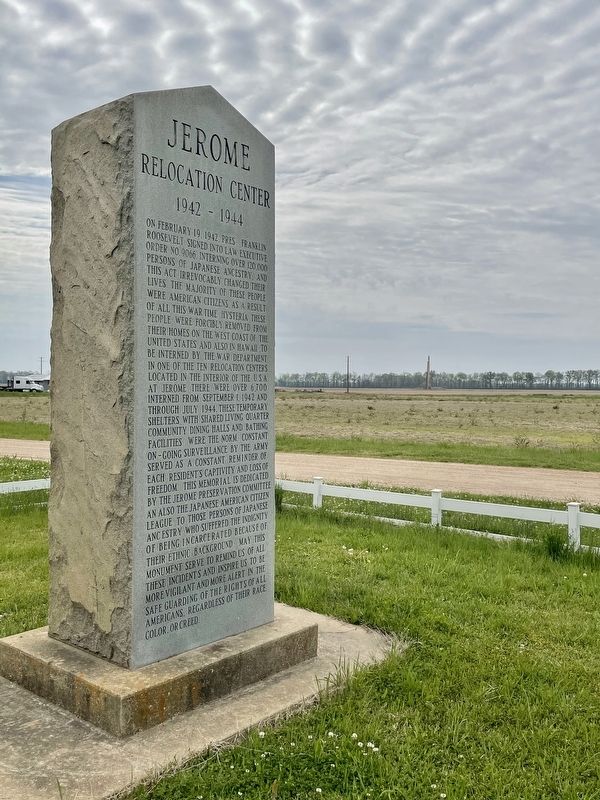
Photographed by Mark Hilton, April 5, 2021
4. Remaining smokestack can be seen in far background right of center.
Credits. This page was last revised on April 7, 2021. It was originally submitted on April 7, 2021, by Mark Hilton of Montgomery, Alabama. This page has been viewed 766 times since then and 78 times this year. Photos: 1, 2, 3, 4. submitted on April 7, 2021, by Mark Hilton of Montgomery, Alabama.
