Moorhead in Sunflower County, Mississippi — The American South (East South Central)
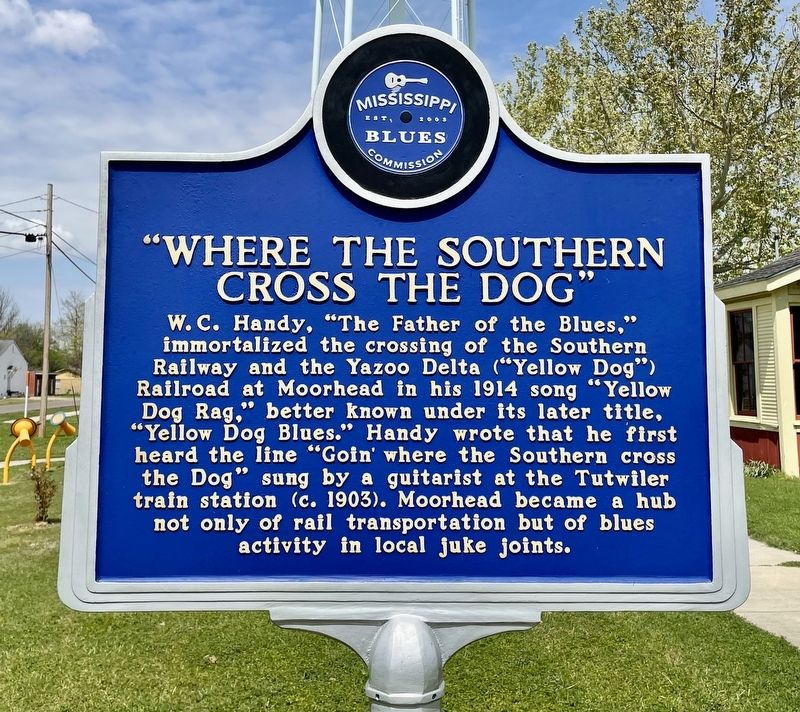
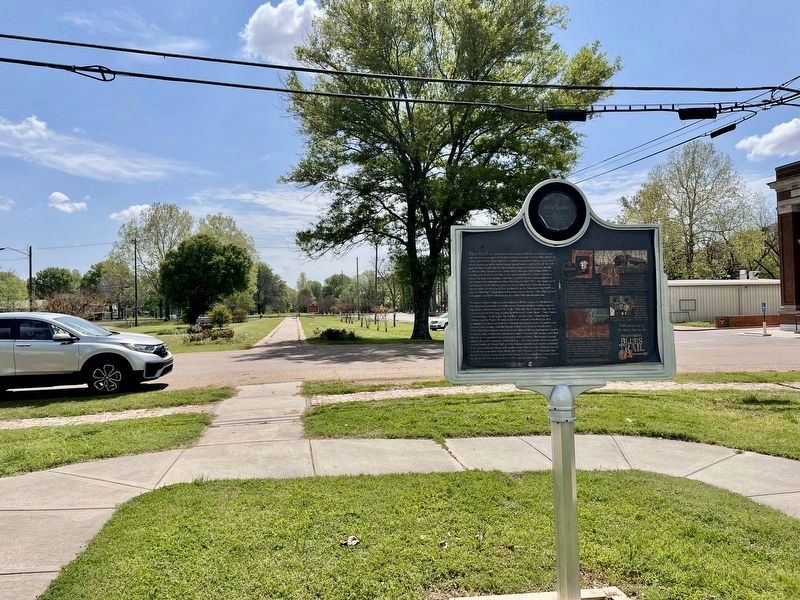
"Where the Southern Cross the Dog"
Photographed by Mark Hilton, April 5, 2021
1. "Where the Southern Cross the Dog" Marker
Inscription.
W. C. Handy, "The Father of the Blues," immortalized the crossing of the Southern Railway and the Yazoo Delta ("Yellow Dog") Railroad at Moorhead in his 1914 song "Yellow Dog Rag," better known under its later title, "Yellow Dog Blues." Handy wrote that he first heard the line "Goin' where the Southern cross the Dog" sung by a guitarist at the Tutwiler train station (c. 1903). Moorhead became a hub not only of rail transportation but of blues activity in local juke joints.
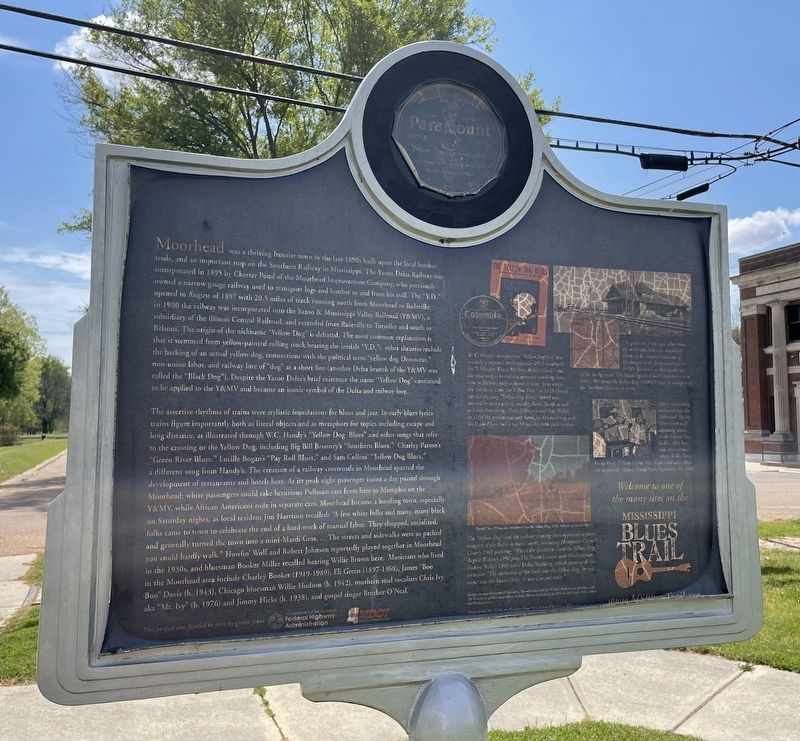
[Reverse] Moorhead was a thriving frontier town in the late 1890s built upon the local lumber trade, and an important stop on the Southern Railway in Mississippi. The Yazoo Delta Railway was incorporated in 1895 by Chester Pond of the Moorhead Improvement Company, who previously owned a narrow gauge railway used to transport logs and lumber to and from his mill. The “Y.D.” opened in August of 1897 with 20.5 miles of track running north from Moorhead to Ruleville; in 1900 the railway was incorporated into the Yazoo & Mississippi Valley Railroad (Y&MV), a subsidiary of the Illinois Central Railroad, and extended from Ruleville to Tutwiler
Click or scan to see this page online
and south to Belzoni. The origin of the nickname “Yellow Dog” is debated. The most common explanation is that it stemmed from yellow-painted rolling stock bearing the initials “Y.D.”; other theories include the barking of an actual yellow dog, connections with the political term “yellow dog Democrat,” non-union labor, and railway lore of “dog” as a short line (another Delta branch of the Y&MV was called the “Black Dog”). Despite the Yazoo Delta’s brief existence the name “Yellow Dog” continued to be applied to the Y&MV and became an iconic symbol of the Delta and railway lore.
The assertive rhythms of trains were stylistic foundations for blues and jazz. In early blues lyrics trains figure importantly both as literal objects and as metaphors for topics including escape and long distance, as illustrated through W.C. Handy’s “Yellow Dog Blues” and other songs that refer to the crossing or the Yellow Dog, including Big Bill Broonzy’s “Southern Blues,” Charley Patton’s “Green River Blues,” Lucille Bogan’s “Pay Roll Blues,”
Photographed by Mark Hilton, April 5, 2021
2. "Where the Southern Cross the Dog" Marker (reverse)
and Sam Collins’ “Yellow Dog Blues,” a different song from Handy’s. The creation of a railway crossroads in Moorhead spurred the development of restaurants and hotels here. At its peak eight passenger trains a day passed through Moorhead; white passengers could take luxurious Pullman cars from here to Memphis on the Y&MV, while African Americans rode in separate cars. Moorhead became a bustling town, especially on Saturday nights, as local resident Jim Harrison recalled: “A few white folks and many, many black folks came to town to celebrate the end of a hard week of manual labor. They shopped, socialized, and generally turned the town into a mini-Mardi Gras. . . The streets and sidewalks were so packed you could hardly walk.” Howlin’ Wolf and Robert Johnson reportedly played together in Moorhead in the 1930s, and bluesman Booker Miller recalled hearing Willie Brown here. Musicians who lived in the Moorhead area include Charley Booker (1919-1989), Eli Green (1897-1968), James “Boo Boo” Davis (b. 1943), Chicago bluesman Willie Hudson (b. 1942), southern soul vocalists Chris Ivy aka “Mr. Ivy”
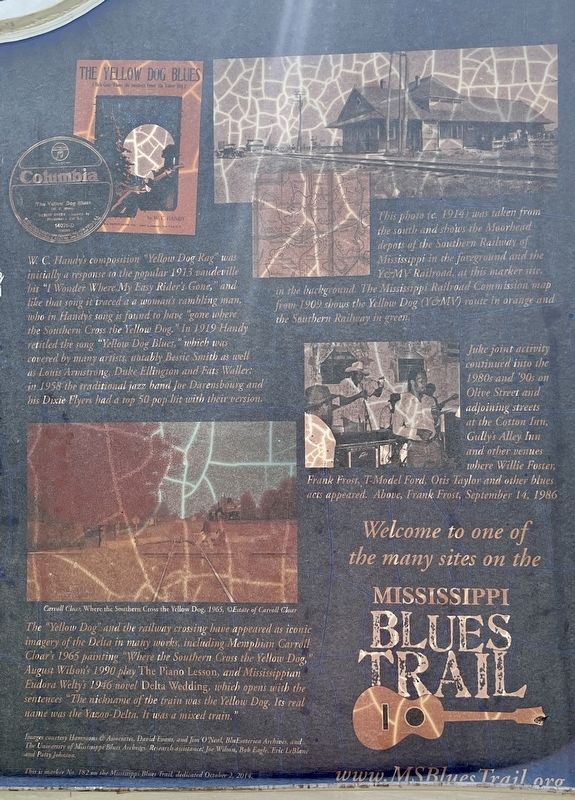
Photographed by Mark Hilton, April 5, 2021
3. Close-up of photos on reverse.
(b. 1976) and Jimmy Hicks (b. 1938), and gospel singer Brother O’Neal.
Erected 2014 by the Mississippi Blues Commission. (Marker Number 182.)
Location. 33° 27.021′ N, 90° 30.419′ W. Marker is in Moorhead, Mississippi, in Sunflower County. It is on Washington Street west of East Delta Avenue, on the right when traveling west. Touch for map. Marker is in this post office area: Moorhead MS 38761, United States of America. Touch for directions.
Regionally, this marker is in the American South, specifically in the Deep South, and in the Mississippi Delta. Globally, it is in North America, a Gulf of Mexico state, the Western Hemisphere, the Western World, and the Anglosphere. Historically, it finds itself in what was once the territory of the Mississippian Culture, one of the Confederate States of America, and the Antebellum South.
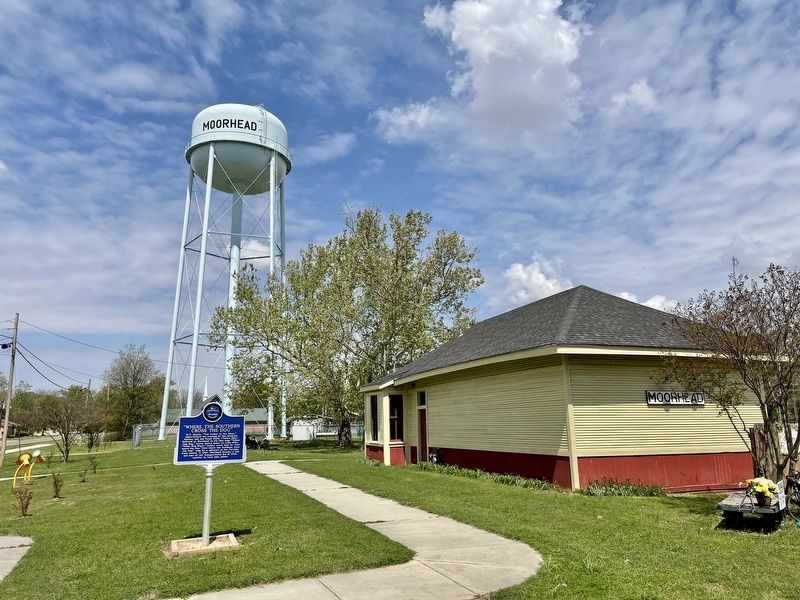
A State of Mississippi marker with a similar title, "Where The Southern Crosses The Dog" can barely be seen at the far end of the path.
Credits. This page was last revised on April 9, 2021. It was originally submitted on April 9, 2021, by Mark Hilton of Montgomery, Alabama. This page has been viewed 772 times since then and 55 times this year. Photos:1, 2, 3, 4, 5. submitted on April 9, 2021, by Mark Hilton of Montgomery, Alabama.