Near Orange in Orange County, Virginia — The American South (Mid-Atlantic)
Campaign of Second Manassas
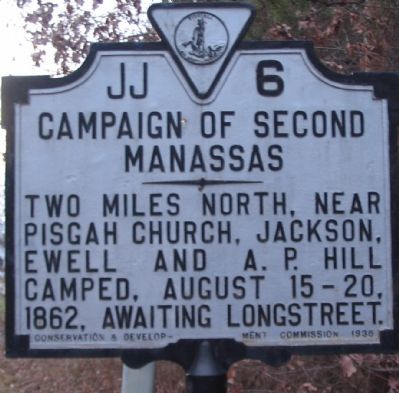
Photographed by Craig Swain, January 5, 2008
1. Campaign of Second Manassas Marker
Erected 1935 by Conservation & Development Commission. (Marker Number JJ-6.)
Topics and series. This historical marker is listed in this topic list: War, US Civil. In addition, it is included in the Virginia Department of Historic Resources (DHR) series list. A significant historical date for this entry is August 15, 1862.
Location. 38° 15.439′ N, 78° 0.71′ W. Marker is near Orange, Virginia, in Orange County. It is at the intersection of Constitution Highway (Virginia Route 20) and Clifton Road (County Route 628), on the right when traveling west on Constitution Highway. Touch for map. Marker is in this post office area: Orange VA 22960, United States of America. Touch for directions.

Regionally, this marker is in Northern Virginia and in the Piedmont. It is also in the American South and specifically in the Upper South. Globally, it is in North America, the Western Hemisphere, the Western World, and the Anglosphere. Historically, it finds itself in what was once the territory of the Mississippian Culture,
this page online
Other nearby markers. At least 8 other markers are within 5 miles of this marker, measured as the crow flies: Elder John Leland (within shouting distance of this marker); Bloomsbury (approx. 2.3 miles away); a different marker also named Bloomsbury (approx. 2.3 miles away); Isabella Lightfoot Training School (approx. 3.1 miles away); Lee's Headquarters (approx. 3.6 miles away); Locust Grove (approx. 4.6 miles away); Historical Rapidan Virginia (approx. 4.7 miles away); Campaign of 1781 (approx. 4.7 miles away). Touch for a list and map of all markers in Orange.
Also see . . . Aftermath of Cedar Mountain. This Civil War Traveler blog post explains the site of Jackson's camp and Mount Pisgah Meeting House in the section titled "Where were the deserters executed?" (Submitted on July 24, 2026, by Evan Dwyer of Richmond, Virginia.)
Additional commentary.
1. Pisgah Church
The place name Pisgah Church should refer to Mt. Pisgah Church to the north of Orange and to the west of Rapidan, and thus much more than
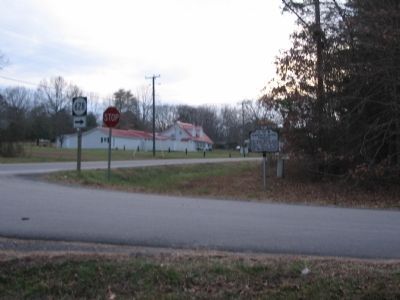
Photographed by Craig Swain, January 5, 2008
2. Campaign of Second Manassas Marker
— Submitted January 13, 2008, by Craig Swain of Leesburg, Virginia.
2. Pisgah Church
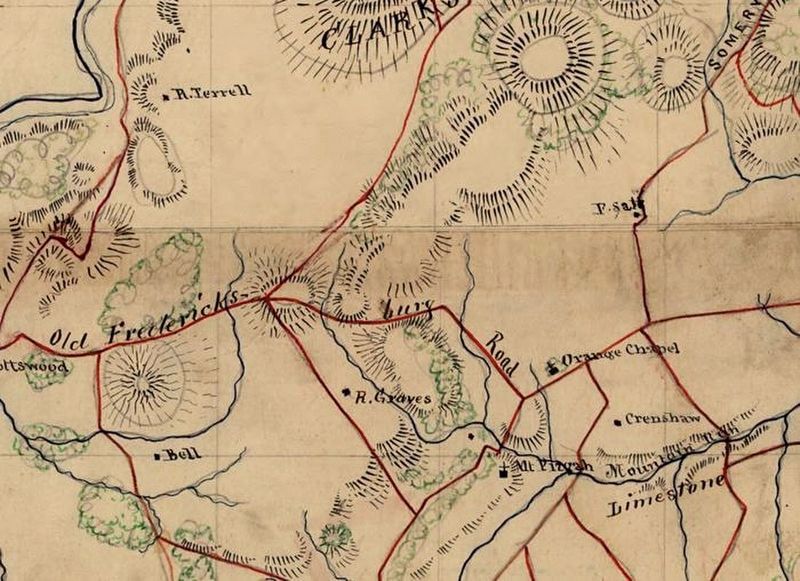
The marker refers to the 1830s "Mount Pisgah Meeting House" and 1856 brick Pisgah Church which both stood just south of Clark Mountain - not the modern 1890s Mount Pisgah Baptist Church several miles east between Burr Hill and Raccoon Ford. The congregation of Methodists that built the 1856 church (which replaced in function the old wooden meeting house, though both still stood) moved to Unionville in 1906 with the construction of Bethlehem Methodist, now replaced by Unionville Christian Church. Episcopalians briefly used the 1856 church afterwards the Methodists shifted to Unionville. Both buildings were torn down - the 1856 church was demolished last, in 1950. According to Civil War era maps, the road route of modern Clarks Mountain Road follows the Old Fredericksburg Road right of way - placing the 1830s wooden meeting
Photographed by Walter Izard, 1989
3. Map of Orange County
Drawn by Walter Izard for the Library of Congress, date and scale derived from Stephenson's Civil War maps. Note the two churches - Orange Chapel and Mt. Pisgah. Orange Chapel was the 1830s "Old Pisgah" Meeting House and Mt. Pisgah was the 1856 Brick Church. Compare the road shape to the path of modern Clarks Mountain Road (VA-627)
Modern Mount Pisgah in True Blue was constructed in 1894 and is not the place referenced by this 1930s marker.
— Submitted July 24, 2026, by Evan Dwyer of Richmond, Virginia.
Photographed by Walter Izard, 1989
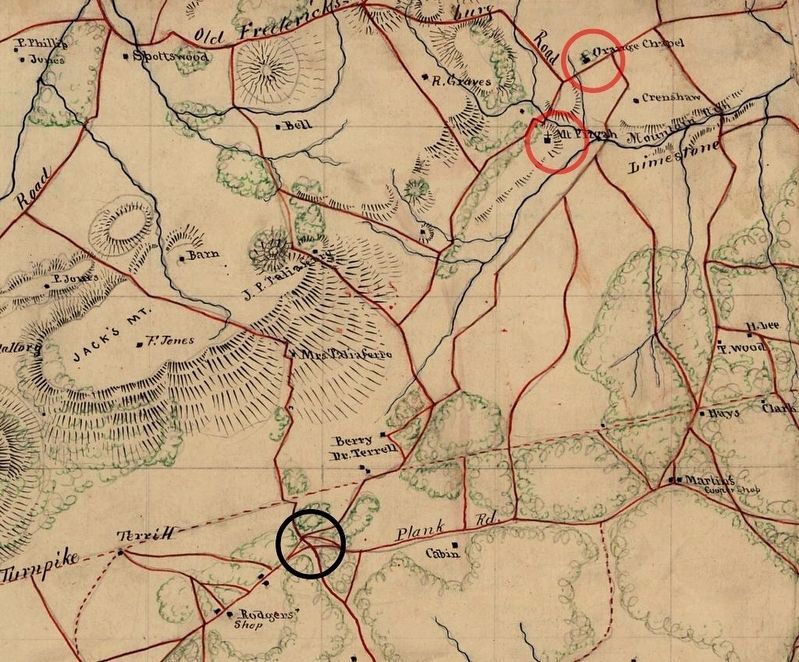
4. Map of Orange County
This is a wider area of the same map shown in the preceding image. The black circle (added by uploader) is the intersection where the marker stands. The two red circles (also added by uploader) show the Pisgah church clusters relative to the marker. The distance north to the 1856 chapel site: 2.15 miles. Distance from the marker to the old meeting house site: 2.5 miles. The connection to the 1894 Mount Pisgah Baptist Church 9.2 miles to the northeast is a mistaken assumption and incorrect.
Credits. This page was last revised on July 26, 2026. It was originally submitted on January 13, 2008, by Craig Swain of Leesburg, Virginia. This page has been viewed 1,664 times since then and 41 times this year. Last updated on April 12, 2021, by Carl Gordon Moore Jr. of North East, Maryland. Photos: 1, 2. submitted on January 13, 2008, by Craig Swain of Leesburg, Virginia. 3, 4. submitted on July 24, 2026, by Evan Dwyer of Richmond, Virginia. • Bernard Fisher was the editor who published this page.
