Mount Vernon in Baltimore, Maryland — The American Northeast (Mid-Atlantic)
Celebrating Culture: The Heart of the City
⎯⎯⎯
Contributing to Society: Baltimore's Best Address
Mount Vernon Cultural Walk
Photographed by Devry Becker Jones (CC0), October 11, 2021
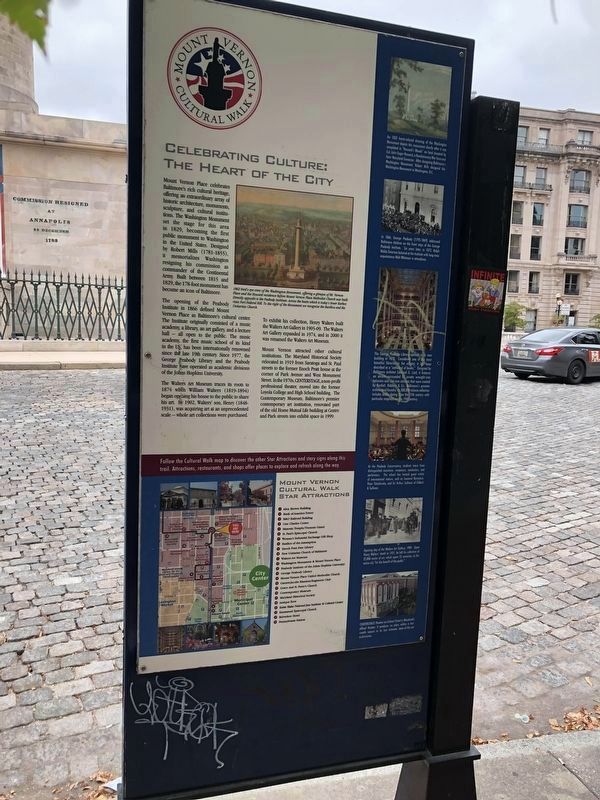
1. Celebrating Culture: The Heart of the City side of the marker
Celebrating Culture: The Heart of the City
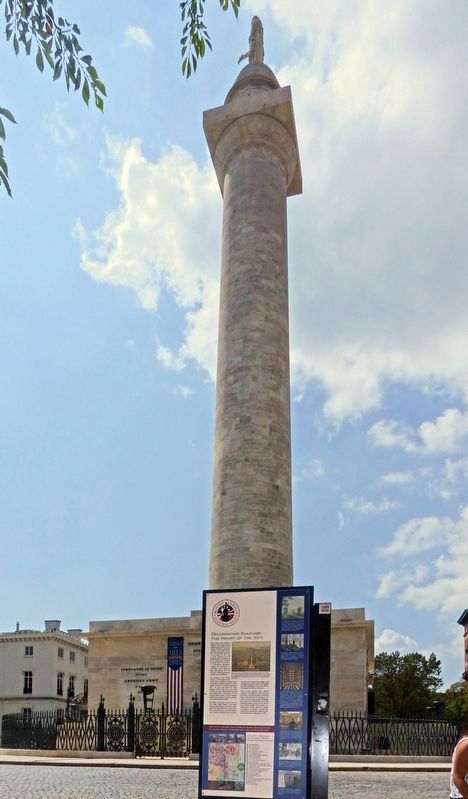
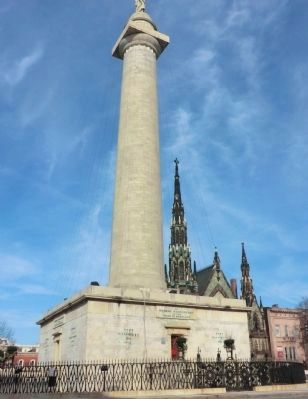
Mount Vernon Place celebrates Baltimore’s rich cultural heritage, offering an extraordinary array of historic architecture, monuments, sculpture and cultural Institutions. The Washington Monument set the stage for this area in 1829, becoming the first public monument to Washington in the United States. Designed by Robert Mills (1781-1855), it memorializes Washington resigning his commission as commander of the Continental Army. Built in 1815 and 1829, the 178-foot monument has become an icon of Baltimore.
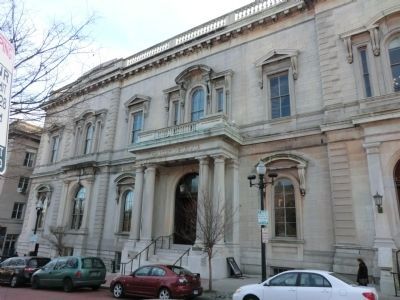
The opening of the Peabody Institute in 1866 defined Mount Vernon as Baltimore’s cultural center. The Institute originally consisted of a music academy, a library, and art gallery, and a lecture hall—all open to the public. The music academy, the first music school of its kind in the US, has been internationally renowned since the late 19th century. Since 1977, the George Peabody Library and the Peabody Institute have operated as academic divisions of the Johns Hopkins University.
The Walters Art Museum traces its roots to 1874 when William Walters (1819-1894) began opening
this page online
To exhibit his collection, Henry Walters built the Walters Art Gallery in 1905-09. The Walters Art Gallery expanded in 1974, and in 2000 it was renamed the Walters Art Museum.
Mount Vernon attracted other cultural institutions. The Maryland Historical Society relocated in 1919 from Saratoga and St. Paul streets to the former Enoch Pratt house at the corner of Park Avenue and West Monument Street. In the 1970s CENTERSTAGE, a non-profit professional theater, moved into the former Loyola College and High School building. The Contemporary Museum, Baltimore’s premier contemporary art institution, renovated part of the old Home Mutual Life building at Centre and Park streets into exhibit space in 1999.
Contributing to Society: Baltimore's Best Address
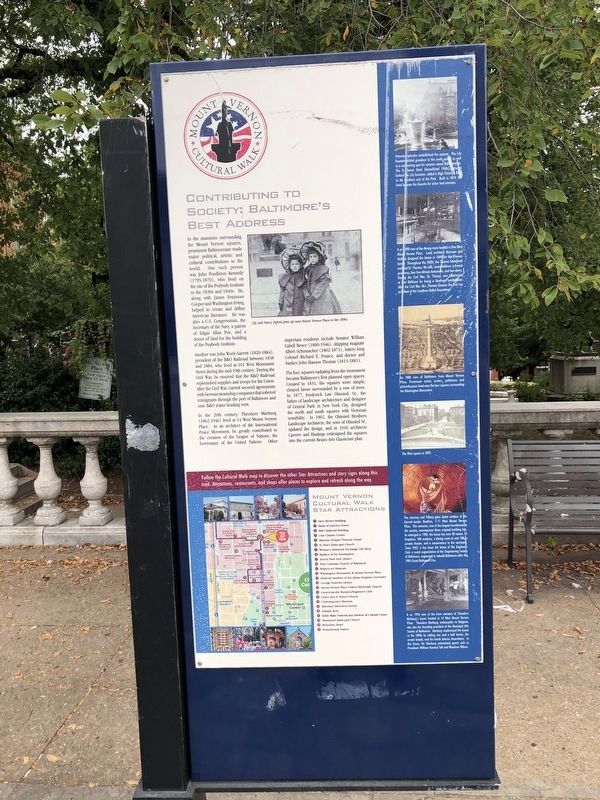
In the mansions surrounding the Mount Vernon squares, prominent Baltimoreans made major political, artistic and cultural contributions to the world. One such person was John Pendleton Kennedy (1795-1870), who lived on
Photographed by Devry Becker Jones (CC0), October 11, 2021
2. Contributing to Society: Baltimore's Best Address side of the marker
Another was John Work Garrett (1820-1884), president of the B&O Railroad between 1858 and 1884, who lived at 101 West Monument Street during the mid-19th century. During the Civil War, he ensured that the B&O Railroad replenished supplies and troops for the Union. After the Civil War, Garrett secured agreements with German steamship companies that ushered immigrants through the port of Baltimore and onto B&O trains heading west.
In the 20th century, Theodore Marburg (1862-1946) lived at 14 West Mount Vernon Place. As an architect of the International Peace Movement, he greatly contributed to the creation of the League of Nations, the forerunner of the United Nations. Other important residents include senator William Cabell Bruce (1860-1946), shipping magnate Albert Schumacher (1802-1871), lottery king Colonel Richard
Photographed by Allen C. Browne, September 5, 2015
3. Mount Vernon Cultural Walk-Celebrating Culture Marker
The four squares radiating from the monument became Baltimore's first planned open spaces. Created in 1831, the squares were simple, cleared lawns surrounded by a row of trees. In 1877, Frederick Law Olmstead, Sr., the father of landscape architecture and designer of Central Park in New York City, designed the north and south squares with Victorian sensibility. In 1902, the Olmsted Brothers Landscape Architects, the sons of Olmsted Sr., updated the design, and in 1916 architects Carrere and Hastings redesigned the squares into the current Beaux-arts Classicism plan.
Topics and series. This historical marker is listed in this topic list: Notable Places. In addition, it is included in the Baltimore and Ohio Railroad (B&O) series list. A significant historical year for this entry is 1829.
Location. 39° 17.859′ N, 76° 36.917′ W. Marker is in Baltimore, Maryland. It is in Mount Vernon. It is at the intersection of North Charles Street and East Mt. Vernon Place, on the right when traveling north on North Charles Street. The marker is near the Washington Monument. Touch for map.
Photographed by Don Morfe, January 5, 2013
4. Mount Vernon Cultural Walk-Celebrating Culture Marker
The Washington Monument

Regionally, this marker is in Central Maryland. It is also in the American Mid-Atlantic, in the Chesapeake Bay Region, and on the Eastern Seaboard. Globally, it is in the North Atlantic Region, North America, the Western Hemisphere, the Western World, and the Anglosphere. Historically, it finds itself in what was once one of the original Thirteen Colonies and also the Antebellum South.
Other nearby markers. At least 8 other markers are within walking distance of this marker: Welcome to the Washington Monument and Mount Vernon Place (here, next to this marker); Mount Vernon Cultural District (a few steps from this marker); Contributing to Society: Baltimore's Best Address (a few steps from this marker); Mount Vernon Place United Methodist Church (a few steps from this marker); Francis Scott Key (a few steps from this marker); Asbury House (within shouting distance of this marker); Washington Monument (within shouting distance of this marker); The Peabody Library (within shouting distance of this
Photographed by Allen C. Browne, September 5, 2015
5. Mount Vernon Square
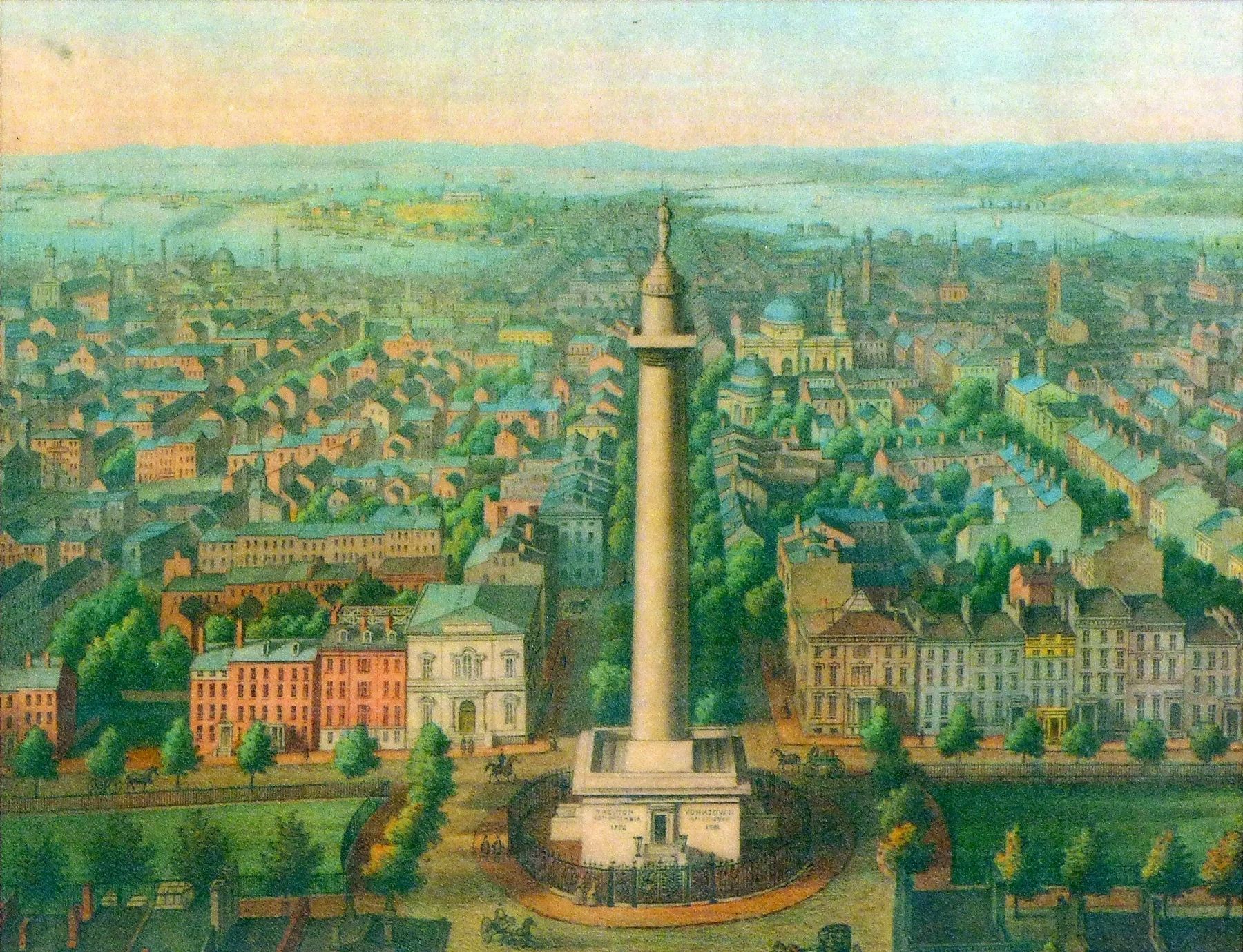
1862 bird's eye view of the Washington Monument, offering a glimpse of Mt. Vernon Place and the Howard residence before Mount Vernon Place Methodist Church was built. Directly opposite is the Peabody Institute. Across the basin which is today's Inner Harbor, rises Fort Federal Hill, to the right of the Monument we recognize the Basilica and the Unitarian Church.Close-up of image on marker
Other markers no longer nearby. A Monumental Mistake (was here, next to this marker but has been permanently removed); Roger B. Taney Monument (was within shouting distance of this marker but has been permanently removed).
Photographed by Allen C. Browne, September 5, 2015
6. The Washington Monument
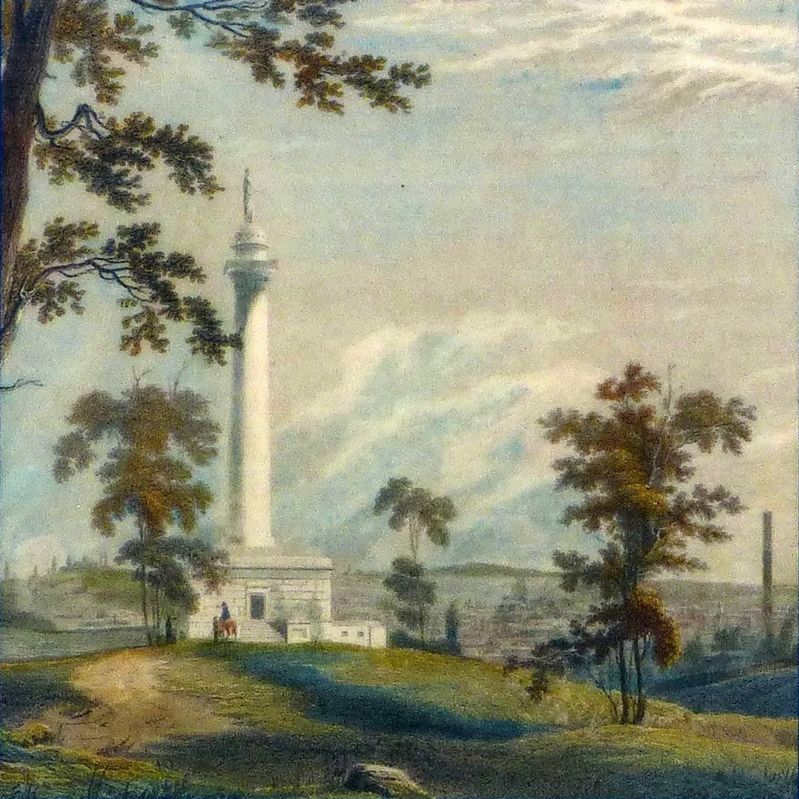
An 1835 hand-colored drawing of the Washington Monument depicts the monument shortly after it was completed in “Howard's Woods” on land donated by Col. John Eager Howard, a Revolutionary War hero and later Maryland Governor. After designing Baltimore's Washington Monument, Robert Mills designed the Washington Monument in Washington, D.C.Close-up of image on marker
Photographed by Don Morfe, January 5, 2013
7. Mount Vernon Cultural Walk-Celebrating Culture Marker
Peabody Institute
Credits. This page was last revised on October 11, 2021. It was originally submitted on January 7, 2013, by Don Morfe of Baltimore, Maryland. This page has been viewed 943 times since then and 34 times this year. Last updated on April 14, 2021, by Carl Gordon Moore Jr. of North East, Maryland. Photos: 1, 2. submitted on October 11, 2021, by Devry Becker Jones of Washington, District of Columbia. 3. submitted on June 20, 2017, by Allen C. Browne of Silver Spring, Maryland. 4. submitted on January 7, 2013, by Don Morfe of Baltimore, Maryland. 5, 6. submitted on June 20, 2017, by Allen C. Browne of Silver Spring, Maryland. 7. submitted on January 7, 2013, by Don Morfe of Baltimore, Maryland. • J. Makali Bruton was the editor who published this page.
