Lynching in America
⎯⎯⎯
The 1921 Tulsa Massacre
Community Remembrance Project
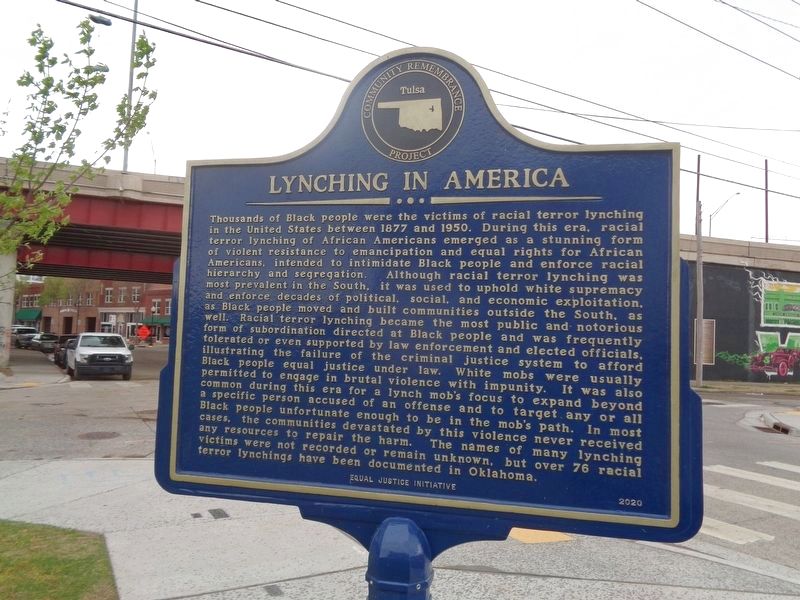
Lynching in America
Thousands of Black people were the victims of racial terror lynching in the United States between 1877 and 1950. During this era, racial terror lynching of African Americans emerged as a stunning form of violent resistance to emancipation and equal rights for African Americans, intended to intimidate Black people and enforce racial hierarchy and segregation. Although racial terror lynching was most prevalent in the South, it was used to uphold white supremacy and enforce decades of political, social, and economic exploitation, as Black people moved and built communities outside the South, as well. Racial terror lynching became the most public and notorious form of subordination directed at Black people and was frequently tolerated or even supported by law enforcement and elected officials, illustrating the failure of the criminal justice system to afford Black people equal justice under law. White mobs were usually permitted to engage in brutal violence with impunity. It was also common during this era for a lynch mob's focus to expand beyond a specific person accused of an offense and to target any
this page online
The 1921 Tulsa Massacre
On May 31 to June 1, 1921, a white mob attacked the prosperous Black neighborhood of Greenwood in Tulsa, resulting in the deaths of at least 36 Black Tulsans, the destruction of 36 city blocks, and the displacement of over 10,000 Black people. On May 31, Dick Rowland, a 19-year-old Black teenager, was jailed after being accused of assaulting a white woman. Although the charges were dropped, the local Tulsa Tribune newspaper published an inflammatory story that mobilized a white mob to lynch Rowland. In response, members of the Black community stationed themselves at the courthouse to protect him. Reports indicate that local authorities provided firearms and ammunition to the mob of thousands of white people who began firing at the Black men trying to protect Rowland. When the man retreated towards
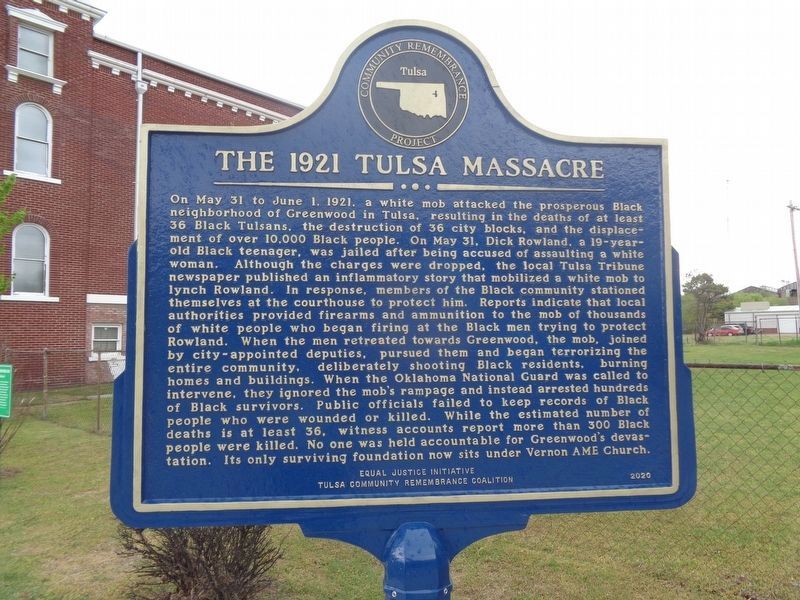
Erected 2020 by Equal Justice Initiative and the Tulsa Community Remembrance Coalition.
Topics and series. This historical marker is listed in these topic lists: African Americans • Civil Rights • Communications • Religion & Religious Structures. In addition, it is included in the Lynching in America series list. A significant historical date for this entry is May 31, 1921.
Location. 36° 9.679′ N, 95° 59.19′ W. Marker is in Tulsa, Oklahoma, in Tulsa County. It is at the intersection of North Greenwood
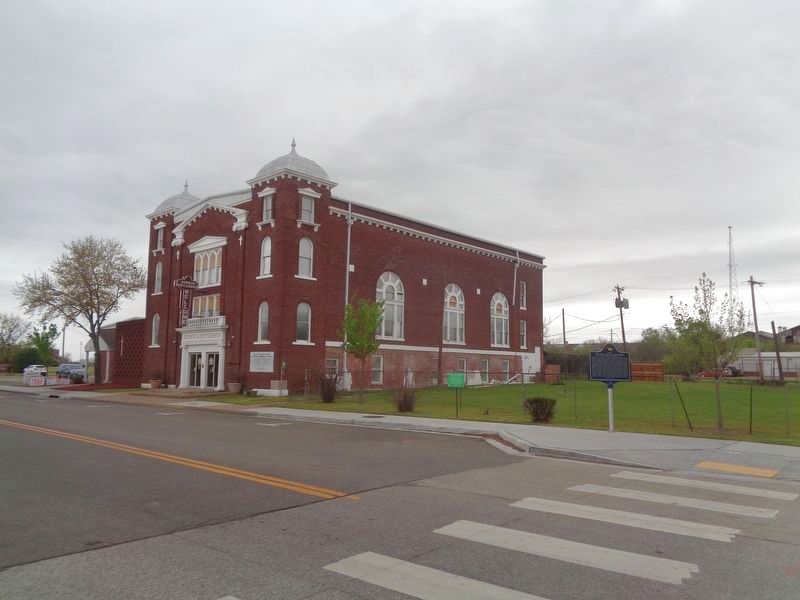

Regionally, this marker is in the Muscogee Nation, specifically in the Cherokee Nation, and in Northeast Oklahoma—Green Country. It is also in the American South, specifically on the prairies, and on the Southern Plains. Globally, it is in North America, the Western Hemisphere, the Western World, and the Anglosphere. Historically, it finds itself in what was once the territory of the Mississippian Culture and also the Louisiana Purchase.
Other nearby markers. At least 8 other markers are within walking distance of this marker: Historic Vernon AME Church Prayer Wall for Racial Healing (here, next to this marker); Vernon A.M.E. Church (a few steps from this marker); A Bench by the Road (within shouting distance of this marker); 1921 Black Wall Street Memorial / O Greenwood!/Commercial Destruction During 1921 Race War (within shouting distance

Also see . . . Tulsa race massacre (Wikipedia). (Submitted on April 17, 2021, by Jason Voigt of Glen Carbon, Illinois.)

Credits. This page was last revised on April 8, 2025. It was originally submitted on April 17, 2021, by Jason Voigt of Glen Carbon, Illinois. This page has been viewed 970 times since then and 65 times this year. Photos: 1, 2, 3. submitted on April 17, 2021, by Jason Voigt of Glen Carbon, Illinois. 4. submitted on October 28, 2024, by Brandon D Cross of Flagler Beach, Florida. 5. submitted on March 25, 2025, by Ian Lefkowitz of New York, New York.
