Near Dayton in Greene County, Ohio — The American Midwest (Great Lakes)
Miss that Tree!
Huffman Prairie Flying Field
| — | Dayton Aviation Heritage National Historic Park | — |
Photographed by Don Morfe, July 19, 2013
1. Miss that Tree! Marker
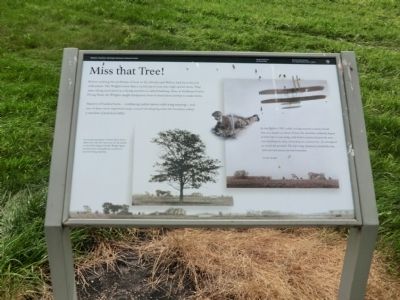
Before tackling the problems of how to fly, Orville and Wilbur had been bicycle enthusiasts. The Wrights knew that a cyclist has to lean into high-speed turns. That same tilting movement in a flying machine is called banking. Here at Huffman Prairie Flying Field, the Wrights taught themselves how to bank their airship to make turns.
Mastery of banked turns — combining rudder moves with wing warping — was one of their most important steps toward developing what the brothers called a machine of practical utility.
inscription next to the photo at the bottom left side of the marker:
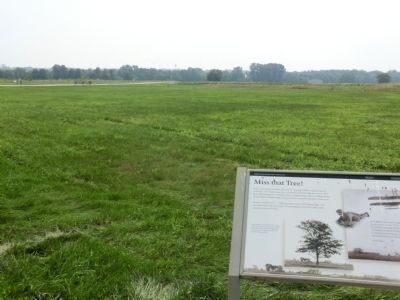
An unexpected gust of wind and a thorn-laden tree, like the ones you see far ahead in this field, helped Orville Wright figure out how best to handle his controls to turn his flying machine.
inscription under the photo at the upper right side of the marker:
In one flight in 1905, while circling around a honey locust tree at a height of about 50 feet, the machine suddenly began to turn up on one wing, and took a course toward the tree---not relishing the idea of landing in a thorn tree, (I) attempted to reach the ground. The left wing,
this page online
Orville Wright
Erected by National Park Service.
Topics. This historical marker is listed in this topic list: Air & Space. A significant historical year for this entry is 1905.
Location. 39° 48.326′ N, 84° 3.628′ W. Marker is near Dayton, Ohio, in Greene County. It is on Pylon Road 0.2 miles south of Marl Road, on the right when traveling south. Access is from Highway 444 at Communications Blvd. Visit the Interpretive Center first for driving directions. Touch for map. Marker is in this post office area: Dayton OH 45433, United States of America. Touch for directions.

Regionally, this marker is in the Miami Valley. It is also in the American Midwest and in the Corn Belt. Globally, it is in North America, the Western Hemisphere, the Western World, and the Anglosphere. Historically, it finds itself in what was once the Haudenosaunee (Iroquois) Confederacy, the territory of the Mississippian Culture, and the Northwest Territory.
Other nearby markers. At least 8 other markers are within walking distance of this marker: A Tough Start after Kitty Hawk (within shouting
Photographed by Don Morfe, July 19, 2013
2. Miss that Tree! Marker
Additional commentary.
1. First stall-spin recovery
In my reading of Fred Howard's book, this event, Wilbur's effort to reach the ground before the flyer collided into the tree, was the 'Aha!' moment that resulted in their realizing full control over the airplane.
The intentional descent in an effort to avoid the tree was in fact a stall-spin recovery (the very first!). The left wing stalled when the banked turn increased the load and simultaneously decreased the airspeed of the inner wing. The cure was to put the plane into a shallow descent whenever they were turning. With this insight, they achieved complete control over the plane. Flights of any duration (barring mechanical trouble) with their gasoline supplies were now within sight.
— Submitted November 10, 2025, by Richard William Miller of Milwaukee, Wisconsin.
Credits. This page was last revised on November 24, 2025. It was originally submitted on August 13, 2013, by Don Morfe of Baltimore, Maryland. This page has been viewed 717 times since then and 26 times this year. Last updated on April 28, 2021, by Craig Baker of Sylmar, California. Photos: 1, 2. submitted on August 13, 2013, by Don Morfe of Baltimore, Maryland. • J. Makali Bruton was the editor who published this page.
