Winston-Salem in Forsyth County, North Carolina — The American South (South Atlantic)
Flonnie T. Anderson
March 15, 1930
| — | Winston-Salem Distinguished Women In The Arts | — |
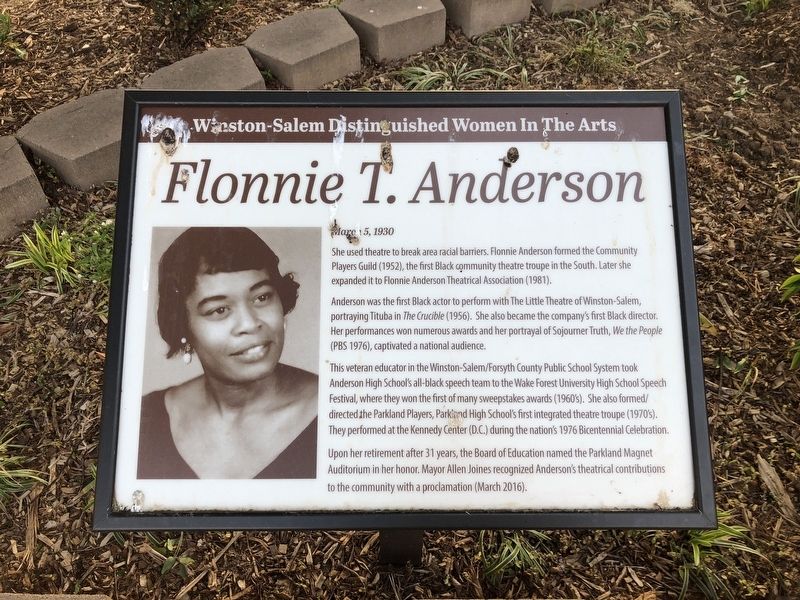
She used theatre to break area racial barriers. Flonnie Anderson formed the Community Players Guild (1952), the first Black community theatre troupe in the South. Later she expanded it to Flonnie Anderson Theatrical Association (1981).
Anderson was the first Black actor to perform with The Little Theatre of Winston-Salem, portraying Tituba in The Crucible 1956. She also became the company's first Black director. Her performances won numerous awards and her portrayal of Sojourner Truth, We the People (PBS 1976), captivated a national audience.
This veteran educator in the Winston-Salem/Forsyth County Public School system took Anderson High School's all-black speech team to the Wake Forest University High School Speech Festival, where they won the first of many sweepstakes awards (1960's). She also formed/directed the Parkland Players, Parkland High School's first integrated theatre troupe (1970's). They performed at the Kennedy Center (D.C.) during the nation's 1976 Bicentennial Celebration.
Upon her retirement after 31 years, the Board of Education named the Parkland Magnet Auditorium in her honor. Mayor Allen
this page online
Topics. This historical marker is listed in these topic lists: African Americans • Arts, Letters, Music • Education • Women. A significant historical year for this entry is 1956.
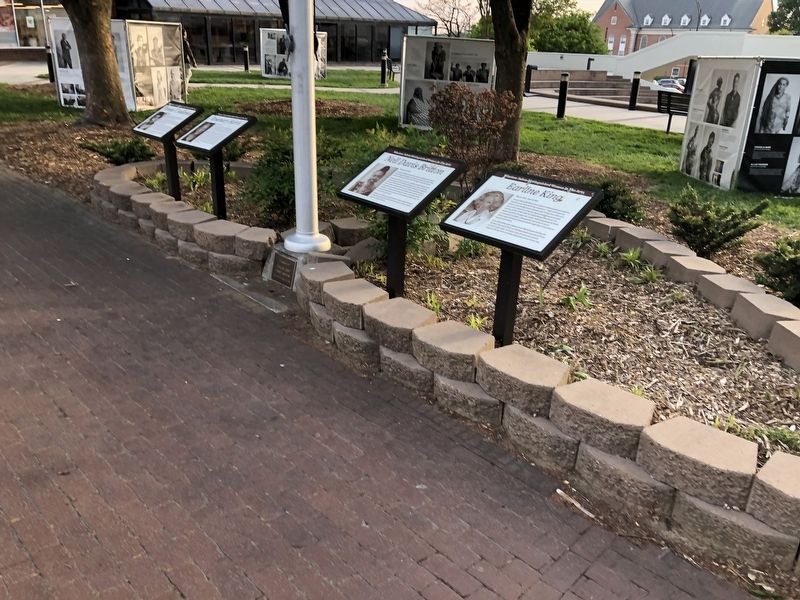
Location. 36° 5.833′ N, 80° 14.873′ W. Marker is in Winston-Salem, North Carolina, in Forsyth County. It is on Marshall Street North 0.1 miles south of West 4th Street, on the right when traveling south. Touch for map. Marker is at or near this postal address: 310 Marshall St N, Winston Salem NC 27101, United States of America. Touch for directions.

Regionally, this marker is in North Carolina’s Piedmont and specifically in Piedmont Triad. It is also in the American South and specifically in the Upper South. Globally, it is in North America, the Western Hemisphere, the Western World, and the Anglosphere. Historically, it finds itself in what was once the territory of the Mississippian Culture, one of the original Thirteen Colonies, one of the Confederate States of America, and the Antebellum South.
Other nearby markers. At
Credits. This page was last revised on February 3, 2026. It was originally submitted on April 28, 2021, by Devry Becker Jones of Washington, District of Columbia. This page has been viewed 1,294 times since then and 65 times this year. Photos: 1, 2. submitted on April 28, 2021, by Devry Becker Jones of Washington, District of Columbia.
