Downtown in Roanoke, Virginia — The American South (Mid-Atlantic)
Virginian Railway Class C-10 Caboose #321
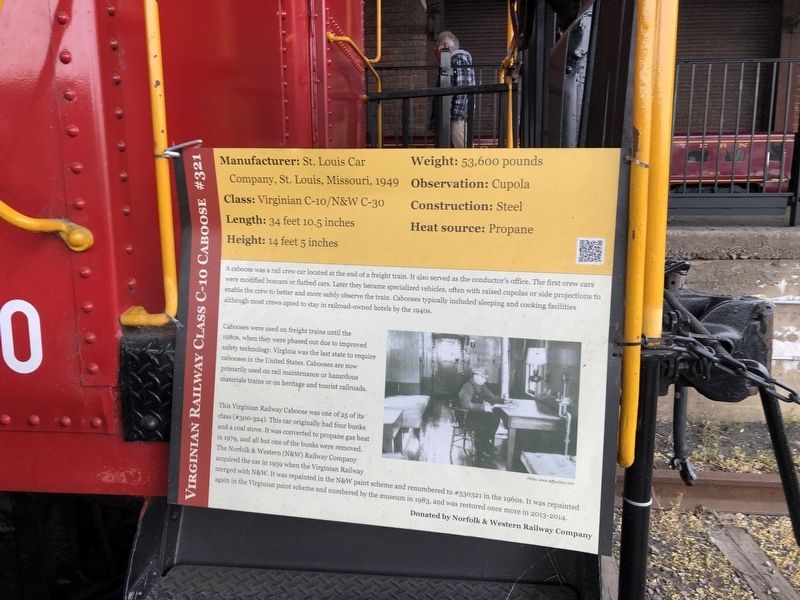
Photographed by Devry Becker Jones (CC0), April 24, 2021
1. Virginian Railway Class C-10 Caboose #321 Marker
Manufacturer: St. Louis Car Company, St. Louis, Missouri, 1949
Class: Virginian C-10/N&W C-30
Length: 34 feet 10.5 inches
Height: 14 feet 5 inches
Weight: 53,600 pounds
Observation: Cupola
Construction: Steel
Heat source: Propane
A caboose was a rail crew car located at the end of a freight train. It also served as the conductor's office. The first crew cars were modified boxcars or flatbed cars. Later they became specialized vehicles, often with raised cupolas or side projections to enable the crew to better and more safely observe the train. Cabooses typically included sleeping and cooking facilities although most crews opted to stay in railroad-owned hotels by the 1940s.
Cabooses were used on freight trains until the 198os, when they were phased out due to improved safety technology. Virginia was the last state to require cabooses in the United States. Cabooses are now primarily used on rail maintenance or hazardous materials trains or on heritage and tourist railroads.
This Virginian Railway Caboose was one of 25 of its class (#300-324). This car originally had four bunks and a coal stove. It
this page online
Erected by Virginia Museum of Transportation, Inc.
Topics. This historical marker is listed in this topic list: Railroads & Streetcars. A significant historical year for this entry is 1949.
Location. 37° 16.39′ N, 79° 56.832′ W. Marker is in Roanoke, Virginia. It is in Downtown. It is at the intersection of Norfolk Avenue Southwest and 3rd Street Southwest on Norfolk Avenue Southwest. Touch for map. Marker is at or near this postal address: 303 Norfolk Ave SW, Roanoke VA 24016, United States of America. Touch for directions.

Regionally, this marker is in the Mountain Region and in Southwest Virginia. It is also in the American South and specifically in the Upper South. Globally, it is in North America, the Western Hemisphere,
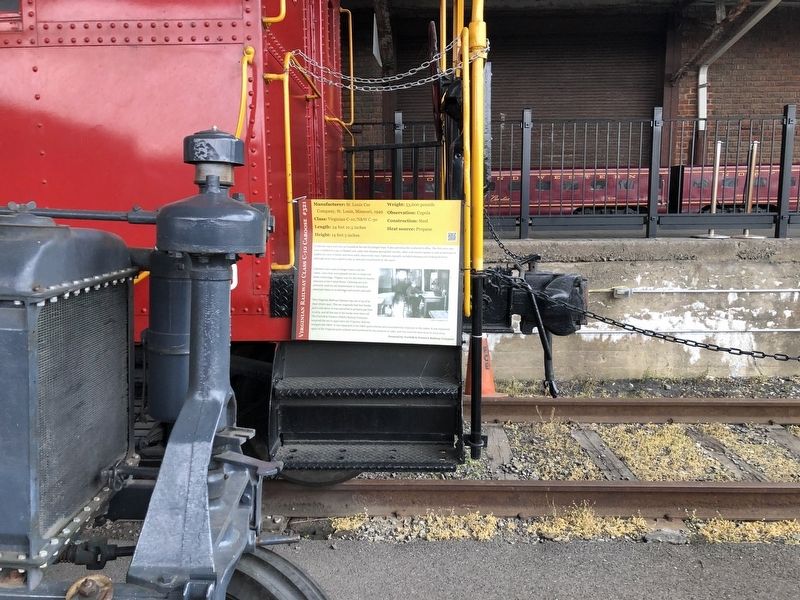
Photographed by Devry Becker Jones (CC0), April 24, 2021
2. Virginian Railway Class C-10 Caboose #321 Marker
Other nearby markers. At least 8 other markers are within walking distance of this marker: 1936 F-20 McCormick Deering Farmall Tractor (here, next to this marker); Mead Corporation Industrial Locomotive #200 (a few steps from this marker); Celanese Porter Fireless #1 (a few steps from this marker); Mining Train (within shouting distance of this marker); Whitcomb 30DM31 Diesel Switcher (within shouting distance of this marker); Panama Canal Mule No. 686 (within shouting distance of this marker); Virginian Class SA #4 (within shouting distance of this marker); Amoco Oil ARA III Tank Car AMOX #9465 (within shouting distance of this marker). Touch for a list and map of all markers in Roanoke.
Credits. This page was last revised on February 1, 2023. It was originally submitted on April 30, 2021, by Devry Becker Jones of Washington, District of Columbia. This page has been viewed 737 times since then and 67 times this year. Photos: 1, 2. submitted on April 30, 2021, by Devry Becker Jones of Washington, District of Columbia.
