Near Holcomb in Grenada County, Mississippi — The American South (East South Central)
Elliot Mission
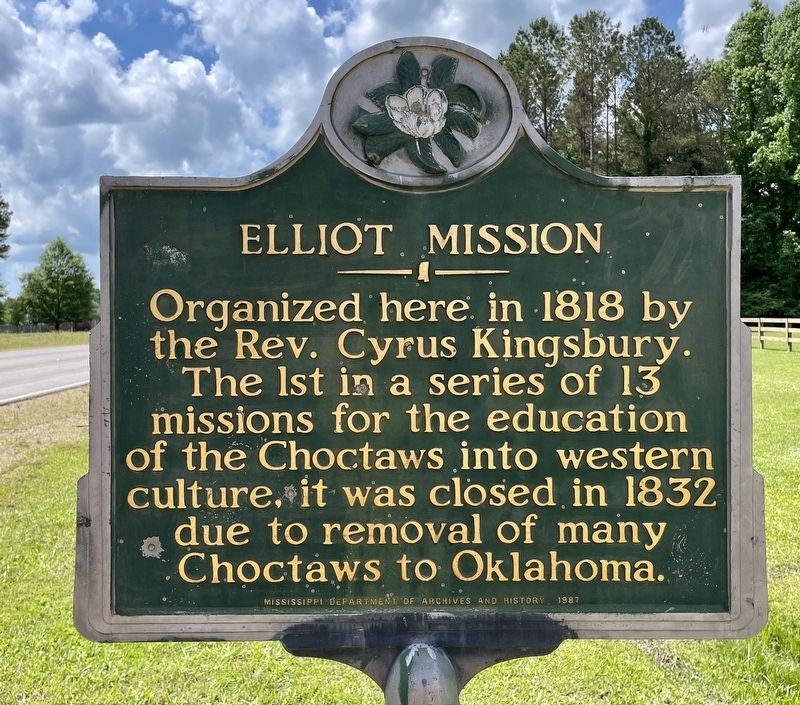
Photographed by Mark Hilton, May 23, 2021
1. Elliot Mission Marker
Erected 1987 by Mississippi Department of Archives and History.
Topics and series. This historical marker is listed in these topic lists: Education • Indigenous Peoples and Communities. In addition, it is included in the Mississippi State Historical Marker Program series list. A significant historical year for this entry is 1818.
Location. 33° 44.363′ N, 89° 58.176′ W. Marker is near Holcomb, Mississippi, in Grenada County. It is at the intersection of Dubard Road (Mississippi Route 35) and Blanch Road, on the right when traveling south on Dubard Road. Touch for map. Marker is in this post office area: Holcomb MS 38940, United States of America. Touch for directions.

Regionally, this marker is in Central Mississippi. It is also in the American South, specifically in the Deep South, and in the Mississippi Delta. Globally, it is in North America, a Gulf of Mexico state, the Western Hemisphere,
this page online
Other nearby markers. At least 8 other markers are within 10 miles of this marker, measured as the crow flies: Mississippi John Hurt (approx. 8.2 miles away); Cascilla (approx. 8.4 miles away); a different marker also named "Mississippi" John Hurt (approx. 8.8 miles away); Grenada Fort (approx. 9 miles away); Odd Fellows/Confederate Cemetery (approx. 9.4 miles away); Grenada (approx. 9½ miles away); Magic Slim (approx. 9.6 miles away); Belle Flower M.B. Church (approx. 9.8 miles away).
Regarding Elliot Mission. The station was named "Eliot" in honor of John Eliot, an English Puritan born in 1604 who had emigrated to America to educate the Indians of Massachusetts.
The little station grew with the arrival of more missionaries and the building of homes, a church and a school. A doctor, a carpenter and blacksmith also arrived and a blacksmith shop, granary and other buildings were erected, and soon furniture, wagons and all kinds
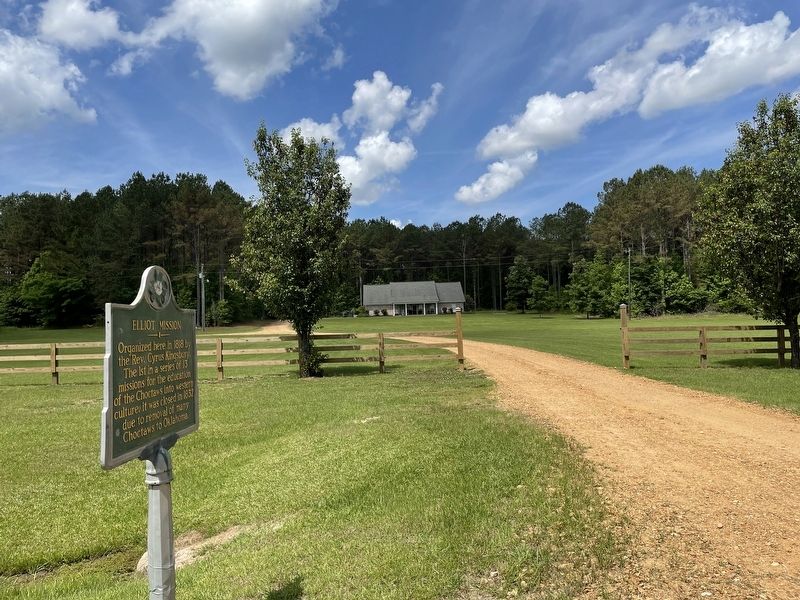
Photographed by Mark Hilton, May 23, 2021
2. Elliot Mission Marker
For more than 20 years, Eliot Mission was a center for Choctaw education. But in 1830, the infamous Treaty of Dancing Rabbit Creek began the removal of the Choctaws from their eastern lands, and by 1832 the mission had closed.
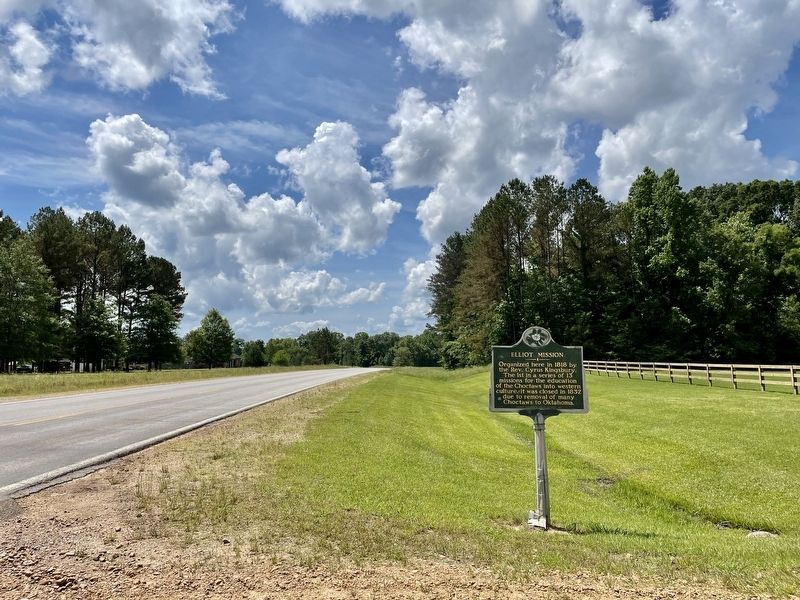
Photographed by Mark Hilton, May 23, 2021
3. View south on MS-35.
Credits. This page was last revised on May 26, 2021. It was originally submitted on May 26, 2021, by Mark Hilton of Montgomery, Alabama. This page has been viewed 1,454 times since then and 112 times this year. Photos: 1, 2, 3. submitted on May 26, 2021, by Mark Hilton of Montgomery, Alabama.
