Near Petroleum in Wood County, West Virginia — The American South (Appalachia)
Volcano, West Virginia
Photographed by J. J. Prats, May 31, 2021
1. Volcano, West Virginia, Marker
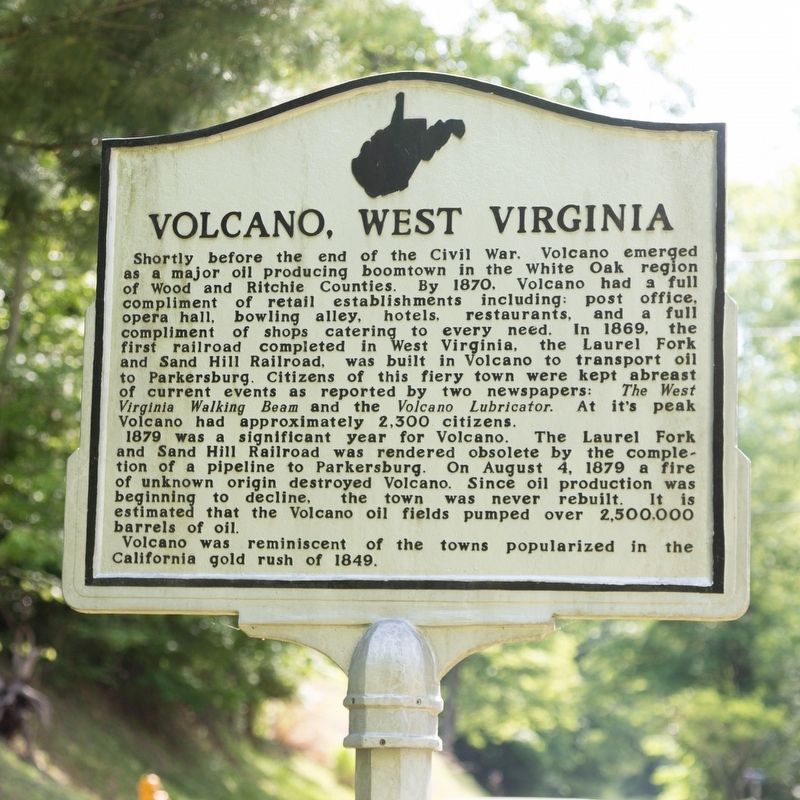
Shortly before the end of the Civil War. Volcano emerged as a major oil producing boomtown in the White Oak region of Wood and Ritchie Counties. By 1870, Volcano had a full compliment of retail establishments including: post office, opera hall, bowling alley, hotels, restaurants, and a full compliment of shops catering to every need. In 1869, the first railroad completed in West Virginia, the Laurel Fork and Sand Hill Railroad, was built in Volcano to transport oil to Parkersburg. Citizens of this fiery town were kept abreast of current events as reported by two newspapers: The West Virginia Walking Beam and the Volcano Lubricator. At its peak Volcano had approximately 2,300 citizens.
1879 was a significant year for Volcano. The Laurel Fork and Sand Hill Railroad was rendered obsolete by the completion of a pipeline to Parkersburg. On August 4, 1879 a fire of unknown origin destroyed Volcano. Since oil production was beginning to decline, the town was never rebuilt. It is estimated that the Volcano oil fields pumped over 2,500,000 barrels of oil.
Volcano was reminiscent of the towns popularized in the California
this page online
Topics. This historical marker is listed in these topic lists: Industry & Commerce • Natural Resources • Settlements & Settlers. A significant historical date for this entry is August 4, 1879.
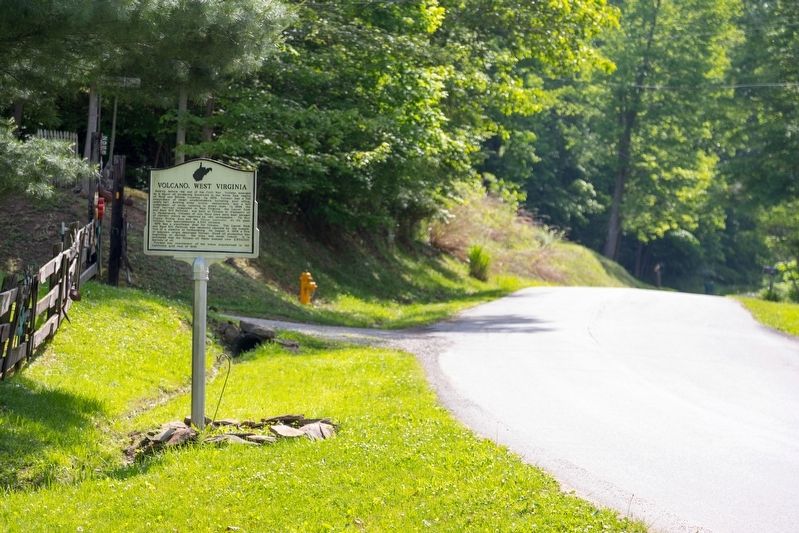
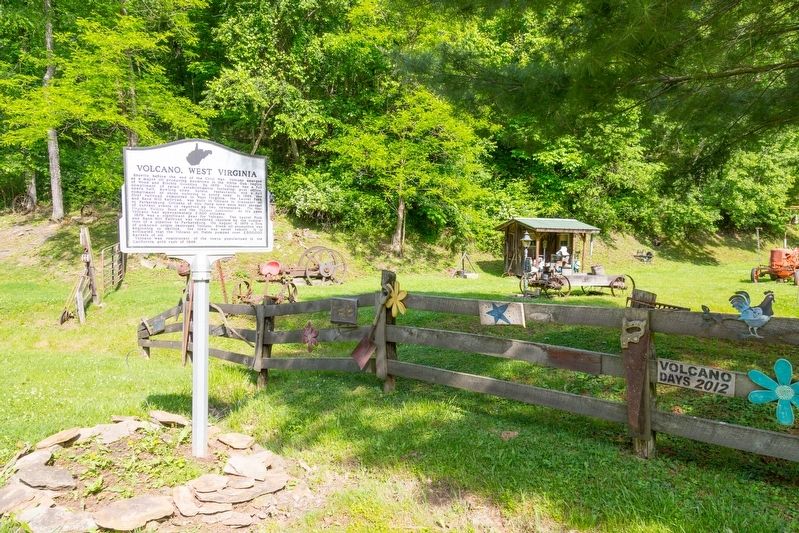
Location. 39° 13.895′ N, 81° 17.398′ W. Marker is near Petroleum, West Virginia, in Wood County. It is on Volcano Road (Local Route 2/8) 3 miles south of Robert Byrd Highway (Route 50), on the right when traveling south. Volcano Road begins as County Route 5. Keep right at the fork with Petroleum Road (County Route 28). Touch for map. Marker is at or near this postal address: 2958 Volcano Rd, Walker WV 26180, United States of America. Touch for directions.

Regionally, this marker is in the Mid-Ohio Valley. It is also in the American South, specifically in the Upper South, in the Ohio River Valley, in Appalachia, and specifically in Northern Appalachia. Globally, it is in North America, the Western Hemisphere, the Western World, and the Anglosphere. Historically, it finds itself in what was once the Viceroyalty of New France and also the territory of the Mississippian Culture.
Other nearby markers. At least 8 other markers
Photographed by J. J. Prats, May 31, 2021
2. Volcano, West Virginia Marker
Regarding Volcano, West Virginia. Wikipedia:
Volcano is a ghost town in Wood County, West Virginia. It burned to the ground in 1879 and was never rebuilt. It was a petroleum town. Gas flares at night made the skyline appear like a volcano, hence the name. Its Post Office no longer exists.
The Volcano oil field was discovered in 1860, according to the West Virginia Geological and Economic Survey (WVGES), “and from 1865 to 1870, drilling was very active, producing from the Salt Sand at a depth of about 360 feet. The heavy lubricants produced led to the development of West Virginia's first oil pipeline, from Volcano to Parkersburg, in 1879.”
In 1874, W.C. Stiles,Jr., employed the endless-wire method of pumping many wells from a central engine, “a technique he invented,” according to the WVGES. “Using wheels, belts, and cables, perhaps as many as 40 wells could be pumped by one engine. One of the systems operated until 1974.”Photographed by J. J. Prats, May 31, 20213. Volcano, West Virginia Marker
The Volcano town-site is located south of the US-50 expressway near the junction of Wood County Routes 5 and 28.
Also see . . . . Article by Mike Baker in Clutch MOV. Excerpt:
As workers and wealth descended upon the town so too descended investors and entrepreneurs. Needing to move product and people, workers erected The Laurel Fork and Sandhill railroad, a connector to the famed Baltimore and Ohio Railroad, between 1866 and 1869. This railway — the first of its gauge in West Virginia — was a game changer, bringing in more workers and facilitating expansion, growing the town’s population to somewhere between 8,000 and 10,000. As workers moved in, businesses began springing up around the fields. Oil and liquor flowed freely with some quipping that saloons outnumbered grocery stores in Volcano.(Submitted on June 6, 2021.)
Volcano proved a lucrative venture but with all industrial ventures,it had its risks. A fire erupted on August 4, 1879, and quickly burned through most of the town, igniting oil barrels and letting loose the burning oil which, according to a New York Times article from 1879, “ran through the streets, setting fire to everything on either side.” The town was reduced to ashes. Volcano would eventually rise from the soot and return to production, however, the damage was irreversible. The once thriving boomtown would never again return to the heights it enjoyed before tragedy struck and closed production for good in the 1970s, over a century after it rose to prominence.Photographed by Bradley Owen, May 29, 20264. Volcano, West Virginia MarkersLocated at the Volcano Museum, 1014 Volcano Road, Waverly, WV.
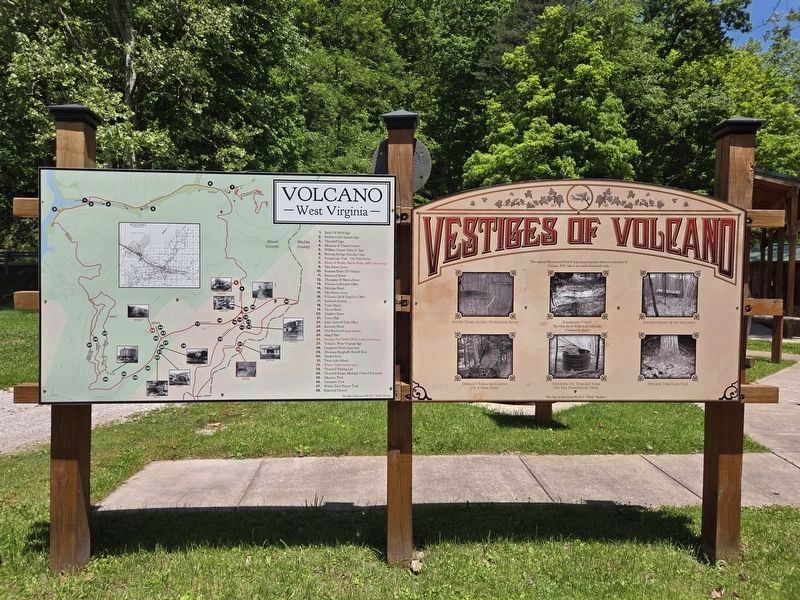
Historic map of Volcano with notable sites.
Vestiges of Volcano
Throughout Mountwood Park & adjoining properties there are reminders of Volcano, WV. Many are visible from park trails.
Water tanks along Petroleum Road • Raymond Street - The only street with brick sidewalks (outlined in black) • Engine house SE of Volcano • Derelict farm implement on a park trail • Wooden oil storage tank on the Pumphouse Trail • Pipeline through tree
Credits. This page was last revised on June 15, 2026. It was originally submitted on June 6, 2021, by J. J. Prats of Powell, Ohio. This page has been viewed 2,905 times since then and 213 times this year. Photos: 1, 2, 3. submitted on June 6, 2021, by J. J. Prats of Powell, Ohio. 4. submitted on June 15, 2026, by Bradley Owen of Morgantown, West Virginia.
