Hayward in Alameda County, California — The American West (Pacific Coastal)
Working in the Salt Ponds
Photographed by Andrew Ruppenstein, June 6, 2021
1. Working in the Salt Ponds Marker
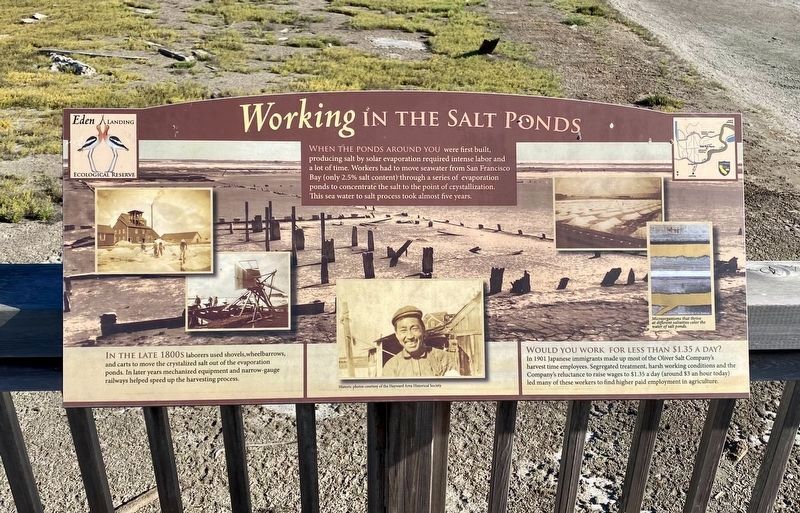
WHEN THE PONDS AROUND YOU were first built, producing salt by solar evaporation required intense labor and a lot of time. Workers had to move seawater from San Francisco Bay (only 2.5% salt content) through a series of evaporation ponds to concentrate the salt to the point of crystallization. This sea water to salt process took almost five years.
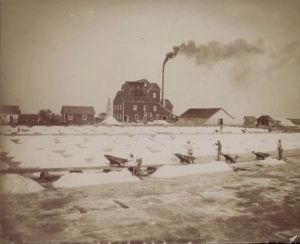
IN THE LATE 1800s laborers used shovels,wheelbarrows, and carts to move the crystalized salt out of the evaporation ponds. In later years mechanized equipment and narrow-gauge railways helped speed up the harvesting process.
Would you work for less than $1.35 a day?
In 1901 Japanese immigrants made up most of the Oliver Salt Company's
harvest time employees. Segregated treatment, harsh working conditions and the
Company's reluctance to raise wages to $1.35 a day (around $3 an hour today)
led many of these workers to find higher paid employment in agriculture.
Topics. This historical marker is listed in these topic lists: Asian Americans • Industry & Commerce.
Location. 37° 36.827′ N, 122° 7.788′ W. Marker
this page online

Regionally, this marker is in the San Francisco Bay Area and on the Coast Ranges. It is also on the American Pacific Coast. Globally, it is in North America, on the Ring of Fire, on the Pacific Rim, in the Western Hemisphere, in the Western World, and in the Anglosphere. Historically, it finds itself in what was once New Spain and also Mexico’s Alta California.
Other nearby markers. At least 8 other markers are within one mile of this marker, measured as the crow flies: Riches from Seawater and Sun (within shouting distance of this marker); Snowy Plovers Find a Home (approx. ¼ mile away); A Salty Experiment in Habitat Management (approx. half a mile away); Got Salt? (approx. 0.6 miles away); Wetland to Salt Pond and Back Again (approx. 0.6 miles away); Who Needs This Habitat The Most? (approx. 0.7 miles away); The Archimedes Screw Pump (approx. 0.8 miles away); Bay-Friendly Rated Landscapes in the City of Hayward (approx.
via The Oliver Salt Company, unknown
2. Labor in the Marshes
The Oliver Salt Company blog entry
Click for more information.
Click for more information.
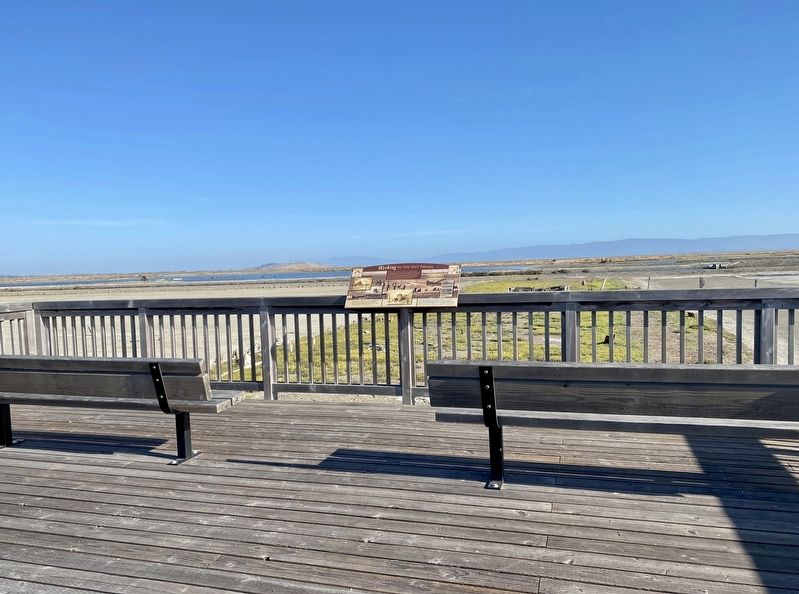
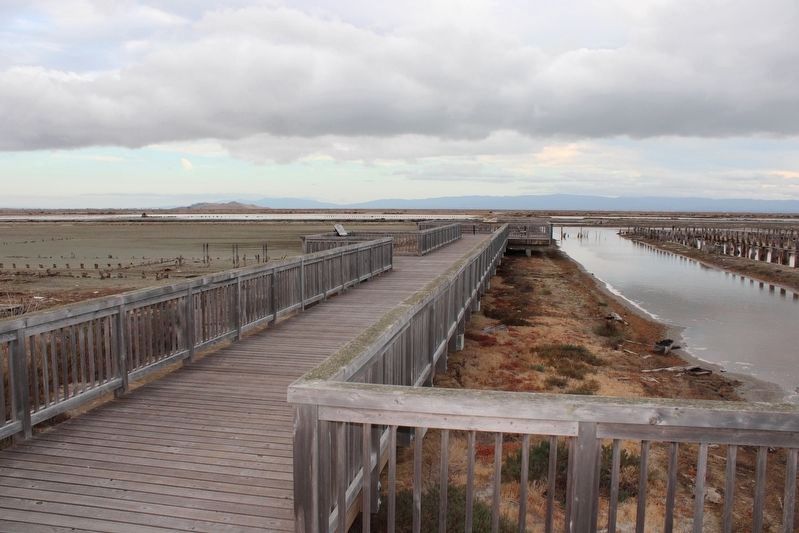
More about this marker. The marker is located at the far end of the observation platform at the former salt works in the Eden Landing Ecological Reserve. Distance to the marker from the trailhead parking lot to the marker is about 3/4ths of a mile along a smooth level path.
Also see . . . California Department of Fish & Game: Area History.
"The area was formerly owned and managed by Cargill Salt Co. as solar salt production facilities. In 1996, 835 acres were acquired from Cargill and an additional 5,500 acres in 2003. In 1998, the area was designated as an ecological reserve by the Fish and Game Commission."(Submitted on October 1, 2022, by Joseph Alvarado of Livermore, California.)
Photographed by Andrew Ruppenstein, June 6, 2021
3. Working in the Salt Ponds Marker - wide view
Photographed by Joseph Alvarado, September 17, 2022
4. Boardwalk Leading to the Markers
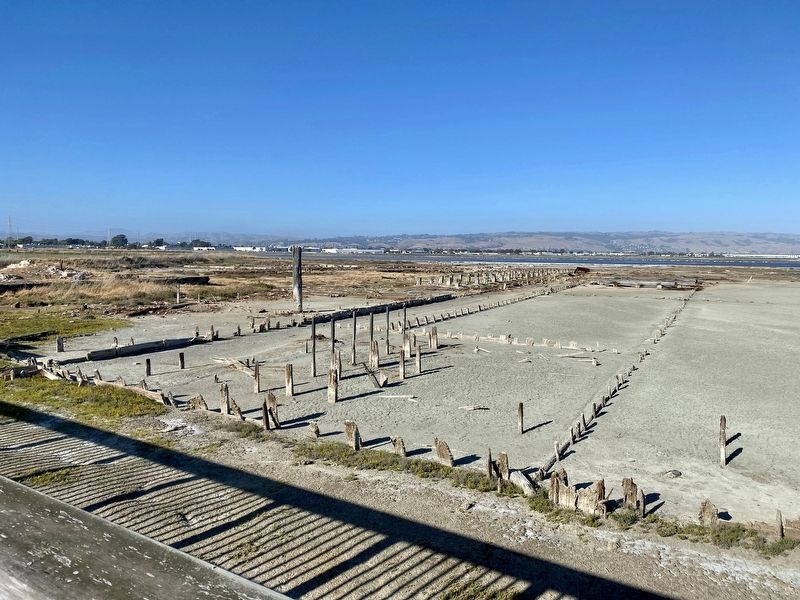
Photographed by Andrew Ruppenstein, June 6, 2021
5. Remains of Oliver Salt Works as seen from the viewing platform
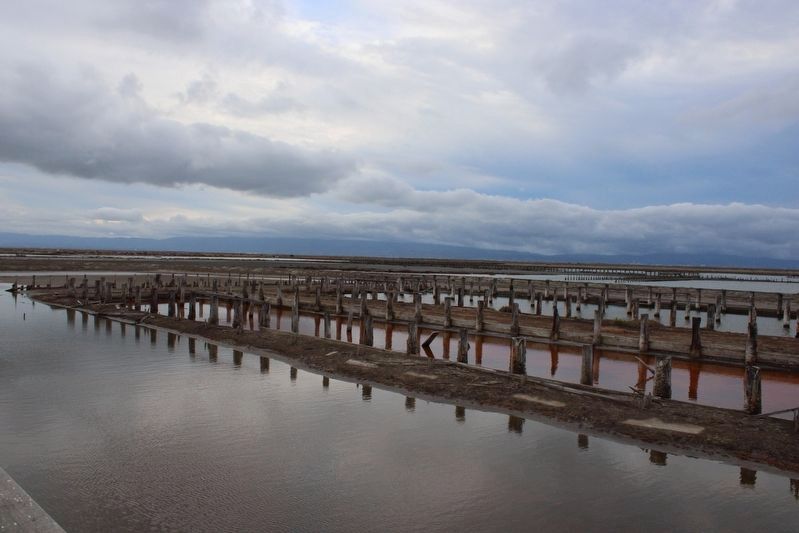
Photographed by Joseph Alvarado, September 17, 2022
6. Area North of the Boardwalk
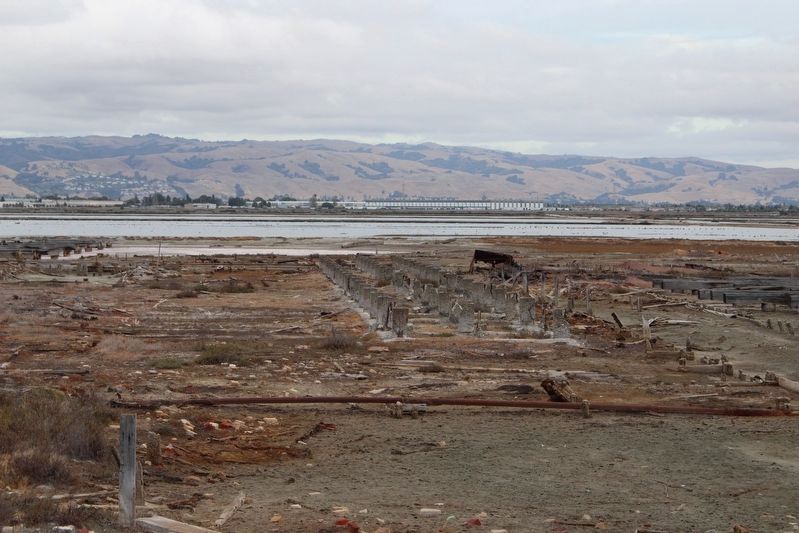
Photographed by Joseph Alvarado, September 17, 2022
7. Area South of the Boardwalk
Credits. This page was last revised on October 6, 2022. It was originally submitted on June 7, 2021, by Andrew Ruppenstein of Lamorinda, California. This page has been viewed 453 times since then and 47 times this year. Photos: 1. submitted on June 7, 2021, by Andrew Ruppenstein of Lamorinda, California. 2. submitted on June 8, 2021, by Larry Gertner of New York, New York. 3. submitted on June 7, 2021, by Andrew Ruppenstein of Lamorinda, California. 4. submitted on October 1, 2022, by Joseph Alvarado of Livermore, California. 5. submitted on June 7, 2021, by Andrew Ruppenstein of Lamorinda, California. 6, 7. submitted on October 1, 2022, by Joseph Alvarado of Livermore, California.
