Settlers' Cemetery
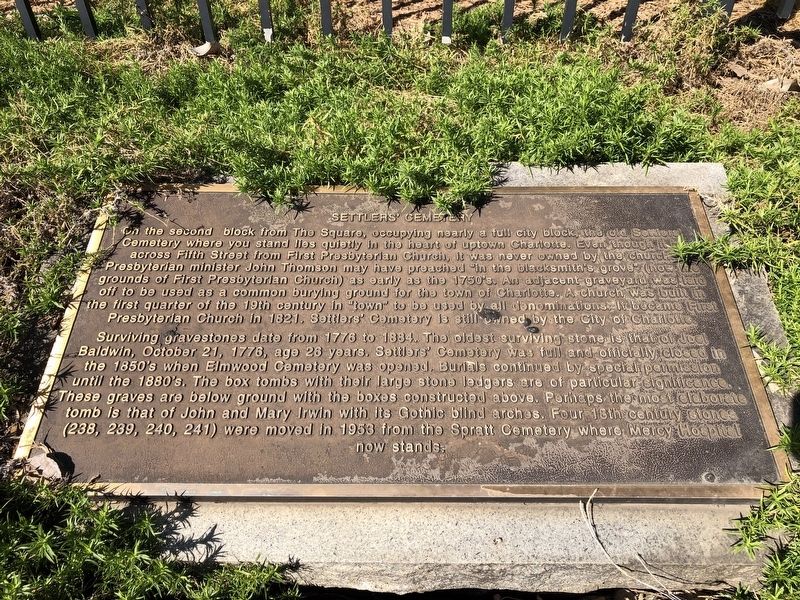
On the second block from The Square, occupying nearly a full city block, the old Settlers' Cemetery where you stand lies quietly in the heart of uptown Charlotte. Even though it is across Fifth Street from First Presbyterian Church, it was never owned by the church. Presbyterian minister John Thomson may have preacheded "in the blacksmith's grove" (now the ground of First Presbyterian Church) as early as the 1750's. An adjacent graveyard was laid off to be used as a common burying ground for the town of Charlotte. A church was built in the first quarter of the 19th century in "town" to be used by all denominations. It became First Presbyterian Church in 1821. Settlers' Cemetery is still owned by the City of Charlotte.
Surviving gravestones date from 1776 to 1884. The oldest surviving stone is that of Joel Baldwin, October 21, 1776, age 26 years. Settlers' Cemetery was full and officially closed in the 1850's when Elmwood Cemetery was opened. Burials continued by special permission until the 1880's. The box tombs with their large stone ledgers are of particular significance. These graves are below ground with the boxes
this page online
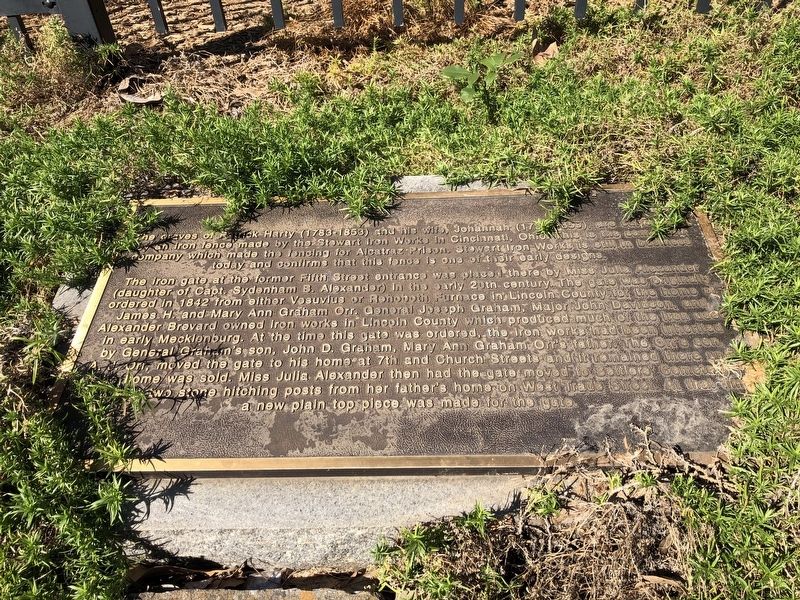
The graves of Patrick Harty (1783-1853) and his wife Johannah (1799-1859), are surrounded by an iron fence made by the Stewart Iron Works in Cincinnati, Ohio. This is the same iron company which made which made the fencing for Alcatraz Prison. Stewart Iron Works is still in business today and confirms that this fence is one of their early designs.
The iron gate at the former Fifth Street entrance was placed there by Miss Julia Alexander (daughter of Capt. Sydenham B. Alexander) in the early 20th century. The gate was originally ordered in 1842 from either Vesuvius or Rehoboth Furnace in Lincoln County for the home of James H. and Mary Ann Graham Orr. General Joseph Graham, Major John Davidson, and Alexander Brevard owned iron works in Lincoln County which produced much of the iron used in early Mecklenburg. At the time this gate was ordered, the iron works had been inherited by General Graham's son,
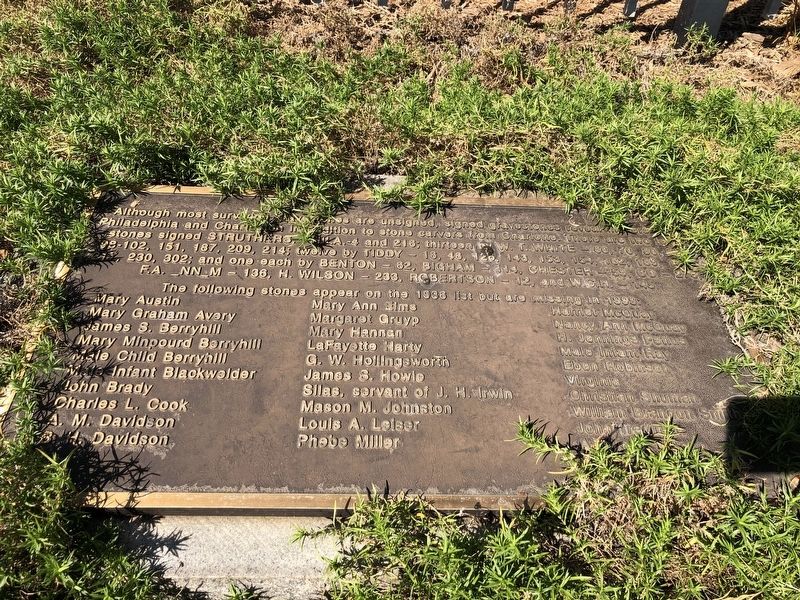
Although most surviving gravestones are unsigned, signed gravestones reveal makers Philadelphia and Charleston in addition to stone carvers from Charlotte. There are two leading stones signed Struthers, Phila.-4 and 216; thirteen by W.T. White - 60, 70, 80, 86, 98-102, 151, 187, 209, 214; twelve by Tiddy - 16 46, 126, 143, 153, 154, 162, 189, 193, 217, 230, 302; and one each by Benton - 82, Bigham - 114, Chester - 59, Co - 273, F.A. _NN_M - 136, H. Wilson - 233, Robertson - 12, and W.C.H. - 145.
The following stones appear on the 1936 list but are missing in 1999:
Mary Austin •
Mary Graham Avery •
James S. Berryhill •
Mary Minpourd Berryhill •
Male Child Berryhill •
Male Infant Blackwelder •
John Brady •
Charles L. Cook •
A.M. Davidson •
B.H.
Topics. This historical marker is listed in these topic lists: Architecture • Cemeteries & Burial Sites • Industry & Commerce. A significant historical date for this entry is October 21, 1776.
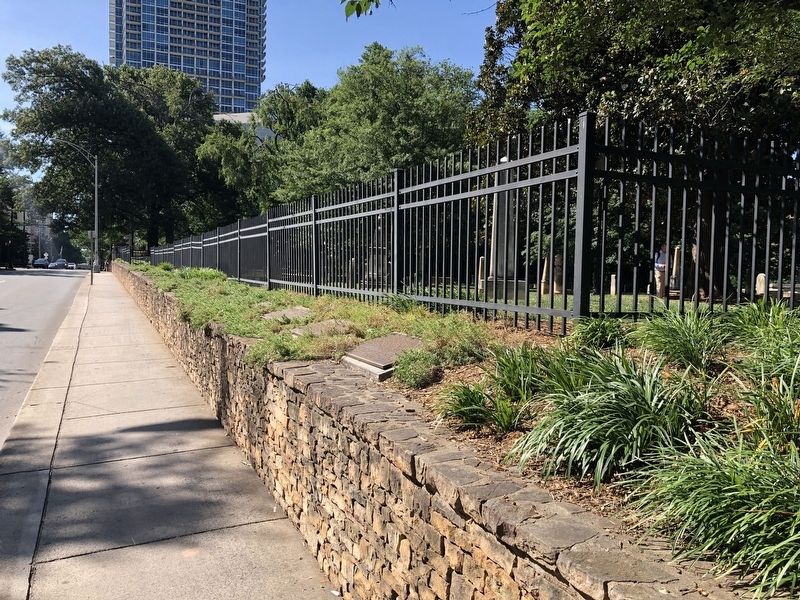
Location. 35° 13.748′ N, 80° 50.589′ W. Marker is in Charlotte, North Carolina, in Mecklenburg County. It is in Charlotte center city. It is on West 5th Street just west of North Church Street, on the right when traveling west. Touch for map. Marker is at or near this postal address: 20 N Church St, Charlotte NC 28202, United States of America. Touch for directions.

Regionally, this marker is in the Piedmont. It is also in the American South and specifically in the Upper South. Globally, it is in North America, the Western Hemisphere,
Other nearby markers. At least 8 other markers are within walking distance of this marker: Prominent Charlotteans Buried At Settlers' Cemetery (here, next to this marker); Restoration Efforts For Settlers' Cemetery (here, next to this marker); The War Between The States (here, next to this marker); Census Information (here, next to this marker); Gold Mining (a few steps from this marker); Ephraim Brevard (a few steps from this marker); Early Education (a few steps from this marker); The Importance Of Religion (a few steps from this marker). Touch for a list and map of all markers in Charlotte.
Credits. This page was last revised on February 3, 2023. It was originally submitted on June 20, 2021, by Devry Becker Jones of Washington, District of Columbia. This page has been viewed 821 times since then and 70 times this year. Photos: 1, 2, 3, 4. submitted on June 20, 2021, by Devry Becker Jones of Washington, District of Columbia.
