King School
⎯⎯⎯
Raise A-B to the Fifth Power
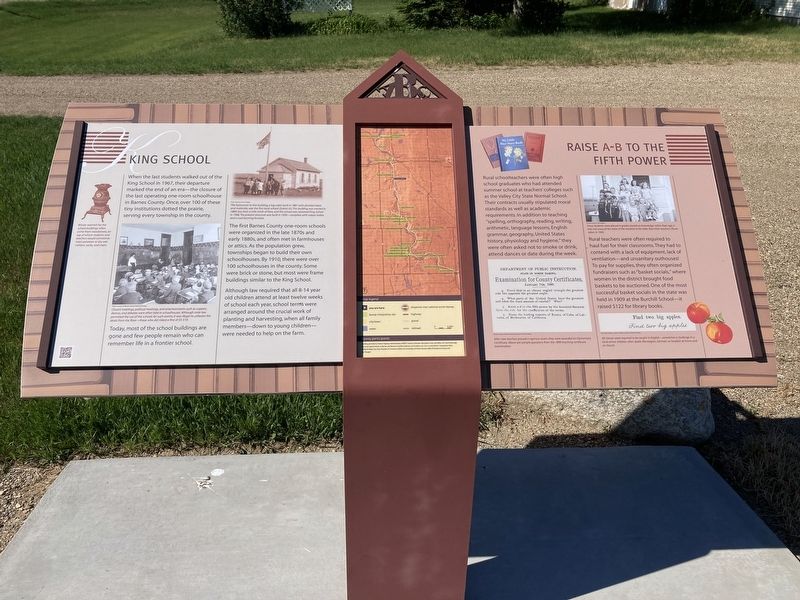
The first Barnes County one-room schools were organized in the late 1870s and early 1880s, and often met in farmhouses or attics. As the population grew, townships began to build their own schoolhouses. By 1910, there were over 100 schoolhouses in the county. Some were brick or stone, but most were frame buildings similar to the King School.
Although law required that all 8-14 year old children attend at least twelve weeks of school each year, school terms were arranged around the crucial work of planting and harvesting, when all family members—down to young children—were needed to help on the farm.
Today, most of the school buildings are gone and few people remain who can remember life in a frontier school.
this page online
Rural teachers were often required to haul fuel for their classrooms. They had to contend with a lack of equipment, lack of ventilation-and unsanitary outhouses! To pay for supplies, they often organized fundraisers such as "basket socials," where women in the district brought food baskets to be auctioned. One of the most successful basket socials in the state was held in 1909 at the Burchill School—it raised $122 for library books.
Captions:
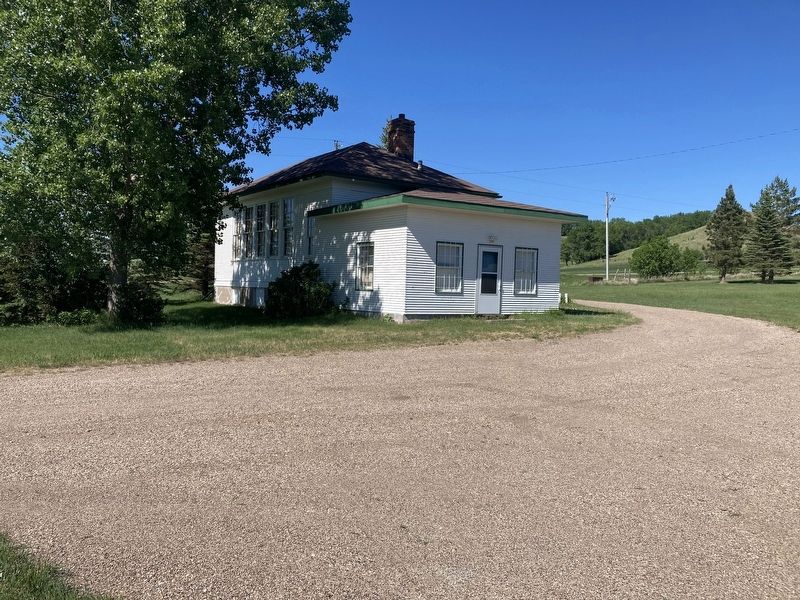
The forerunner to this building, a log cabin built in 1881 with donated labor
and materials, was the first local school: District #3. This building was erected in
1889, less than a mile north of here, and the school was renamed King School
in 1908. The present structure was built in 1930-complete with indoor toilets
and a coal-burning furnace.
Winter warmth for the
school buildings often
came from woodstoves on
top of which students and
teachers would sometimes
roast potatoes or dry wet
mittens, socks, and coats.
Church meetings, political meetings, and entertainments such as suppers,
dances, and debates were often held in schoolhouses. Although state law
permitted the use of the schools for such events, It was illegal to unfasten the
desks from the floor-those who did risked a fine of $5-$10.
Since students were placed in grades based on knowledge rather than age it
was not unusual for some of the students to be older than their teachers.
After new teachers passed a rigorous exam, they were awarded an Elementary
Certificate. Above are sample questions from the 1890 teaching certificate
examination
All classes were required to be taught in English - sometimes a challenge in a
land where children often spoke Norwegian, German or Swedish at home and
at church.
Erected by Federal
Topics. This historical marker is listed in these topic lists: Education • Settlements & Settlers. A significant historical year for this entry is 1909.
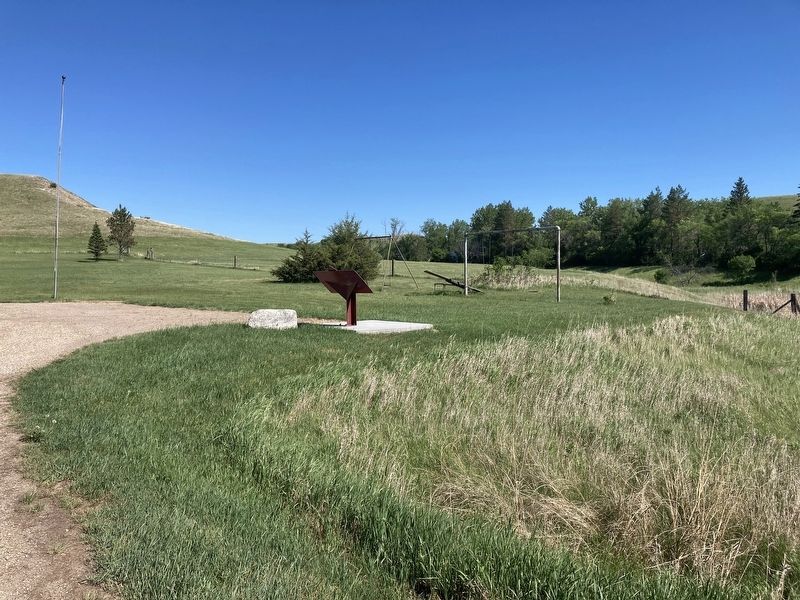
Location. 46° 50.863′ N, 97° 59.818′ W. Marker is near Valley City, North Dakota, in Barnes County. It is on Kathryn Road south of 39th Street Southeast, on the left when traveling south. Touch for map. Marker is in this post office area: Valley City ND 58072, United States of America. Touch for directions.

Regionally, this marker is in the Red River Valley. It is also in the American Lewis & Clark Corridor, on the prairies, and on the Northern Plains. Globally, it is in North America, the Western Hemisphere, the Western World, and the Anglosphere. Historically, it finds itself in what was once Rupert’s Land and also the Louisiana Purchase.
Other nearby markers. At least 8 other markers are within 6 miles of this marker, measured as the crow flies: Sibley Trail (approx. 3.3 miles away); Bridging Time (approx. 5 miles away); Bridging the Community (approx. 5 miles away);
Credits. This page was last revised on June 21, 2021. It was originally submitted on June 20, 2021, by Connor Olson of Menomonee Falls, Wisconsin. This page has been viewed 337 times since then and 27 times this year. Photos: 1, 2, 3. submitted on June 20, 2021, by Connor Olson of Menomonee Falls, Wisconsin. • Mark Hilton was the editor who published this page.
