Fort Mill in York County, South Carolina — The American South (South Atlantic)
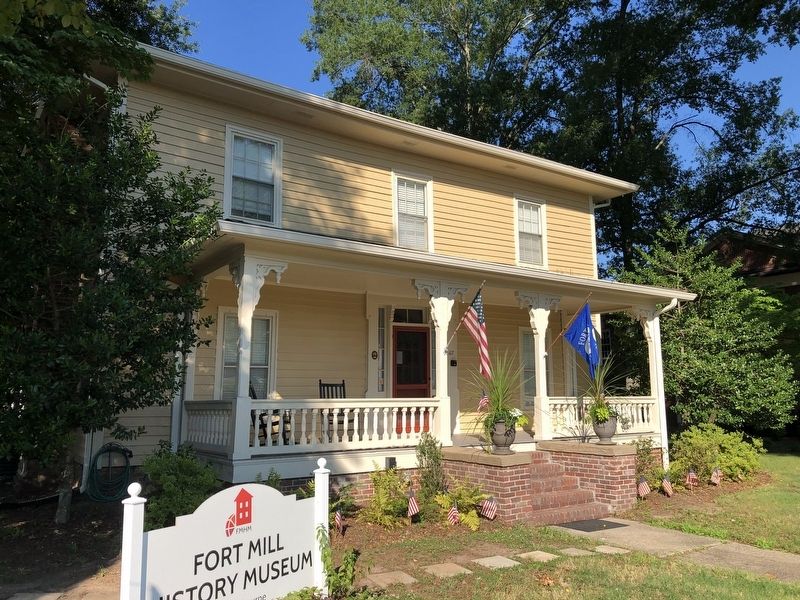
Wilson House
107 Clebourne Street
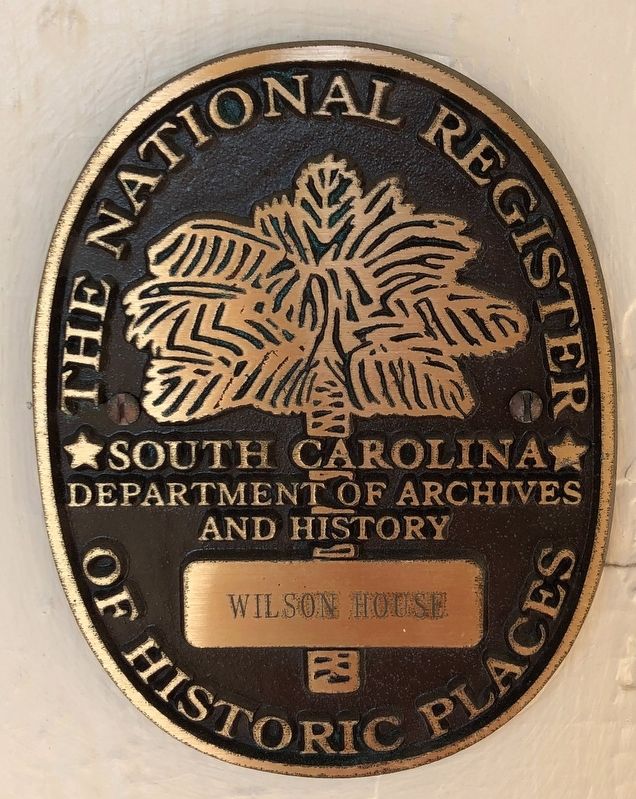
of Historic Places
South Carolina
Department of Archives
and History
Wilson House
Erected by South Carolina Department of Archives and History.
Topics. This historical marker is listed in these topic lists: Architecture • Industry & Commerce. A significant historical year for this entry is 1869.
Location. 35° 0.515′ N, 80° 56.622′ W. Marker is in Fort Mill, South Carolina, in York County. It is on Clebourne Street west of Main Street (State Highway 160), on the left when traveling west. Touch for map. Marker is at or near this postal address: 107 Clebourne St, Fort Mill SC 29715, United States of America. Touch for directions.

Regionally, this marker is in the Midlands and in the Olde English District. It is also in the American South and specifically in the Deep South. Globally, it is in North America, the Western Hemisphere, the Western World, and the Anglosphere. Historically, it finds itself in what was once the original Cherokee Nation, the territory of the Mississippian Culture, one of the original Thirteen Colonies, one of the Confederate States of America, and
this page online
Other nearby markers. At least 8 other markers are within walking distance of this marker: Catawba Fort (a few steps from this marker); Fort Mill Confederate Memorial (about 400 feet away, measured in a direct line); Catawba Indian Memorial (about 400 feet away); Women of the Confederacy Memorial (about 500 feet away); To the Faithful Slaves (about 500 feet away); Confederate Park (about 500 feet away); 1LT Elliott White Springs (about 600 feet away); Millstone Park (about 700 feet away). Touch for a list and map of all markers in Fort Mill.
Also see . . . National Register of Historic Places Nomination Form for the Wilson House/Hull House.
This form was prepared by Paul M. Gettys, Paul M. Gettys Associates, on September 28, 1990. The statement of significance is on page 2:
The Wilson House (c. 1869) is significant as an example of Late Victorian residential architecture. It represents the early growth of Fort Mill, as it was originally located on Main Street and was moved to accommodate commercial expansion. The house, having been moved, falls under Criteria Consideration B. Since the move(Submitted on May 26, 2026, by Devry Becker Jones of Washington, District of Columbia.)occurred well over fifty years ago and the house has retained its character and form, and is significant primarily for its architectural value, the property qualifies.
For a period of time following the construction of the railroad through Fort Mill in 1852, the village grew as a trading center and point of sale for cotton grown in the surrounding countryside. As the merchants became successful, larger houses began to appear, clustered around Main Street. The Wilson House was built about 1869 by Stewart Wilson. A visitor to Fort Mill in 1875 was a guest of Dr. S. A. Kell, then owner of the house. He described it as a fine, impressive home on the summit of the chief hill of the town on Main Street. In the 1920s the house was moved to its present location on Clebourne Street, just around the corner from the original location. Several houses existed on Main Street and they faced either demolition or being moved to make way for the expansion of commercial properties. The Wilson House is the only known house which still exists and underwent this process. The growth of the commercial properties along Main Street was fueled by the continuing growth of the downtown area as the textile mi11s provided a steady payroll to a growing number of employees.
The house has had a number of owners. In recent years, it has become known as the Hull House, and is currently used for specialty shops.
Credits. This page was last revised on May 26, 2026. It was originally submitted on June 21, 2021, by Devry Becker Jones of Washington, District of Columbia. This page has been viewed 639 times since then and 41 times this year. Photos: 1, 2. submitted on June 21, 2021, by Devry Becker Jones of Washington, District of Columbia.
