Concord in Cabarrus County, North Carolina — The American South (South Atlantic)
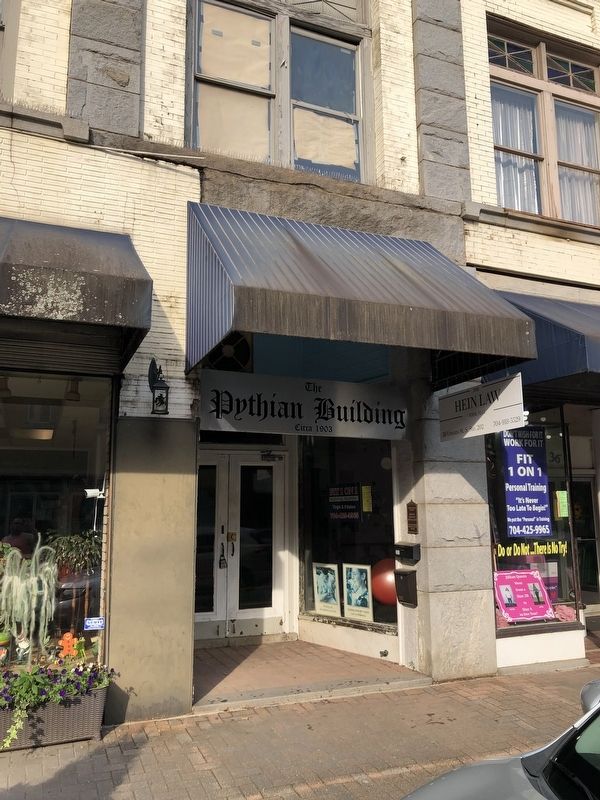
Pythian Building
40 South Union Street
| — | South Union Street Courthouse and Commercial Historic District | — |
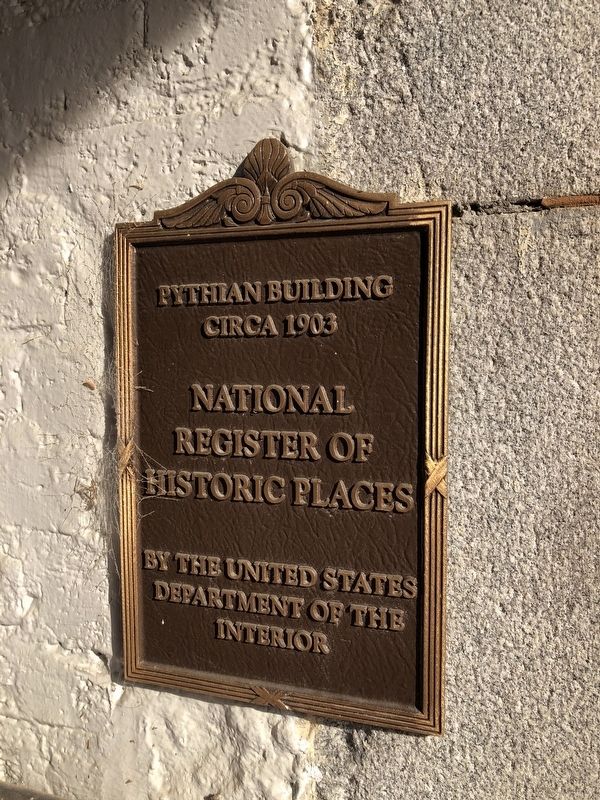
Circa 1903
National
Register of
Historic Places
by the United States
Department of the
Interior
Topics. This historical marker is listed in these topic lists: Architecture • Industry & Commerce. A significant historical year for this entry is 1903.
Location. 35° 24.585′ N, 80° 34.834′ W. Marker is in Concord, North Carolina, in Cabarrus County. It is on Union Street South 0.1 miles south of Cabarrus Avenue West (County Road 1002), on the right when traveling south. Touch for map. Marker is at or near this postal address: 40 Union St S, Concord NC 28025, United States of America. Touch for directions.

Regionally, this marker is in the Piedmont and in Greater Charlotte. It is also in the American South and specifically in the Upper South. Globally, it is in North America, the Western Hemisphere, the Western World, and the Anglosphere. Historically, it finds itself in what was once the territory of the Mississippian Culture, one of the original Thirteen Colonies, one of the Confederate States of America, and the Antebellum South.
Other nearby markers. At least 8 other markers are
this page online
Also see . . . National Register of Historic Places nomination form for the historic district.
This form was prepared in 1997 by Laura A.W. Phillips, Architectural Historian, consulting for the Concord Downtown Development Corporation. An architectural description of the building can be found on pages 12-13:
8. Pythian Building(Submitted on March 21, 2024, by Devry Becker Jones of Washington, District of Columbia.)
40 Union Street, S.
ca. 1903
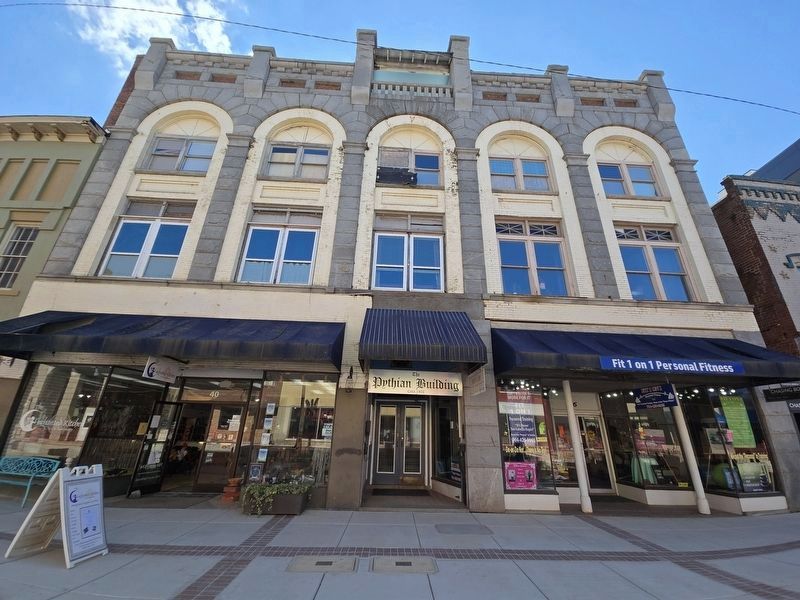
The three-story, stone-veneered Pythian Building is one of the finest and best-preserved turn-of-the-century commercial structures in Concord's central business district. It was built by the Pythian Realty Company, a firm incorporated in 1902 by Charles Ritchie,J. L. Miller, and others. The building was designed to accommodate ground-floor stores, upper-story office space, and a large, second-floor meeting hall for the Knights of Pythias, a fraternal order. The Ritchie Hardware Company occupied the store in the north half of the building for several decades, and Efird's opened their first Concord store in the south half in 1907 or 1908. For several years during the early twentieth century, the Eagle's Club occupied the north front second-floor rooms. The Pythian Building exhibits a distinctive design influenced by the nineteenth-century Romanesque Revival style. Pilasters and round arches of rusticated stone divide the facade into five bays: within the areas defined by the arches, the second and third story windows are set in yellow, paneled brickwork. At the cornice level directly above the pilasters, bold stone corbels that project forward and above the main roof line emphasize the facade's five-bay division; the corbels framing the center bay rise to form an open pavilion on the roof that appears in numerous old photographs of Concord's downtown. Although the store fronts have been remodeled,some original features remain intact, including rusticated stone pilasters, cast-iron store-front columns, and partially hidden leaded glass transoms over the display windows. One of the stores retains a decorative, pressed metal ceiling. Particularly handsome are the broad, central stair with beaded-board wainscot that leads to the second floor, and the second-floor landing that features original transomed doors, interior windows, a beaded-board wainscot, and a decorative tile floor. A partially enclosed, balustraded and wainscoted stair leads from the landing to the third floor.Photographed by Mark Parker, October 5, 20243. Full view of Pythian Building
Credits. This page was last revised on October 10, 2024. It was originally submitted on June 23, 2021, by Devry Becker Jones of Washington, District of Columbia. This page has been viewed 942 times since then and 153 times this year. Photos: 1, 2. submitted on June 23, 2021, by Devry Becker Jones of Washington, District of Columbia. 3. submitted on October 9, 2024, by Mark Parker of Hickory, North Carolina.
