The ABCFM
Lac qui Parle Mission
- The Bible Matthew 28:18-20
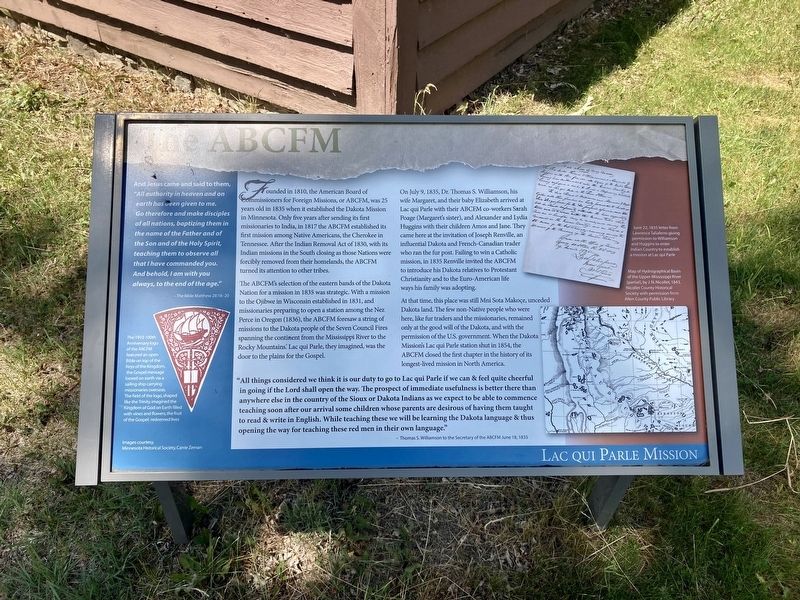
Founded in 1810, the American Board of Commissioners for Foreign Missions, or ABCFM, was 25 years old in 1835 when it established the Dakota Mission in Minnesota. Only five years after sending its first missionaries to India, in 1817 the ABCFM established its first mission among Native Americans, the Cherokee in Tennessee. After the Indian Removal Act of 1830, with its Indian missions in the South closing as those Nations were forcibly removed from their homelands, the ABCFM turned its attention to other tribes.
The ABCFM's selection of the eastern bands of the Dakota Nation for a mission in 1835 was strategic. With a mission to the Ojibwe in Wisconsin established in 1831, and missionaries preparing to open a station among the Nez Perce
this page online
On July 9, 1835, Dr. Thomas S. Williamson, his wife Margaret, and their baby Elizabeth arrived at Lac qui Parle with their ABCFM co-workers Sarah Poage (Margaret's sister), and Alexander and Lydia Huggins with their children Amos and Jane. They came here at the invitation of Joseph Renville, an influential Dakota and French-Canadian trader who ran the fur post. Failing to win a Catholic mission, in 1835 Renville invited the ABCFM to introduce his Dakota relatives to Protestant Christianity and to the Euro-American life ways his family was adopting.
At that time, this place was still Mni Sota Makoçe, unceded Dakota land. The few non-Native people who were here, like fur traders and the missionaries, remained only at the good will of the Dakota, and with the permission of the U.S. government. When the Dakota Mission's Lac qui Parle station shut in 1854, the ABCFM

"All things considered we think it is our duty to go to Lac qui Parle if we can & feel quite cheerful
in going if the Lord shall open the way. The prospect of immediate usefulness is better there than
anywhere else in the country of the Sioux or Dakota Indians as we expect to be able to commence
teaching soon after our arrival some children whose parents are desirous of having them taught
to read & write in English. While teaching these we will be learning the Dakota language & thus
opening the way for teaching these red men in their own language.”
- Thomas S. Williamson to the Secretary of the ABCFM June 18, 1835
Captions:
The 1910 100th
Anniversary logo
of the ABCFM
featured an open
Bible on top of the
Keys of the Kingdom,
the Gospel message
loosed on earth via a
sailing ship carrying
missionaries overseas.
The field of the logo, shaped
like the Trinity, imagined the
Kingdom of God on Earth filled
with vines and flowers, the fruit
of the Gospel: redeemed lives
June 22, 1835 letter from
Lawrence Taliaferro giving
permission to Williamson
and Huggins to enter
Indian Country to establish
a mission at Lac qui Parle
Map of Hydrographical Basin
of the Upper Mississippi River
Erected by Minnesota
Topics. This historical marker is listed in these topic lists: Charity & Public Work • Indigenous Peoples and Communities • Religion & Religious Structures. A significant historical year for this entry is 1810.
Location. 45° 1.427′ N, 95° 52.083′ W. Marker is near Churchill, Minnesota, in Chippewa County. It can be reached from 140th Avenue Northwest (County Road 32) near 1st Avenue West (County Road 13). Located near the corner of the chapel, Lac qui Parle Mission State Historic Site. Touch for map. Marker is in this post office area: Watson MN 56295, United States of America. Touch for directions.

Regionally, this marker is in Southwest Minnesota. It is also in the American Midwest, in the Corn Belt, and on the Great Plains. Globally, it is in North America, the Western Hemisphere, the Western World, and the Anglosphere. Historically, it finds itself in what was once Rupert’s Land, the territory of the Mississippian Culture, and the Louisiana Purchase.
Other nearby markers. At least 8 other markers are within walking distance of this marker: Dakotas at Lac qui Parle (a few steps from this marker); Missionaries at Lac qui Parle (a few steps from this marker); Williamson Cabin (a few steps from this marker); Acculturation & Autonomy (a few steps from this marker); Huggins Cabin (within shouting distance of this marker); The Dakota (within shouting distance of this marker); Riggs & Pettijohn Cabins (within shouting distance of this marker); Lac qui Parle Mission (about 300 feet away, measured in a direct line). Touch for a list and map of all markers in Churchill.
Also see . . . The ABCFM. (Submitted on July 6, 2021, by Connor Olson of Menomonee Falls, Wisconsin.)
Credits. This page was last revised on October 30, 2024. It was originally submitted on July 6, 2021, by Connor Olson of Menomonee Falls, Wisconsin. This page has been viewed 360 times since then and 27 times this year. Photos: 1. submitted on July 6, 2021, by Connor Olson of Menomonee Falls, Wisconsin. 2. submitted on October 29, 2024. • Mark Hilton was the editor who published this page.
