Nokomis in Minneapolis in Hennepin County, Minnesota — The American Midwest (Upper Plains)
Playgrounds
The Innovation of Play
Photographed by McGhiever, June 22, 2021
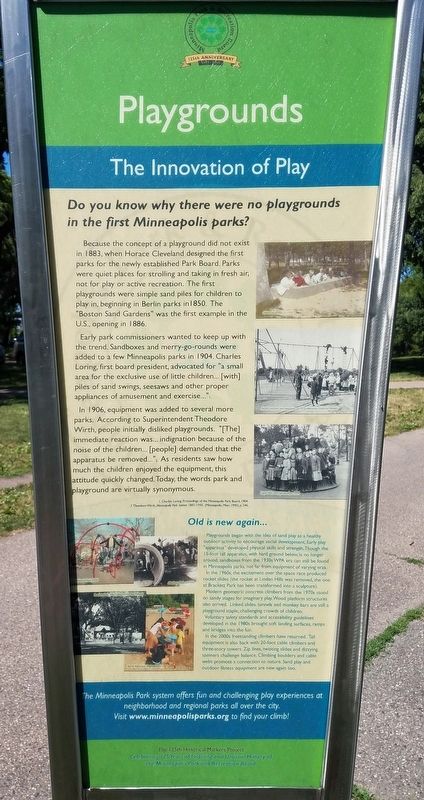
1. Playgrounds: The Innovation of Play marker
Early park commissioners wanted to keep up with the trend. Sandboxes and merry-go-rounds were added to a few Minneapolis parks in 1904. Charles Loring, first board president, advocated for "a small area for the exclusive use of little children... [with] piles of sand, swings, seesaws and other proper appliances of amusement and exercise..."
In 1906, equipment was added to several more parks. According to Superintendent Theodore Wirth, people initially disliked playgrounds. "[The] immediate reaction was... indignation because of the noise of the children... [people] demanded that the apparatus be removed..." As residents saw how much the children enjoyed the equipment, this attitude quickly changed. Today, the words park and playground are virtually synonymous.
Old is new again...
Playgrounds began with the idea of sand play as a healthy outdoor activity to encourage social development. Early play "apparatus" developed physical skills and strength. Though the 15-foot tall apparatus, with hard ground below, is no longer around, sandboxes from the 1930s WPA era can still be found in Minneapolis parks, not far from equipment of varying eras.
In the 1960s, the excitement over the space race produced rocket slides (the rocket at Linden Hills was removed, the one at Brackett Park has been transformed into
this page online
Modern geometric concrete climbers form the 1970s stood on sandy stages for imaginary play. Wood platform structures also arrived. Linked slides, tunnels and monkey bars are still a playground staple, challenging crowds of children.
Voluntary safety standards and accessibility guidelines developed in the 1980s brought soft landing surfaces, ramps and bridges into the fun.
In the 2000s freestanding climbers have returned. Tall equipment is also back with 20-foot cable climbers and three-story towers. Zip lines, twisting slides and dizzying spinners challenge balance. Climbing boulders and cable webs promote a connection to nature. Sand play and outdoor fitness equipment are new again too.
Erected 2008 by Minneapolis Park and Recreation Board.
Topics. This historical marker is listed in this topic list: Parks & Recreational Areas. A significant historical year for this entry is 1904.
Location. 44° 54.928′ N, 93° 14.097′ W. Marker is in Minneapolis, Minnesota, in Hennepin County. It is in Nokomis. It can be reached from East Minnehaha Parkway. Touch for map. Marker is at or near this postal address: 2405 E Minnehaha
Photographed by McGhiever, June 22, 2021
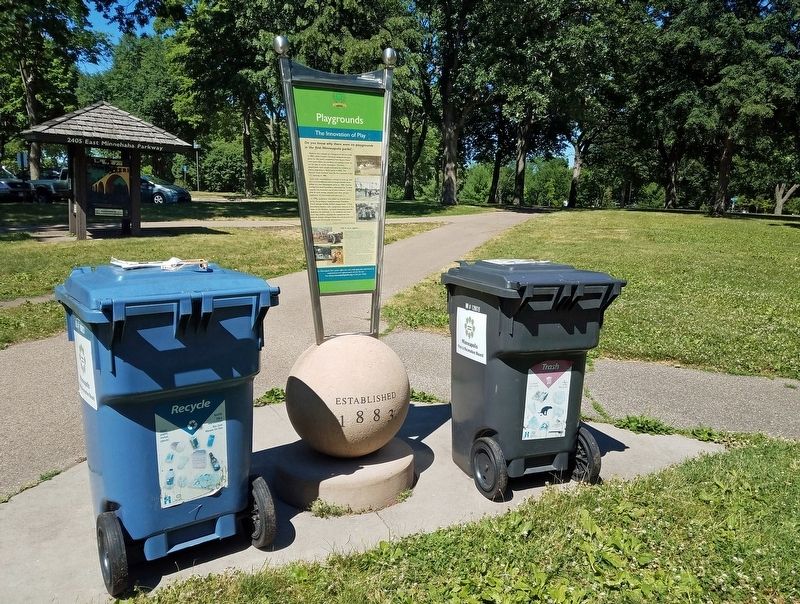
2. Marker just south of a parking lot off Minnehaha Parkway

Regionally, this marker is in the Twin Cities Metropolitan Area. It is also in the American Midwest, in the Corn Belt, and in the Great River Road Region. Globally, it is in North America, the Western Hemisphere, the Western World, and the Anglosphere. Historically, it finds itself in what was once Rupert’s Land, the territory of the Mississippian Culture, and the Louisiana Purchase.
Other nearby markers. At least 8 other markers are within 2 miles of this marker, measured as the crow flies: Bicycle Paths (approx. one mile away); Restoration (approx. one mile away); Minnehaha Depot (approx. 1.2 miles away); President Lyndon B. Johnson at Minnehaha Falls (approx. 1.2 miles away); Stevens House (approx. 1.2 miles away); Col. John H. Stevens (approx. 1.2 miles away); Gunnar Wennerberg (approx. 1.2 miles away); John Harrington Stevens House (approx. 1.2 miles away). Touch for a list and map of all markers in Minneapolis.
Another marker is no longer nearby. George Washington Bi-Centennial Tree (was approx. 1.2 miles away but has been confirmed missing).
More about this marker. Located at Lake Nokomis, between the playground and the easternmost parking lot off Minnehaha Parkway. It is just east of Lake Nokomis Community Center.
Credits. This page was last revised on February 12, 2023. It was originally submitted on July 10, 2021, by McGhiever of Minneapolis, Minnesota. This page has been viewed 369 times since then and 25 times this year. Photos: 1, 2. submitted on July 10, 2021, by McGhiever of Minneapolis, Minnesota. • Mark Hilton was the editor who published this page.
