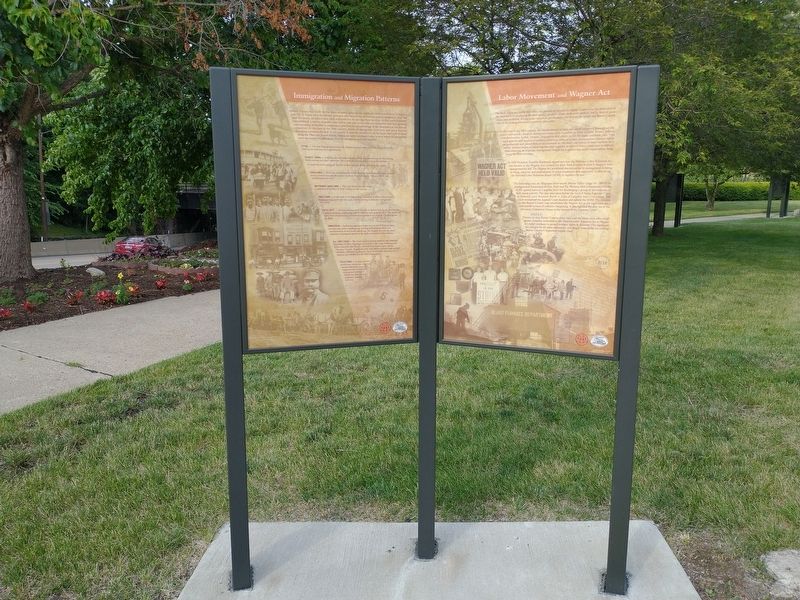
Labor Movement and Wagner Act

At the turn of the 20th century, the establishment of large and small industries throughout the county attracted a flood of immigrants from such countries as Italy, Croatia, Russia, Poland, Czechoslovakia, Serbia, Ukraine, Yugoslavia and others to fill the many available jobs. This rapid growth and surplus of workers, however, came at a cost, as companies focused solely on production and placed little or no emphasis on the needs and safety of their workers. As a result, workers began to band together and organize in order to force companies to address their concerns. In response, management fought back against this union organization, firing many for their activities.
In 1935 President Franklin Roosevelt signed into law the National Labor Relations Act, also known
this page online
The following year, an Aliquippa labor union, Beaver Valley Lodge No. 200 of the Amalgamated Association of Iron, Steel and Tin Workers, filed a complaint with the NLRB against Jones & Laughlin Steel for discharging a group of men because of their union activity. The case was taken before the United States Supreme Court in National Labor Relations Board vs. Jones & Laughlin Steel Corporation. The court overturned the Appeals Court decision and upheld the NLRB. The decision in this Beaver County case established the Wagner Act as the legal basis for a nationwide system of collective bargaining. It also signified the first use of the Interstate Commerce Clause in the history of the Supreme Court.
Thanks to that Beaver County court case and the brave men who stood against company intimidation, the National Labor Relations
Topics. This historical marker is listed in these topic lists: Industry & Commerce • Labor Unions. A significant historical year for this entry is 1935.
Location. 40° 41.885′ N, 80° 17.842′ W. Marker is in Beaver, Pennsylvania, in Beaver County. It is on East End Avenue, on the right when traveling north. Touch for map. Marker is in this post office area: Beaver PA 15009, United States of America. Touch for directions.

Regionally, this marker is in Greater Pittsburgh. It is also in the American Northeast, in the Mid-Atlantic, and in the Ohio River Valley. Globally, it is in North America, the Western Hemisphere, the Western World, and the Anglosphere. Historically, it finds itself in what was once the Haudenosaunee (Iroquois) Confederacy and also one of the original Thirteen Colonies.
Other nearby markers. At least 8 other markers are within walking distance of this marker: Immigration and Migration Patterns (here, next to this marker); Growth And Decline 1946-1985 (here, next to this marker); A New Era Begins 1986-Present (here, next to this marker); Famous Athletes (a few steps from this marker); Military Service (a few steps from this marker); Beaver Area Heritage Foundation (a few steps from this marker); African Americans (a few steps from this marker); Women in Beaver County (a few steps from this marker). Touch for a list and map of all markers in Beaver.
Credits. This page was last revised on July 15, 2021. It was originally submitted on July 11, 2021, by Craig Doda of Napoleon, Ohio. This page has been viewed 326 times since then and 23 times this year. Photos: 1, 2. submitted on July 11, 2021, by Craig Doda of Napoleon, Ohio. • Bill Pfingsten was the editor who published this page.
