Glanhayes in Wayne County, West Virginia — The American South (Appalachia)
Polley Freedom Case
⎯⎯⎯
William Ratliff (Ratcliff)
Photographed by J. J. Prats, July 23, 2021
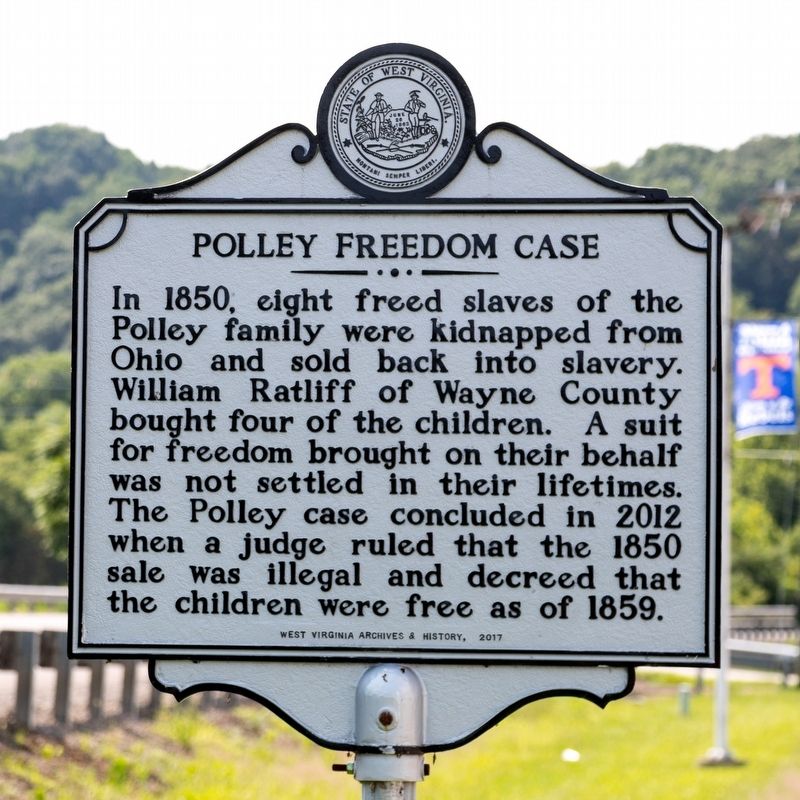
1. Polley Freedom Case side of marker
Polley Freedom Case. In 1850, eight freed slaves of the Polley family were kidnapped from Ohio and sold back into slavery. William Ratliff of Wayne County bought four of the children. A suit for freedom brought on their behalf was not settled in their lifetimes. The Polley case concluded in 2012 when a judge ruled that the 1850 sale was illegal and decreed that the children were free as of 1859.
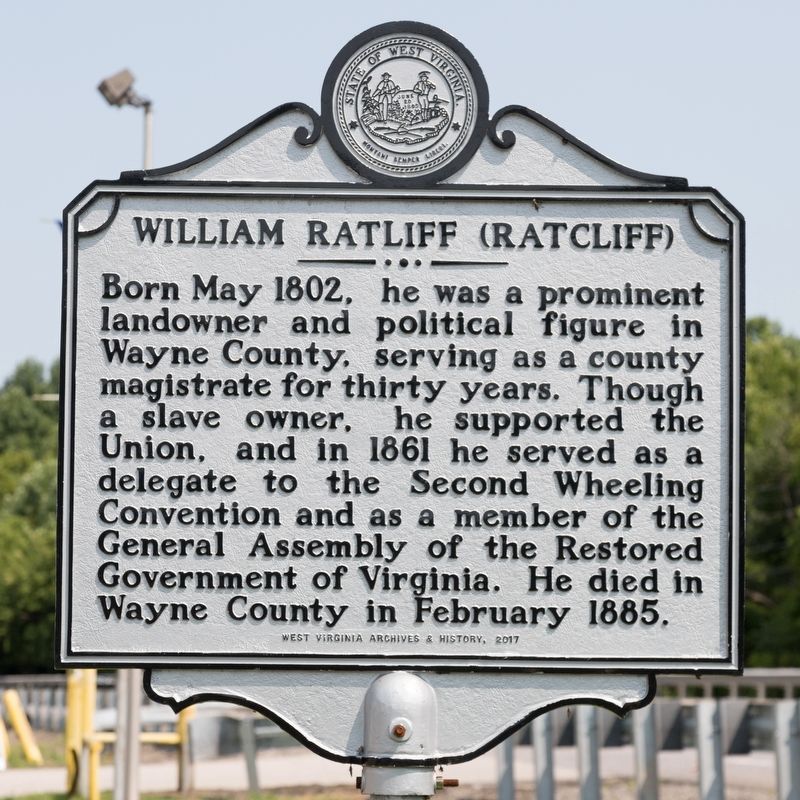
William Ratliff (Ratcliff). Born May 1802, he was a prominent landowner and political figure in Wayne County, serving as a county magistrate for thirty years. Though a slave owner, he supported the Union, and in 1861 he served as a delegate to the Second Wheeling Convention and as a member of the General Assembly of the Restored Government of Virginia. He died in Wayne County in February 1885.
Erected 2017 by West Virginia Archives & History.
Topics and series. This historical marker is listed in this topic list: African Americans. In addition, it is included in the West Virginia Archives and History series list. A significant historical month for this entry is February 1885.
Location. 38° 0.036′ N, 82° 30.07′ W.
this page online

Regionally, this marker is in the Kyova Tri-State Region and in the Southern Coalfields. It is also in the American South, specifically in the Upper South, in the Ohio River Valley, in Appalachia, and specifically in Southern Appalachia. Globally, it is in North America, the Western Hemisphere, the Western World, and the Anglosphere. Historically, it finds itself in what was once the territory of the Mississippian Culture.
Other nearby markers. At least 8 other markers are within 10 miles of this marker, measured as the crow flies: Revolutionary War Soldier’s Grave (approx. 5.6 miles away); a different marker also named Revolutionary War Soldier’s Grave (approx. 8½ miles away); Pioneer Furnace / Iron Made in Kentucky (approx. 8.7 miles away in Kentucky); a different marker also named Revolutionary War Soldier’s Grave (approx. 9.4 miles away); Fort Gay Toll Bridge (approx.
Photographed by J. J. Prats, July 23, 2021
2. Polley Freedom Case / William Ratliff (Ratcliff) Marker
Also see . . .
1. Free at Last. 2012 article by Michelle Goodman in the Ironton Tribune. Excerpt:
In a unique court case Friday, Wayne County Circuit Court Judge Darrell Pratt ruled on a case that had been pending in the county since 1856, essentially redefining the family history of James Hale and his relatives, as it should have been done more than 160 years ago.(Submitted on July 30, 2021.)
Hale, a Huntington, W.Va. resident, filed a motion recently to get an official and final ruling on the freedom status of his great-great-grandfather Harrison Polley, and two of Polley’s sisters, Anna and Louisa.
2. The Long Road to Freedom: The Story of the Enslaved Polley Children. 2014 book by James L. Hale on Amazon.com. (Submitted on July 30, 2021.)
Photographed by J. J. Prats, July 23, 2021
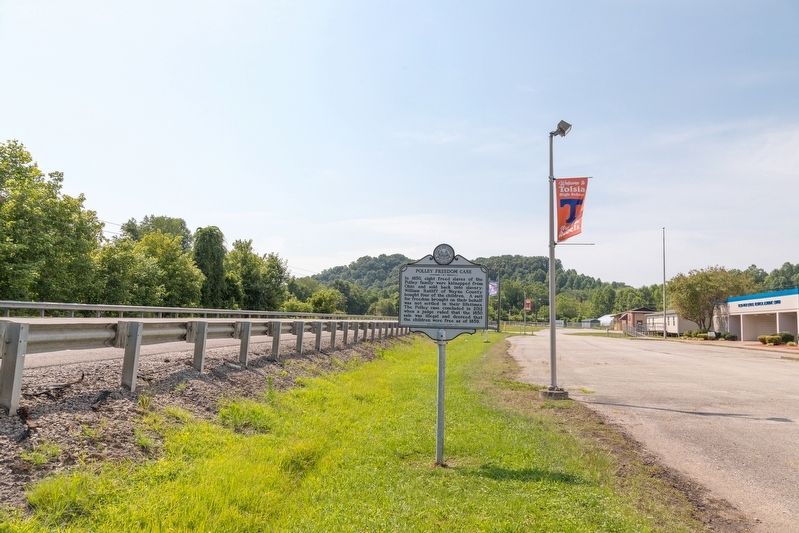
3. Polley Freedom Case / William Ratliff (Ratcliff) Marker
Credits. This page was last revised on July 30, 2021. It was originally submitted on July 30, 2021, by J. J. Prats of Powell, Ohio. This page has been viewed 1,098 times since then and 74 times this year. Photos: 1, 2, 3. submitted on July 30, 2021, by J. J. Prats of Powell, Ohio.
