Bramwell in Mercer County, West Virginia — The American South (Appalachia)
The Workers
National Coal Heritage Trail
Photographed by J. J. Prats, July 24, 2021
1. The Workers Marker
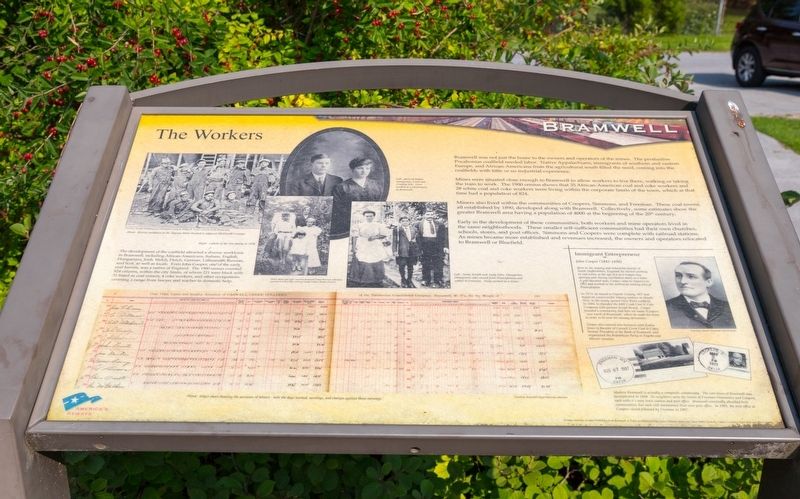
Bramwell was not just the home to the owners and operators of the mines. The productive Pocahontas coalfield needed labor. Native Appalachians, immigrants of southern and eastern Europe and African-Americans from the agricultural south filled the need, coming into the coalfields with little or no industrial experience.
Mines were situated close enough to Bramwell to allow workers to live there, walking or taking the train to work. The 1900 census shows the 35 African-Americans coal and coke workers and 28 white coal and coke workers were living within the corporate limits of the town, which at that time had a population of 824.
Miners also lived within the communities of Coopers, Simmons, and Freeman. These coal towns, all established by 1890, developed along with Bramwell. Collectively, some estimates show the greater Bramwell area having a population of 4000 at the beginning of the 20th century.
Early in the development of these communities, both workers and mine operators lived in the same neighborhoods. These smaller self-sufficient communities had their own churches, schools, stores, and post offices. Simmons
this page online
[Sidebar:]
The development of the coalfield attracted a diverse workforce to Bramwell, including African-Americans, Italians, English, Hungarians, Irish, Welch, Dutch, German, Lithuanian, Russian, and Scott, as well as locals. Even John Cooper, one of the early coal barons, was a native of England. The 1900 census counted 824 citizens within the city limits, of whom 221 were black with 31 listed as coal miners, 4 coke workers, and other occupations covering a range from lawyer to domestic help.
Immigrant Entrepeneur, John Cooper (1842–1898).
Born in the mining and industrial district of South Staffordshire, England, he started working in coal mines at the age of 6 as a trapper boy — opening and closing ventilation doors in a mine. A self-educated man, Cooper came to America in 1862 and worked in the anthracite mining area of Pennsylvania.
In 1873, he moved to Fayette County, WV and began an unsuccessful mining venture at Hawks Nest, in the newly opened New River coalfield. In 1884, he founded the Mill Creek Coal Coke Company with partner Joseph Beury. Cooper founded a community that bore his name (Coopers — just south of Bramwell) where he made his home in order to be-near his mining operations.
Cooper also entered into business with Jenkin Jones (a founder of Caswell Creek Coal & Coke), became President of the .Bank of Bramwell, and organized the Republican Party in Fayette and Mercer counties.
Modern Bramwell is actually a composite community. The core town of Bramwell was incorporated in 1888. Its neighbors were the towns of Freeman (Simmons) and Coopers, each with its own train station and post office. Bramwell eventually absorbed both communities, but each still maintained their own post office. In 1993, the post office at Coopers closed followed by Freeman in 1997.
Erected by National

Photographed by J. J. Prats, July 24, 2021
2. The Workers Marker
Topics and series. This historical marker is listed in these topic lists: Industry & Commerce • Natural Resources. In addition, it is included in the Coal Heritage Trail series list. A significant historical year for this entry is 1900.
Location. 37° 19.498′ N, 81° 18.8′ W. Marker is in Bramwell, West Virginia, in Mercer County. It is at the intersection of Main Street (County Route 120) and Simmons Avenue (County Route 120), on the left when traveling west on Main Street. Touch for map. Marker is at or near this postal address: 100 Simmons Avenue, Bramwell WV 24715, United States of America. Touch for directions.

Regionally, this marker is in the Southern Coalfields. It is also in the American South, specifically in the Upper South, in Appalachia, and specifically in Southern Appalachia. Globally, it is in North America, the Western Hemisphere, the Western World, and the Anglosphere. Historically, it finds itself in what was once the territory of the Mississippian Culture.
Other nearby markers. At least 8 other markers are within 2 miles of this marker, measured as the crow

Photographed by J. J. Prats, July 24, 2021
3. Three of the Interpretive Panels at Bramwell
This panel is the rightmost panel. The small panel on the left is not a historical marker, it is shows a map of the National Coal Heritage Trail and lists points of interest on and near the trail.
More about this marker. This interpretive panel is illustrated with five photographs, a “ledger sheet showing the accounts of miners” listing “the days worked, earnings, and charges against those earnings,” and postmarks from Freeman and Coopers post offices before they closed. The photographs were captioned as follows, left to right,
- Diverse workforce at the Algoma Mine (located in adjacent McDowell County)
- the Yon family in 1934
- photo of Italian immigrants, Livio and Cristina Yon. Livio worked as a stonemason i Bramwell.
- Anna, Joseph and Andy Sabo, Hungarian immigrants who moved from Pennsylvania and settled in Freeman. Andy worked as a miner.
- (a portrait of John Cooper)

Photographed by J. J. Prats, July 24, 2021
4. Replica of the N&W Station in Bramwell, West Virginia
It is a museum and gift shop and one of the National Coal Heritage Area interpretive sites. The interpretive panels are arranged around the small plaza out of frame on the left.
Credits. This page was last revised on August 8, 2021. It was originally submitted on August 8, 2021, by J. J. Prats of Powell, Ohio. This page has been viewed 333 times since then and 20 times this year. Last updated on August 8, 2021, by Bradley Owen of Morgantown, West Virginia. Photos: 1, 2, 3, 4. submitted on August 8, 2021, by J. J. Prats of Powell, Ohio. • Devry Becker Jones was the editor who published this page.
