
Bowling Green in Wood County, Ohio — The American Midwest (Great Lakes)
Ties That Bind
Photographed by Craig Doda, August 28, 2021
1. Ties That Bind Marker
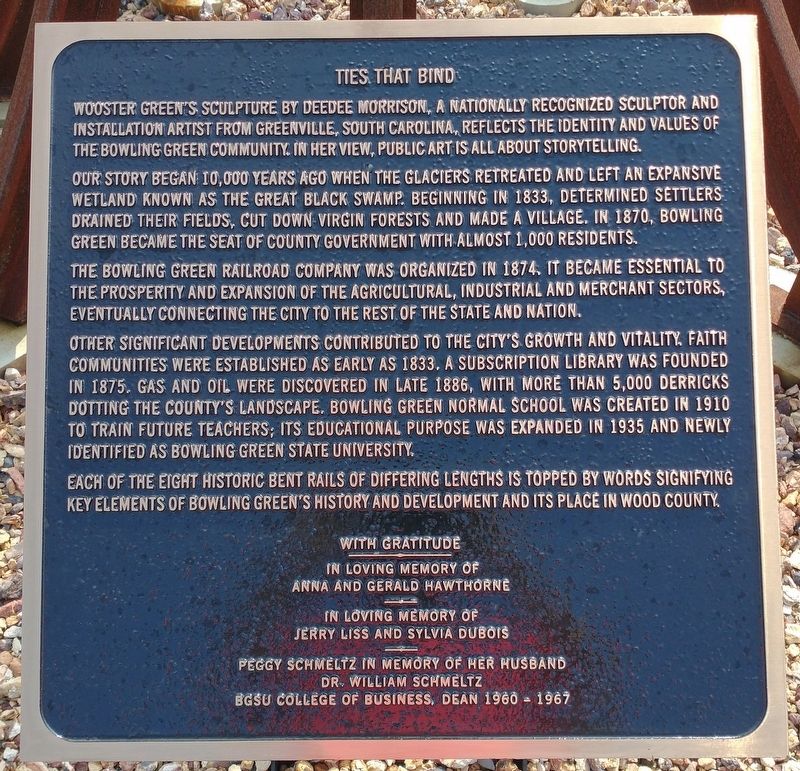
Our story began i0,000 years ago when the glaciers retreated and left an expansive wetland known as the great black swamp. Beginning in 1833, determined settlers drained their fields, cut down virgin forests and made a village. In 1870, Bowling Green became the seat of county government with almost 1,000 residents.
The Bowling Green railroad company was organized in 1874. It became essential to the prosperity and expansion of the agricultural, industrial and merchant sectors, eventually connecting the city to the rest of the state and nation.
Other significant developments contributed to the city's growth and vitality. Faith communities were established as early as 1833. A subscription library was founded in 1875. Gas and oil were discovered in late 1886, with more than 5,000 derricks dotting the county's landscape. Bowling Green normal school was created
this page online
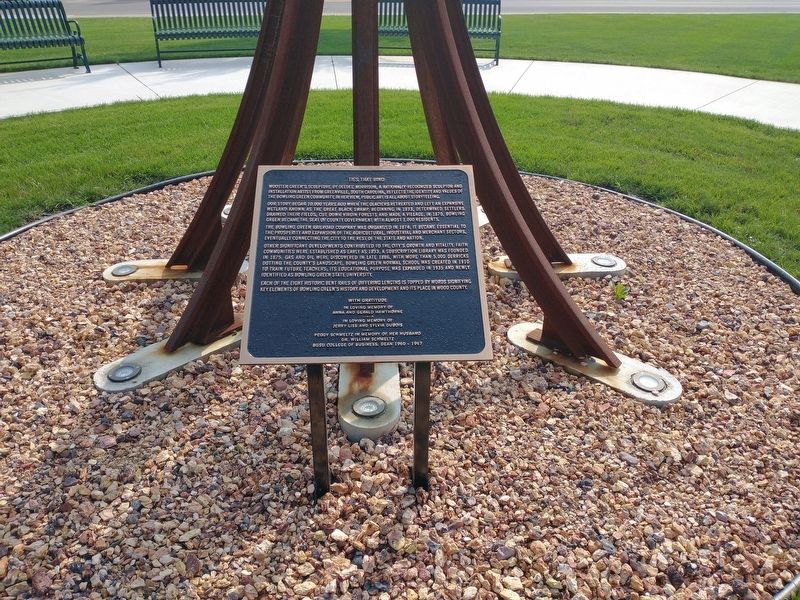
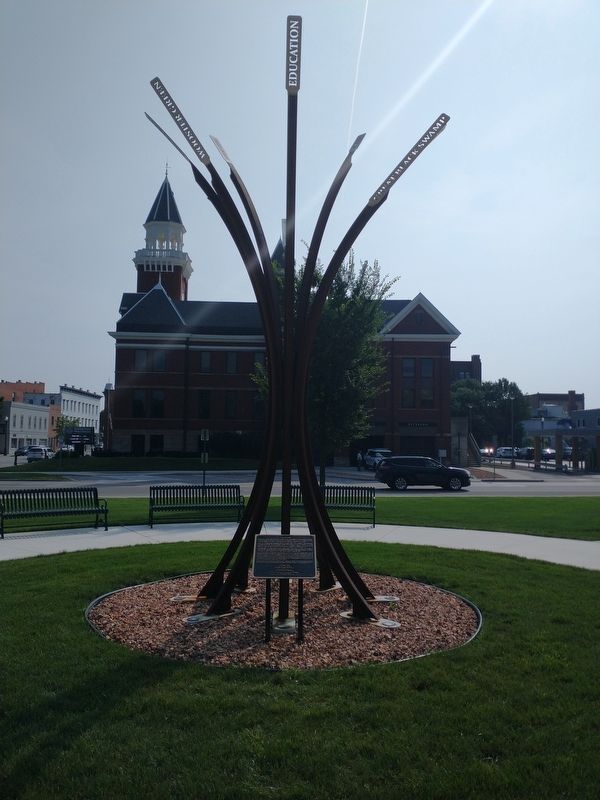
Each of the eight historic bent rails of differing lengths is topped by words signifying key elements of Bowling Green's history and development and its place in Woood County.
Topics. This historical marker is listed in these topic lists: Arts, Letters, Music • Education. A significant historical year for this entry is 1833.
Location. 41° 22.478′ N, 83° 39.145′ W. Marker is in Bowling Green, Ohio, in Wood County. It is at the intersection of W. Wooster Street and S. Church Street, on the right when traveling east on W. Wooster Street. Touch for map. Marker is in this post office area: Archbold OH 43502, United States of America. Touch for directions.

Regionally, this marker is in Ohio’s Black Swamp, in the Till Plains, and in the Toledo Metropolitan Area. It is also in the American Midwest and in the Corn Belt. Globally, it is in North America, on the Great Lakes, in the Western Hemisphere, in the Western World, and in the Anglosphere. Historically, it finds itself in what
Photographed by Craig Doda, August 28, 2021
2. Ties That Bind Marker
Other nearby markers. At least 8 other markers are within walking distance of this marker: Historic Churches (here, next to this marker); Welcome To Wooster Green (a few steps from this marker); Historic Schools (within shouting distance of this marker); A Legacy of Public Service (within shouting distance of this marker); Boom Town (within shouting distance of this marker); Wiley Post No. 46 (within shouting distance of this marker); The Four Corners (about 500 feet away, measured in a direct line); Exchange Bank (about 500 feet away). Touch for a list and map of all markers in Bowling Green.
Photographed by Craig Doda, August 28, 2021
3. Ties That Bind Marker
Credits. This page was last revised on September 2, 2021. It was originally submitted on September 1, 2021, by Craig Doda of Napoleon, Ohio. This page has been viewed 229 times since then and 11 times this year. Photos: 1, 2, 3. submitted on September 1, 2021, by Craig Doda of Napoleon, Ohio. • Bill Pfingsten was the editor who published this page.
