Kirtland Air Force Base in Albuquerque in Bernalillo County, New Mexico — The American Mountains (Southwest)
Thor
Photographed by J. Makali Bruton, August 23, 2021
1. Thor Marker
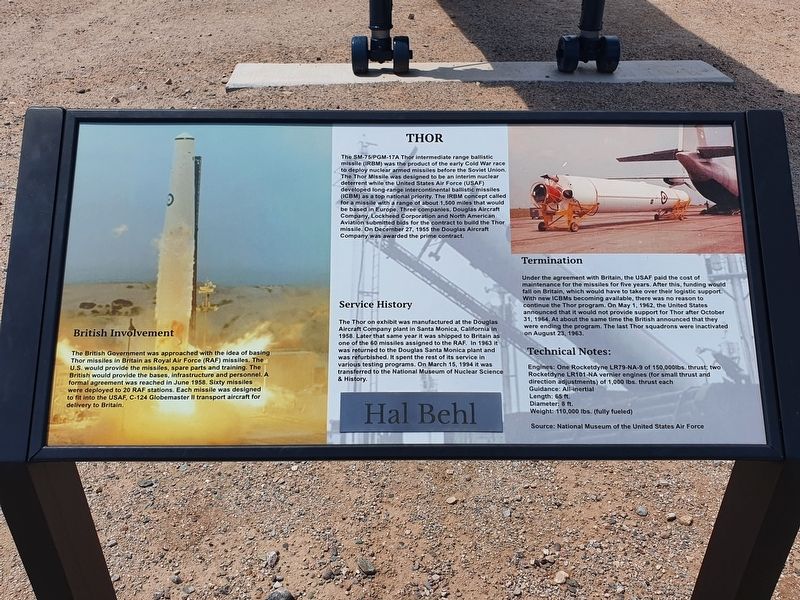
The SM-75/PGM-17A Thor intermediate range ballistic missile (IRBM) was the product of the early Cold War race to deploy nuclear armed missiles before the Soviet Union. The Thor Missile was designed to be an interim nuclear deterrent while the United States Air Force (USAF) developed long-range intercontinental ballistic missiles (ICBM) as a top national priority. The IRBM concept called for a missile with a range of about 1,500 miles that would be based in Europe. Three companies, Douglas Aircraft Company, Lockheed Corporation and North American Aviation submitted bids for the contract to build the Thor missile. On December 27, 1955 the Douglas Aircraft Company was awarded the prime contract.
British Involvement
The British Government was approached with the idea of basing Thor missiles in Britain as Royal Air Force (RAF) missiles. The U.S. would provide the missiles, spare parts and training. The British would provide the bases, infrastructure and personnel. A formal agreement was reached in June 1958. Sixty missiles were deployed to 20 RAF stations. Each missile was designed to fit into the USAF, C-124 Globemaster
this page online
Service History
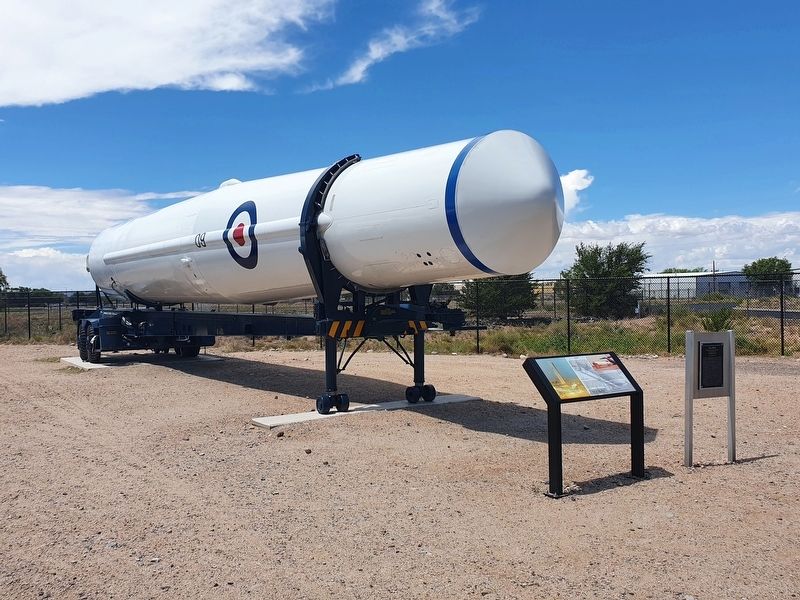
The Thor on exhibit was manufactured at the Douglas Aircraft Company plant in Santa Monica, California in 1958. Later that same year it was shipped to Britain as one of the 60 missiles assigned to the RAF. In 1963 it was returned to the Douglas Santa Monica plant and was refurbished. It spent the rest of its service in various testing programs. On March 15, 1994 it was transferred to the National Museum of Nuclear Science & History.
Termination
Under the agreement with Britain, the USAF paid the cost of maintenance for the missiles for five years. After this, funding would fall on Britain, which would have to take over their logistic support. With new ICBMs becoming available, there was no reason to continue the Thor program. On May 1, 1962, the United States announced that it would not provide support for Thor after October 31, 1964. At about the same time the British announced that they were ending the program. The last Thor squadrons were inactivated on August 23, 1963.
Technical Notes:
Engines: One Rocketdyne LR79-NA-9 of 150,000lbs. thrust; two Rocketdyne LR101-NA
Photographed by J. Makali Bruton, August 23, 2021
2. Thor and Markers
Guidance: All-inertial
Length: 65 ft.
Diameter: 8 ft.
Weight: 110,000 lbs. (fully fueled)
Source: National Museum of the United States Air Force
Topics. This historical marker is listed in this topic list: Air & Space. A significant historical date for this entry is March 15, 1994.
Location. 35° 3.979′ N, 106° 32.099′ W. Marker is in Albuquerque, New Mexico, in Bernalillo County. It is in Kirtland Air Force Base. It is on Eubank Boulevard SE south of Southern Boulevard SE, on the right when traveling south. The marker is on the grounds of the National Museum of Nuclear Science and History. A fee is necessary to access the marker. Touch for map. Marker is in this post office area: Albuquerque NM 87123, United States of America. Touch for directions.

Regionally, this marker is in the American Southwest. Globally, it is in North America, the Western Hemisphere, the Western World, and the Anglosphere. Historically, it finds itself in what was once New Spain and also the Republic of Texas.
Other nearby markers. At least 8 other markers are within walking
Photographed by J. Makali Bruton, August 23, 2021
3. A nearby Hal Behl Marker
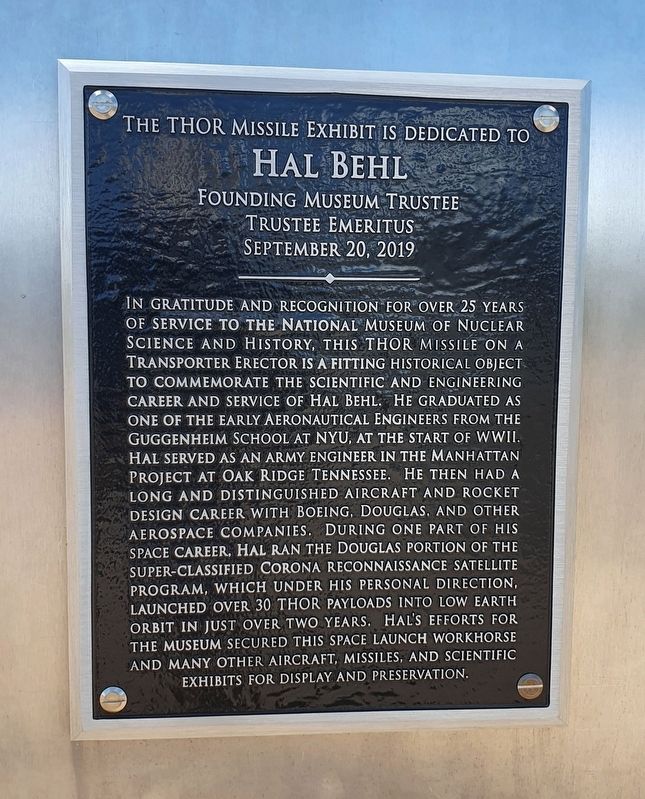
The Thor missile exhibit is dedicated to Hal Behl
Founding museum trustee
Trustee emeritus
September 20, 2019
In gratitude and recognition for over 25 years of service to the National Museum of Nuclear Science And History, this Thor missile on a transporter erector is a fitting historical object to commemorate the scientific and engineering career and service of Hal Behl. He graduated as one of the early aeronautical engineers from the Guggenheim School at NYU, at the start of WWII. Hal served as an Army engineer in the Manhattan Project at Oak Ridge Tennessee. He then had a long and distinguished aircraft and rocket design career with Boeing, Douglas, and other aerospace companies. During one part of his space career, Hal ran the Douglas portion of the super-classified Corona reconnaissance satellite program, which under his personal direction, launched over 30 Thor payloads into low earth orbit in just over two years. Hal's efforts for the museum secured this space launch workhorse and many other aircraft, missiles, and scientific exhibits for display and preservation.
Founding museum trustee
Trustee emeritus
September 20, 2019
In gratitude and recognition for over 25 years of service to the National Museum of Nuclear Science And History, this Thor missile on a transporter erector is a fitting historical object to commemorate the scientific and engineering career and service of Hal Behl. He graduated as one of the early aeronautical engineers from the Guggenheim School at NYU, at the start of WWII. Hal served as an Army engineer in the Manhattan Project at Oak Ridge Tennessee. He then had a long and distinguished aircraft and rocket design career with Boeing, Douglas, and other aerospace companies. During one part of his space career, Hal ran the Douglas portion of the super-classified Corona reconnaissance satellite program, which under his personal direction, launched over 30 Thor payloads into low earth orbit in just over two years. Hal's efforts for the museum secured this space launch workhorse and many other aircraft, missiles, and scientific exhibits for display and preservation.
Credits. This page was last revised on February 2, 2023. It was originally submitted on September 9, 2021, by J. Makali Bruton of Washington, District of Columbia. This page has been viewed 405 times since then and 41 times this year. Photos: 1, 2, 3. submitted on September 9, 2021, by J. Makali Bruton of Washington, District of Columbia.
