
Northside in Ann Arbor in Washtenaw County, Michigan — The American Midwest (Great Lakes)
The Washtenaw House Hotel
Photographed by J.T. Lambrou, September 10, 2021
1. The Washtenaw House Hotel Marker
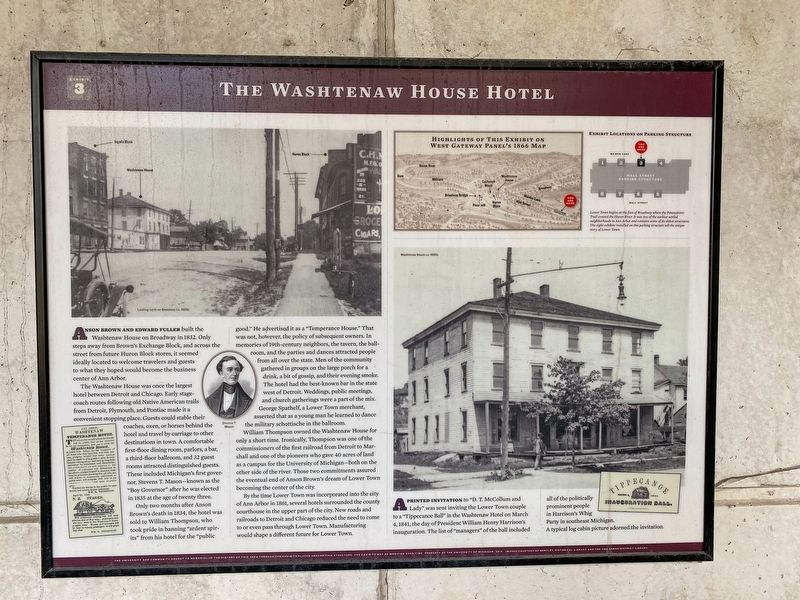
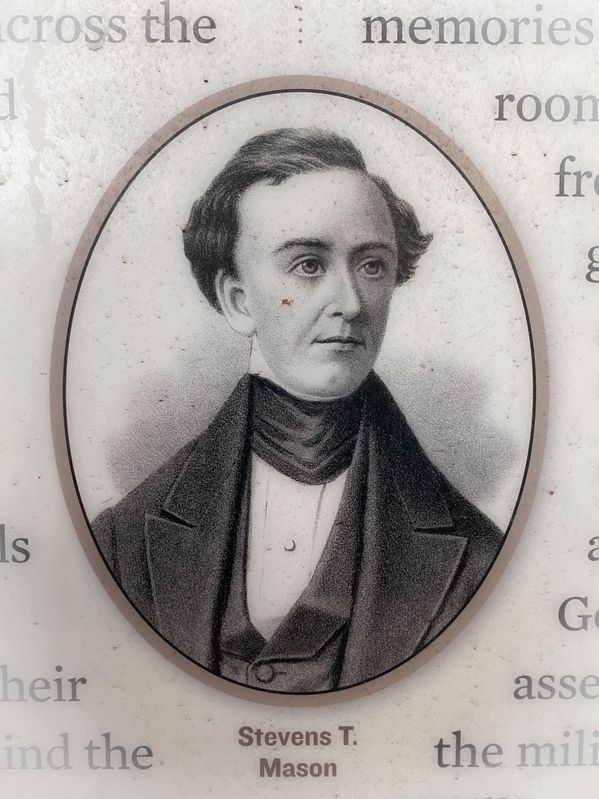
Anson Brown and Edward Fuller built the Washtenaw House on Broadway in 1832. Only steps away from Brown's Exchange Block, and across the street from future Huron Block stores, it seemed ideally located to welcome travelers and guests to what they hoped would become the business center of Ann Arbor. Arbor The Washtenaw House was once the largest hotel between Detroit and Chicago. Early stage coach routes following old Native American trails from Detroit, Plymouth, and Pontiac made it a convenient stopping place. Guests could stable their coaches, oxen, or horses behind the hotel and travel by carriage to other destinations in town. A comfortable first-floor dining room, parlors, a bar, a third-floor ballroom, and 32 guest rooms attracted distinguished guests. These included Michigan's first governor, Stevens T. Mason-known as the "Boy Governor" after he was elected in 1835 at the age of twenty three.
Only two months after Anson Brown's death in 1834, the hotel was sold to William Thompson, who took pride in banning "ardent spirits" from his hotel for the "public good." He advertised it as a "Temperance House." That
this page online
William Thompson owned the Washtenaw House for only a short time. Ironically, Thompson was one of the commissioners of the first railroad from Detroit to Marshall and one of the pioneers who gave 40 acres of land as a campus for the University of Michigan-both on the other side of the river. Those two commitments assured the eventual end of Anson Brown's dream of Lower Town the becoming the center of the city.
By the time Lower Town was incorporated into the city of Ann Arbor in 1861, several hotels surrounded the county courthouse in the upper part of the city. New roads
Photographed by J.T. Lambrou, September 10, 2021
2. The Washtenaw House Hotel Marker
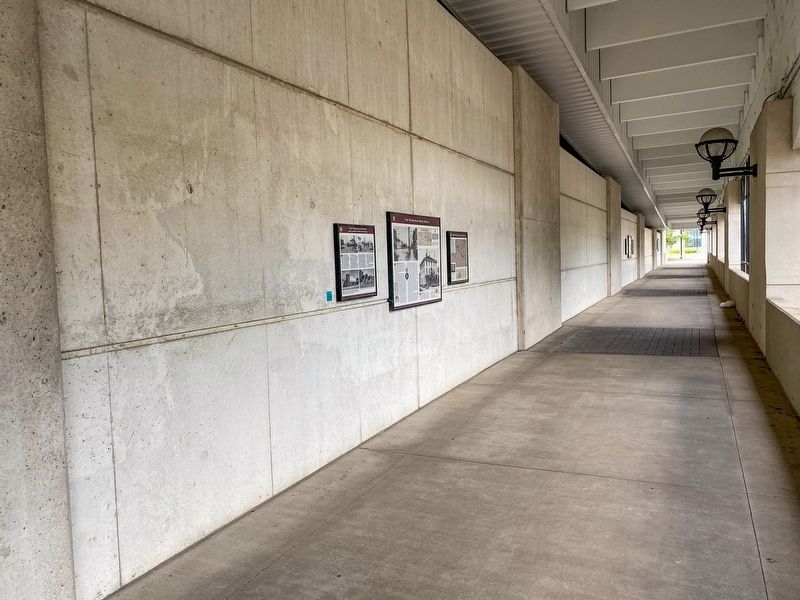
Marker is in the middle
A printed invitation to "D. T. McCollum and Lady" was sent inviting the Lower Town couple to a "Tippecanoe Ball" in the Washtenaw Hotel on March 4, 1841, the day of President William Henry Harrison's inauguration. The list of "managers" of the ball included all of the politically prominent people in Harrison's Whig Party in southeast Michigan. A typical log cabin picture adorned the invitation.
Erected 2014 by the University of Michigan. (Marker Number 3.)
Topics. This historical marker is listed in this topic list: Industry & Commerce. A significant historical date for this entry is March 4, 1841.
Location. 42° 17.296′ N, 83° 44.086′ W. Marker is in Ann Arbor, Michigan, in Washtenaw County. It is in Northside. It is at the intersection of Maiden Lane and Freesia Court, on the right when traveling east on Maiden Lane. Touch for map. Marker is at or near this postal address: 1024 Maiden Ln, Ann Arbor MI 48105, United States of America. Touch for directions.

Regionally, this marker
Photographed by J.T. Lambrou, September 10, 2021
3. The Washtenaw House Hotel Marker
Inset photo: Stevens T. Mason
Other nearby markers. At least 8 other markers are within walking distance of this marker: Indian Trails, Roads, and Trains (here, next to this marker); The Washtenaw House and Lower Town Decline (here, next to this marker); The Civil War and Lower Town (here, next to this marker); The Baptist Church and Meeting House (a few steps from this marker); Abolition and the Underground Railroad (a few steps from this marker); The Jonathan and Almy Lund House (within shouting distance of this marker); Agriculture, Water Power, and Transportation (within shouting distance of this marker); David McCollum's House (within shouting distance of this marker). Touch for a list and map of all markers in Ann Arbor.
Credits. This page was last revised on February 27, 2026. It was originally submitted on September 16, 2021, by J.T. Lambrou of New Boston, Michigan. This page has been viewed 441 times since then and 42 times this year. Photos: 1, 2, 3. submitted on September 16, 2021, by J.T. Lambrou of New Boston, Michigan. • Mark Hilton was the editor who published this page.
