Rushville in Schuyler County, Illinois — The American Midwest (Great Lakes)
Lincoln's Reception
Looking for Lincoln
1858
Photographed by Jason Voigt, September 8, 2021
1. Lincoln's Reception Marker
Inscription.
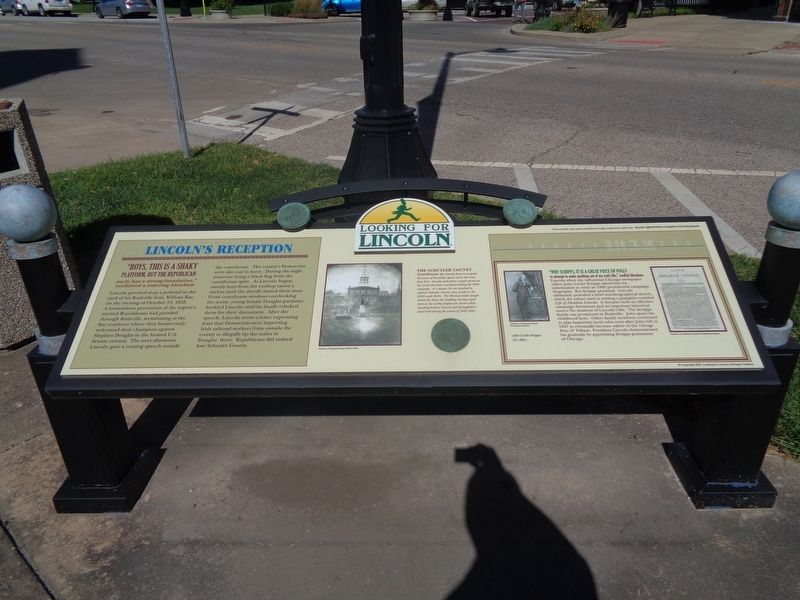
Lincoln's Reception. Looking for Lincoln. "Boys, this is a shaky platform, but the Republican party has a strong foundation," exclaiming a tottering Abraham Lincoln perched atop a pedestal in the yard of his Rushville host, William Ray, on the evening of October 19, 1858. A tremendous procession of the region's excited Republicans had paraded through Rushville, terminating at the Ray residence where they boisterously welcomed their champion against Stephen Douglas in the heated U.S. Senate contest. The next afternoon Lincoln gave a rousing speech outside the courthouse. The county's Democrats were also out in force. During the night someone hung a black flag from the courthouse spire. As Lincoln began, unruly boys from the rooftop raised a ruckus until the sheriff chased them away. From courthouse windows overlooking the scene, young female Douglas partisans heckled Lincoln until he finally rebuked them for their discourtesy. After the speech, Lincoln wrote a letter expressing fears that Democrats wee importing Irish railroad workers from outside the county to illegally tip the scales in Douglas' favor. Republicans did indeed lose Schuyler County., The Schuyler County Courthouse as Lincoln knew is occupied the center of the public square across the street from here. Lincoln spoke from a stand erected on the north side of the courthouse during the 1858 campaign. As a lawyer, he was involved in eighteen Schuyler County cases, mostly in the 1830's and 1840's. The Mormon leader Joseph Smith also knew this building, having stayed twice at the nearby Stephenson Tavern while traveling between Nauvoo and Springfield to stand trial during the winter of 1842-1843., "Why Scripps, it is a great piece of folly to attempt to make anything out of my early life," scoffed Abraham Lincoln when the influential Chicago newspaper editor John Locke Scripps asked him for information to write an 1860 presidential campaign biography. But Scripps persisted, Lincoln ultimately provided a brief autobiographical sketch, which the editor used in writing a pamphlet entitled Life of Abraham Lincoln. It became both an effective campaign document and an important historical source for students of Lincoln's life. The Scripps family was prominent in Rushville. John spent his childhood here. Other family members continued to play important local roles even after John left in 1847 to eventually become editor of the Chicago Press and Tribune. President Lincoln demonstrated his gratitude by appointing Scripps postmaster of Chicago.
"Boys, this is a shaky platform, but the Republican party has a strong foundation," exclaiming a tottering Abraham Lincoln perched atop a pedestal in the yard of his Rushville host, William Ray, on the evening of October 19, 1858. A tremendous procession of the region's excited Republicans had paraded through Rushville, terminating at the Ray residence where they boisterously welcomed their champion against Stephen Douglas in the heated U.S. Senate contest. The next afternoon Lincoln gave a rousing speech outside the courthouse. The county's Democrats were also out in force. During the night someone hung a black flag from the courthouse spire. As Lincoln began, unruly boys from the rooftop raised a ruckus until the sheriff chased them away. From courthouse windows overlooking the scene, young female Douglas partisans heckled Lincoln until he finally rebuked them for their discourtesy. After the speech, Lincoln wrote a letter expressing fears that Democrats wee importing Irish railroad workers from outside the county to illegally tip the scales in Douglas' favor. Republicans did indeed lose Schuyler County.
The Schuyler County Courthouse as
Click or scan to see this page online
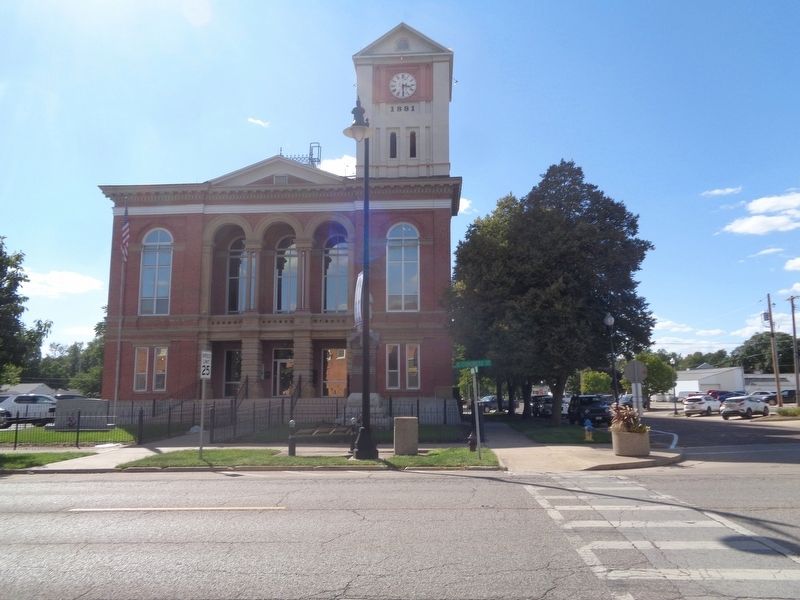
Lincoln knew is occupied the center of the public square across the street from here. Lincoln spoke from a stand erected on the north side of the courthouse during the 1858 campaign. As a lawyer, he was involved in eighteen Schuyler County cases, mostly in the 1830's and 1840's. The Mormon leader Joseph Smith also knew this building, having stayed twice at the nearby Stephenson Tavern while traveling between Nauvoo and Springfield to stand trial during the winter of 1842-1843.
"Why Scripps, it is a great piece of folly to attempt to make anything out of my early life," scoffed Abraham Lincoln when the influential Chicago newspaper editor John Locke Scripps asked him for information to write an 1860 presidential campaign biography. But Scripps persisted, Lincoln ultimately provided a brief autobiographical sketch, which the editor used in writing a pamphlet entitled Life of Abraham Lincoln. It became both an effective campaign document and an important historical source for students of Lincoln's life. The Scripps family was prominent in Rushville. John spent his childhood here. Other family members continued to play important local
Photographed by Jason Voigt, September 8, 2021
2. Lincoln's Reception Marker
Marker is in front of Schuyler County Courthouse, next to the light post.
roles even after John left in 1847 to eventually become editor of the Chicago Press & Tribune. President Lincoln demonstrated his gratitude by appointing Scripps postmaster of Chicago.
Erected 2008 by Looking for Lincoln Heritage Coalition and the Ellen Browning Scripps Foundation.
Location. 40° 7.229′ N, 90° 33.82′ W. Marker is in Rushville, Illinois, in Schuyler County. It is at the intersection of South Congress Street (U.S. 24) and West Lafayette Street, on the right when traveling south on South Congress Street. Marker is in front of Schuyler County Courthouse. Touch for map. Marker is at or near this postal address: 102 S Congress St, Rushville IL 62681, United States of America. Touch for directions.
Regionally, this marker is in the American Midwest and in the Corn Belt. Globally, it is in North America, the Western Hemisphere, the Western World, and the Anglosphere. Historically, it finds itself in what was once the territory of the Mississippian Culture and also the Northwest Territory.
Credits. This page was last revised on September 18, 2021. It was originally submitted on September 17, 2021, by Jason Voigt of Glen Carbon, Illinois. This page has been viewed 372 times since then and 19 times this year. Photos:1, 2. submitted on September 17, 2021, by Jason Voigt of Glen Carbon, Illinois.