Midtown in Nashville in Davidson County, Tennessee — The American South (East South Central)
The Exposition Ends, Centennial Park Begins
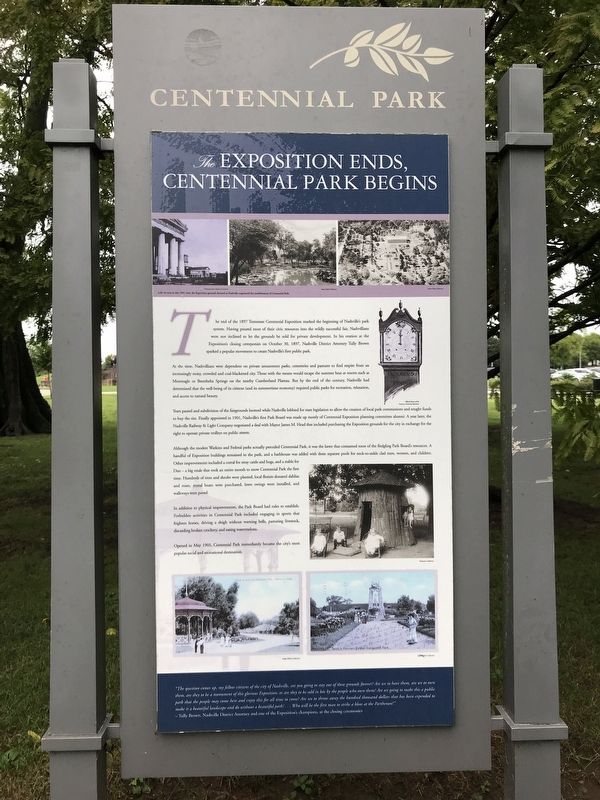
Photographed by Duane and Tracy Marsteller, September 18, 2021
1. The Exposition Ends, Centennial Park Begins Marker
At the time, Nashvillians were dependent on private amusement parks, cemeteries and pastures to find respite from an increasingly noisy, crowded and coal-blackened city. Those with the means would escape the summer heat at resorts such as Monteagle or Beersheba Springs on the nearby Cumberland Plateau. But by the end of the century, Nashville had determined that the well-being of its citizens (and its summertime economy) required public parks for recreation, relaxation, and access to natural beauty.
Years passed and subdivision of the fairgrounds loomed while Nashville lobbied for state legislation to allow the creation of local park commissions and sought funds to buy the site. Finally
this page online
Although the modest Watkins and Federal parks actually preceded Centennial Park, it was the latter that consumed most of the fledgling Park Board's resources. A handful of Exposition buildings remained in the park, and a bathhouse was added with three separate pools for neck-to-ankle clad men, women, and children. Other improvements included a corral for stray cattle and hogs, and a stable for Dan — a big mule that took an entire month to mow Centennial Park the first time. Hundreds of trees and shrubs were planted, local florists donated dahlias and roses, rental boats were purchased, lawn swings were installed, and walkways were paved.
In addition to physical improvements, the Park Board had rules to establish. Forbidden activities in Centennial Park included engaging in sports that frighten
Photographed by Duane and Tracy Marsteller, 1901
2. The Exposition Ends, Centennial Park Begins Marker detail
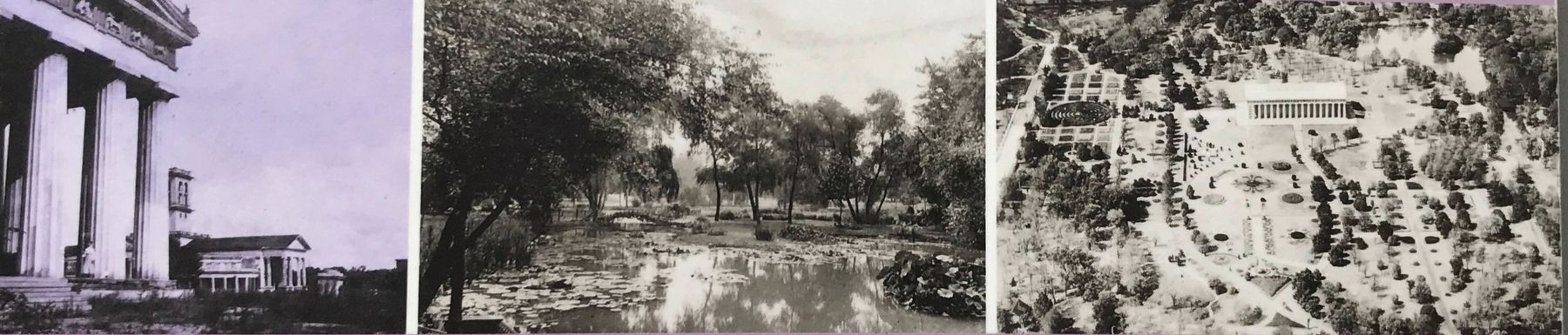
As these pictures show, the Centennial Exposition site was decaying just four years after the fair ended.
Opened in May 1903, Centennial Park immediately became the city's most popular social and recreational destination.
“The question comes up, my fellow citizens of the city of Nashville, are you going to stay out of these grounds forever? Are we to have them, are we to own them, are they to be a monument of this glorious Exposition. or are they to be sold in lots by the people who own them? Are we going to make this a public park that the people may come here and enjoy this for all time to come? Are we to throw away the hundred thousand dollars that bas been expended to make it a beautiful landscape and do without a beautiful park? … Who will be the first man to strike a blow at the Parthenon?”— Tully Brown, Nashville District Attorney and one of the Exposition's champions, at the closing ceremonies.
Caption (top)As seen in this 1901 view, the Exposition grounds decayed as Nashville negotiated the establishment of Centennial Park. (1) Tennessee State Library & Archives; (2 and 3) Metro Parks Collection.
Topics.
Photographed by Duane and Tracy Marsteller, September 18, 2021
3. The Exposition Ends, Centennial Park Begins Marker detail
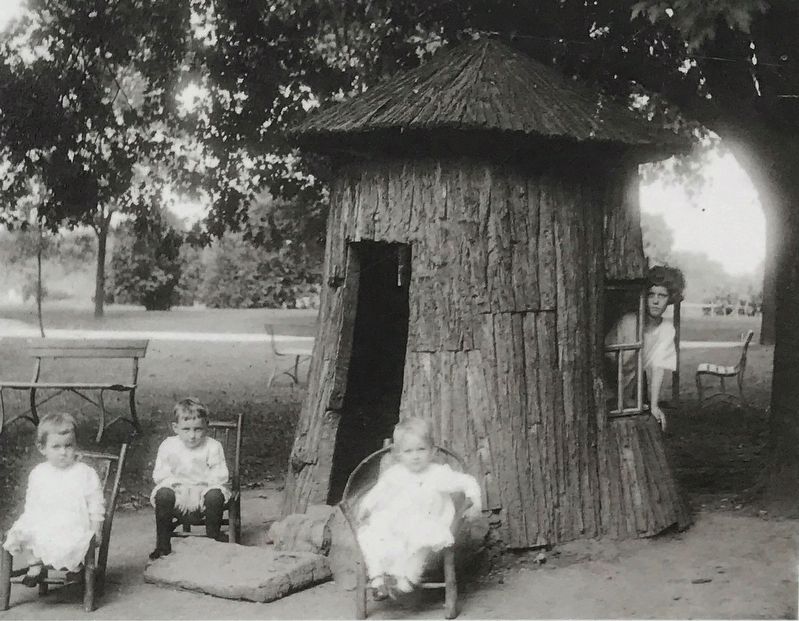
Children play in a "treehouse" at Centennial Park.
Location. 36° 9.044′ N, 86° 48.777′ W. Marker is in Nashville, Tennessee, in Davidson County. It is in Midtown. It can be reached from 27th Avenue North north of Parman Place, on the right when traveling north. Marker is on the Lake Watauga Loop Trail in Centennial Park. Touch for map. Marker is in this post office area: Nashville TN 37203, United States of America. Touch for directions.

Regionally, this marker is in Middle Tennessee. It is also in the American South and specifically in the Upper South. Globally, it is in North America, the Western Hemisphere, the Western World, and the Anglosphere. Historically, it finds itself in what was once the territory of the Mississippian Culture, one of the Confederate States of America, and the Antebellum South.
Other nearby markers. At least 8 other markers are within walking distance of this marker: The Exposition's Negro Building (within shouting distance of this marker); The Nashville Parthenon (about 300 feet away, measured in a direct line); Nineteenth Amendment To The United States Constitution
Photographed by Duane and Tracy Marsteller, September 18, 2021
4. The Exposition Ends, Centennial Park Begins Marker detail
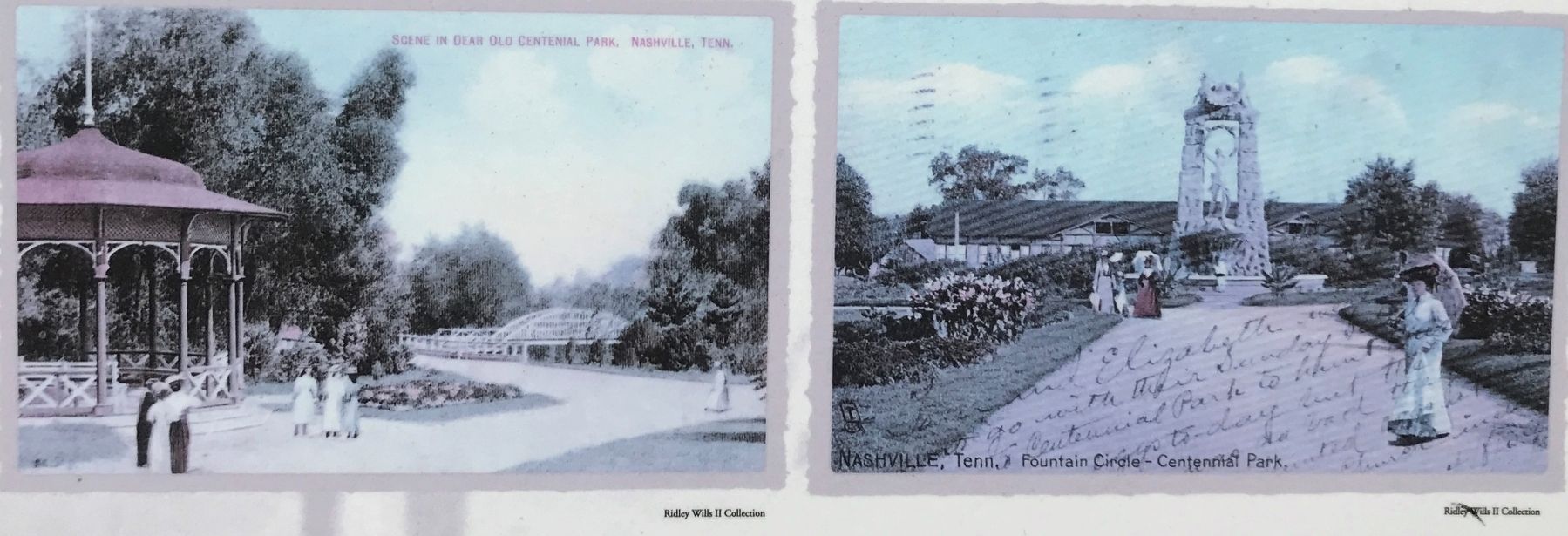
Early postcards of Centennial Park.
Related markers. Click here for a list of markers that are related to this marker.
Photographed by Duane and Tracy Marsteller, September 18, 2021
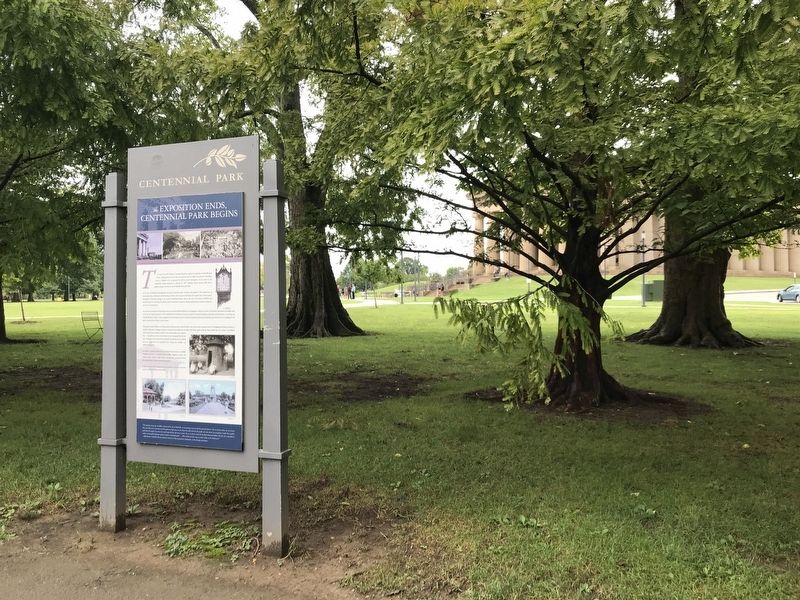
5. The Exposition Ends, Centennial Park Begins Marker
The Parthenon replica built for the Centennial Exposition is visible through the trees.
Credits. This page was last revised on May 5, 2025. It was originally submitted on September 19, 2021, by Duane and Tracy Marsteller of Murfreesboro, Tennessee. This page has been viewed 394 times since then and 17 times this year. Photos: 1, 2, 3, 4, 5. submitted on September 19, 2021, by Duane and Tracy Marsteller of Murfreesboro, Tennessee.
