Friendship in Jackson County, Oklahoma — The American South (West South Central)
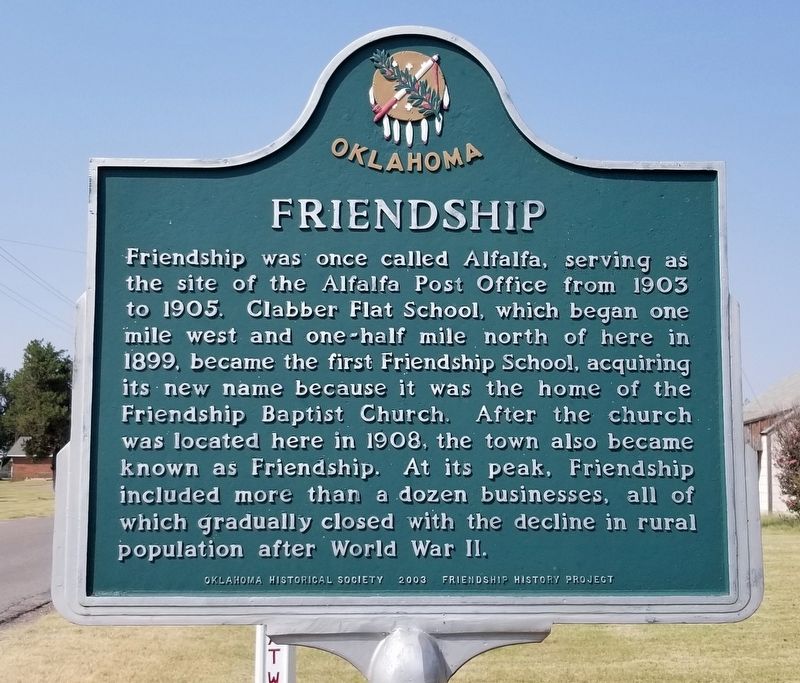
Friendship
⎯⎯⎯
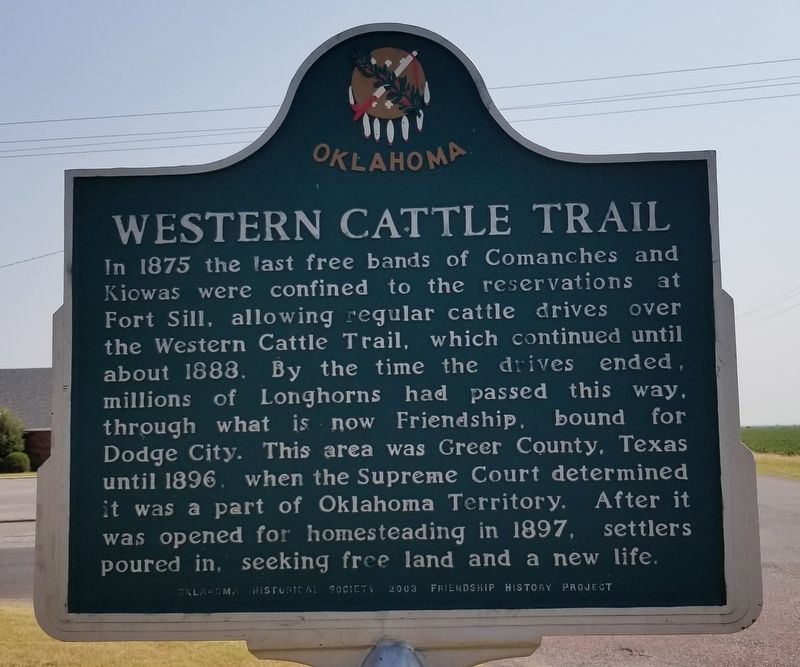
Western Cattle Trail
Photographed by James Hulse, September 9, 2021
1. Friendship Marker
Erected 2003
this page online
Topics. This historical marker is listed in these topic lists: Animals • Education • Indigenous Peoples and Communities • Settlements & Settlers. A significant historical year for this entry is 1903.
Location. 34° 41.766′ N, 99° 13.739′ W. Marker is in Friendship, Oklahoma, in Jackson County. It is at the intersection of County Road 210 and East 1600 Road, on the right when traveling north on County Road 210. Located at the NE corner of the intersection. Touch for map. Marker is at or near this postal address: 15998 Co Rd S 210, Altus OK 73521, United States of America. Touch for directions.

Regionally, this marker is in Southwest Oklahoma—Great Plains Country. It is also in the American South, specifically on the prairies, and on the Southern Plains. Globally, it is in North America, the Western Hemisphere, the Western World, and the Anglosphere. Historically, it finds itself in what was once New Spain, the Comanchería, the territory of the Mississippian Culture, the Dust Bowl, and the Louisiana Purchase.
Other nearby markers. At least 6 other
Photographed by James Hulse, September 9, 2021
2. Reverse Side - Western Cattle Trail
Also see . . . Western Trail.
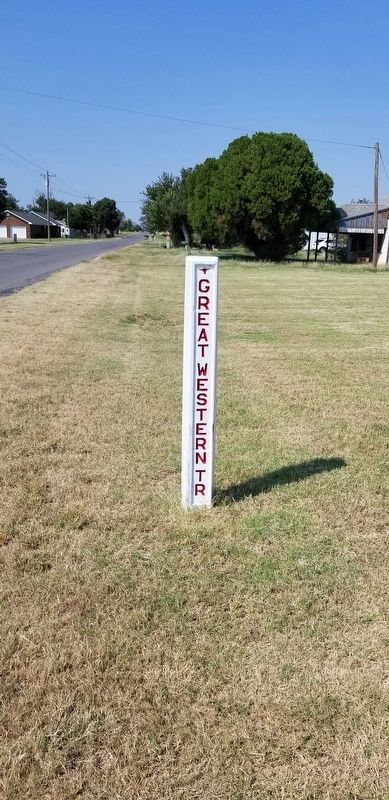
The Western Trail, also known as the Great Western Trail, Dodge City Trail, and the Fort Griffin Trail, was blazed in 1874 by cattle-drover John T. Lytle, who herded 3,500 longhorn cattle along the leading edge of the frontier from South Texas to the Red Cloud Indian Agency at Fort Robinson, Nebraska. Following the defeat of the Plains Indians in the Red River War, Lytle's route supplanted the farmer-laden Chisholm Trail to the east. By 1879 the Western Trail was the principal thoroughfare for Texas cattle bound for northern markets. Source: The Handbook of Texas(Submitted on September 22, 2021, by James Hulse of Medina, Texas.)

Photographed by James Hulse, September 9, 2021
3. Friendship Marker - Front Side
Photographed by James Hulse, September 9, 2021
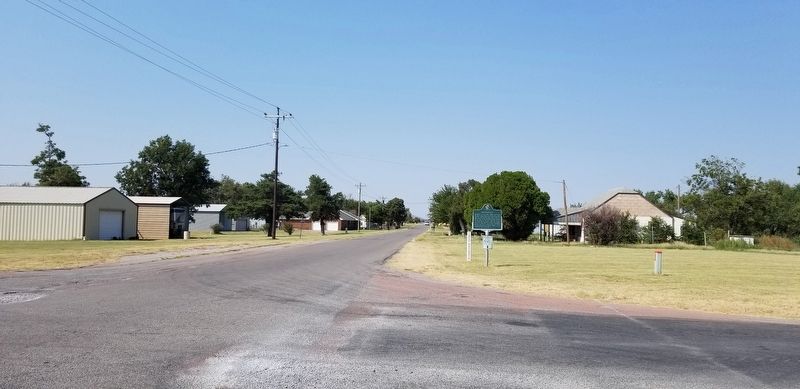
4. The view of the Friendship Marker from across the road
Photographed by James Hulse, September 9, 2021
5. Great Western Trail Marker
Credits. This page was last revised on November 29, 2021. It was originally submitted on September 21, 2021, by James Hulse of Medina, Texas. This page has been viewed 456 times since then and 40 times this year. Photos: 1, 2, 3, 4, 5. submitted on September 22, 2021, by James Hulse of Medina, Texas.
