Fort Sill in Comanche County, Oklahoma — The American South (West South Central)
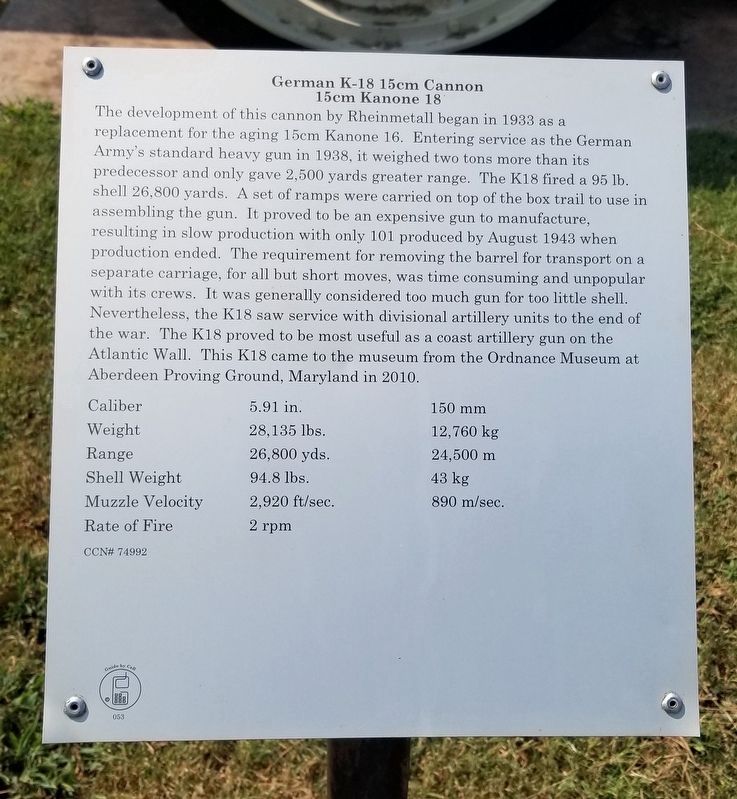
German K-18 15cm Cannon
15cm Kanone 18
Photographed by James Hulse, September 9, 2021
1. German K-18 15cm Cannon
The development of this cannon by Rheinmetall began in 1933 as a replacement for the aging 15cm Kanone 16. Entering service as the German Army's standard heavy gun in 1938, it weighed two tons more than its predecessor and only gave 2,500 yards greater range. The K18 fired a 95 lb. shell 26,800 yards. A set of ramps were carried on top of the box trail to use in assembling the gun. It proved to be an expensive gun to manufacture, resulting in slow production with only 101 produced by August 1943 when production ended. The requirement for removing the barrel for transport on a separate carriage, for all but short moves, was time consuming and unpopular with its crews. It was generally considered too much gun for too little shell. Nevertheless, the K18 saw service with divisional artillery units to the end of the war. The K18 proved to be most useful as a coast artillery gun on the Atlantic Wall. This K18 came to the museum from the Ordnance Museum at Aberdeen Proving Ground, Maryland in 2010.
Caliber - 5.91 in. - 150 mm
Weight - 28,135 lbs. - 12,760 kg
Range - 26,800 yds. - 24,500 m
Shell Weight - 94.8 lbs. - 43 kg
Muzzle
this page online
Rate of Fire - 2 rpm
CCN# 74992
Erected by U.S. Army Field Artillery Museum. (Marker Number 053.)
Topics. This historical marker is listed in this topic list: War, World II. A significant historical year for this entry is 1938.
Location. 34° 39.937′ N, 98° 23.051′ W. Marker is in Fort Sill, Oklahoma, in Comanche County. It can be reached from the intersection of Corral Road and Randolph Road, on the right when traveling east. The marker is located east of the U.S. Army Field Artillery Museum in Missile Park. Touch for map. Marker is in this post office area: Fort Sill OK 73503, United States of America. Touch for directions.

Regionally, this marker is in the Kiowa Tribe, in the Comanche Nation, and in Southwest Oklahoma—Great Plains Country. It is also in the American South, specifically on the prairies, and on the Southern Plains. Globally, it is in North America, the Western Hemisphere, the Western World, and the Anglosphere. Historically, it finds itself in what was once New Spain, the Comanchería, the territory of the Mississippian Culture, and the Louisiana Purchase.
Photographed by James Hulse, September 9, 2021
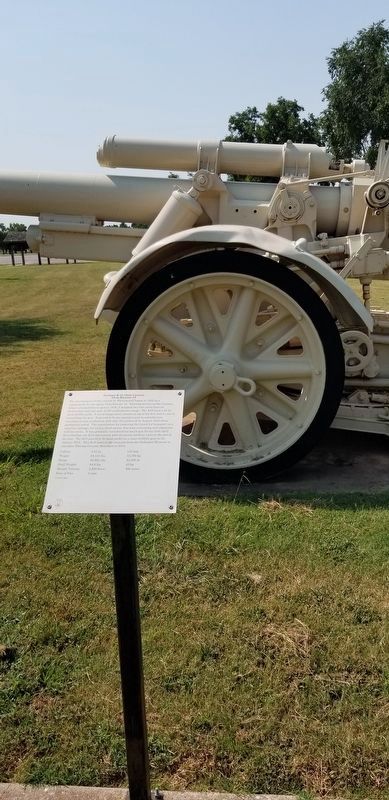
2. The German K-18 15cm Cannon and Marker
Other nearby markers. At least 8 other markers are within walking distance of this marker: U.S. MGM-31A Pershing I (a few steps from this marker); U.S. PGM-11 Redstone Missile (a few steps from this marker); U.S. M65 280mm Gun, "Atomic Annie" (within shouting distance of this marker); U.S. M2 Corporal Missile (within shouting distance of this marker); U.S. M249 & M250 4x4 Heavy Gun-Lifting Trucks (within shouting distance of this marker); U.S. M119 105mm Light Howitzer (within shouting distance of this marker); 280mm Heavy Motorized Gun M65 (within shouting distance of this marker); German 105mm Field Howitzer, M1898/1909 (within shouting distance of this marker). Touch for a list and map of all markers in Fort Sill.
Another marker is no longer nearby. Proud American (was a few steps from this marker but has been confirmed missing).
More about this marker. The marker and museum are located on Fort Sill, an active military installation. The museum is open to the public, but appropriate photo identification is required for access to the post.
Also see . . . U.S. Army Field Artillery Museum. Museum website homepage (Submitted on September 24, 2021, by James Hulse of Medina, Texas.)
Photographed by James Hulse, September 9, 2021
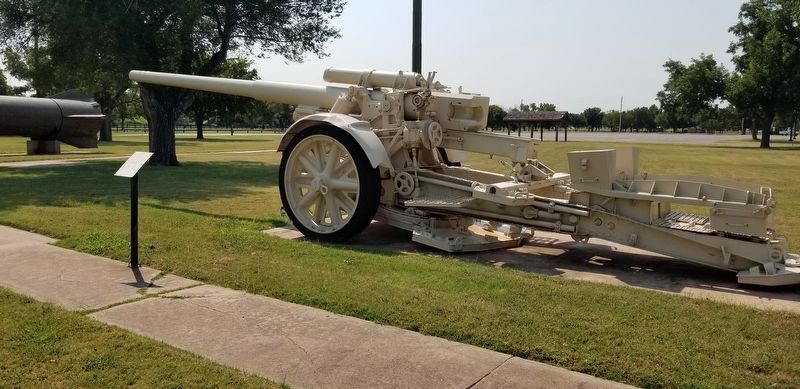
3. The view of the German K-18 15cm Cannon
Credits. This page was last revised on March 18, 2022. It was originally submitted on September 23, 2021, by James Hulse of Medina, Texas. This page has been viewed 743 times since then and 77 times this year. Photos: 1, 2, 3. submitted on September 23, 2021, by James Hulse of Medina, Texas.
